A Strategic Recovery™ Training
In Modern Addiction Medicine
Built for physicians who are ready for a higher level of addiction medicine
This training is for physicians who do not want more fragmented advice, more vague addiction education, or more guesswork in high-stakes cases. It is for those who want a clear system, a real framework, and a more confident way to assess, stabilize, treat, and lead in one of the most complex areas of modern medicine.
The Addiction Mastery Method™
for Physicians
You were never properly trained for addiction medicine
Most physicians receive less than four hours of addiction education in their entire training. Yet you are still expected to assess, stabilize, and manage some of the most clinically complex, emotionally charged, and high-stakes cases in modern medicine.

The system didn’t train you. That does not change the responsibility.
You are already treating addiction. You just have not been given a framework.
This is not a knowledge gap.
It is a systems gap.

This program is for you if you are ready to practice addiction medicine with more clarity, structure, and depth
Not every physician is looking for the same thing. This training is designed for those who want a real framework, a repeatable clinical approach, and a higher standard of addiction care.
You are a physician who:
-
Wants to confidently treat addiction instead of referring everything out
-
Sees addiction affecting a significant portion of your patients
-
Wants a structured, repeatable approach — not guesswork
-
Cares about doing this work well
-
Wants deeper competence — not fragmented addiction education
This is likely not the right fit for:
-
Physicians looking for surface-level CME
-
Those unwilling to rethink their approach
-
Anyone looking for quick tactics or shortcuts
-
Physicians who want passive theory without real implementation
-
Those looking to stay comfortably vague in complex addiction cases
This is for physicians who want to build real competence — not just collect more information.
The challenge is growing faster than the training
Addiction care is becoming more layered, more volatile, and more clinically demanding. Poly-substance use is rising. Fentanyl has changed the risk landscape. Behavioral addictions are increasing. Patients are arriving more dysregulated, more fragile, and more medically complex than ever before.

At the same time, physicians are carrying more emotional load, more decision fatigue, and less margin. Time is tighter. Complexity is higher. And the system still expects confident addiction care without giving most doctors a coherent operating framework.
You are already treating addiction medicine.
The problem is that most physicians were never given a system robust enough to match the complexity now walking into the room.
-
Poly-substance use is rising, making assessment and sequencing more complex
-
Fentanyl has altered withdrawal risk, induction strategy, and margin for error
-
Behavioral addictions are increasing alongside substance-based presentations
-
Patients are presenting more dysregulated, fragile, and medically intertwined than before
The gap between what physicians are now expected to handle — and what they were actually trained to handle — is widening.
And it will not close on its own.
The real shift is moving from willpower thinking to systems thinking
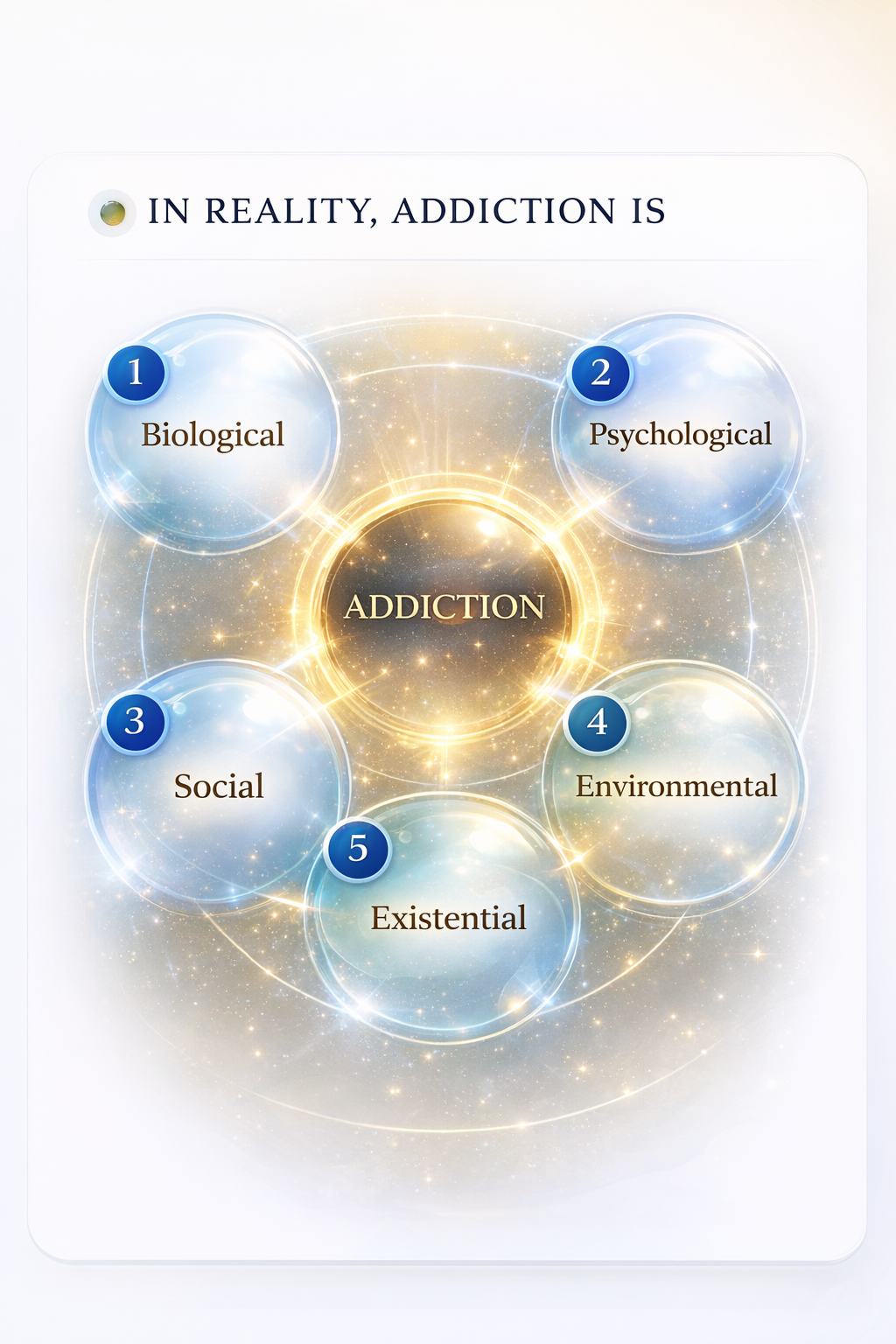
Most approaches fail because they treat addiction in isolation. In reality, addiction is not a willpower problem. It is a systems problem.
Addiction is not a moral failure to overpower.
It is a multi-dimensional system to understand and treat.
The Addiction Mastery Method™ for Physicians is a complete operating system for addiction medicine. Built on Strategic Recovery™, it integrates the biological, psychological, social, environmental, and existential dimensions of addiction into a clear, usable structure.
This is not another course.
It is the practical framework addiction medicine fellowships often do not provide in a usable, real-world way.
The difference between reacting to decline and directing recovery
This is what changes when a physician moves from vague addiction management to a clear operating system. The shift is not subtle. It changes how you assess, how you plan, how you follow, and how confidently you lead.

Uncertain. Reactive. Limited.
-
You see a patient with escalating alcohol use
-
The labs are trending in the wrong direction
-
You pause — unsure how far to go
-
You offer general advice or refer out
-
They return months later — worse
Clear. Structured. Directed.
-
You assess with clarity
-
You understand where they are in the recovery process
-
You stabilize the underlying drivers
-
You create a structured, phase-based plan
-
You follow them longitudinally with confidence
-
You are no longer reacting to decline — you are directing recovery
The difference is not more information.
It is having a system.

By the end of this program, you will be able to practice with more clarity, structure, and confidence
These are not vague takeaways. They are concrete capabilities you will carry into real patient care, clinical decision-making, and the long-term evolution of your addiction medicine work.
You will leave with more than information.
You will leave with a usable clinical operating system.
Built for the realities of modern physician practice
This program was not designed for idealized academic settings. It was built for physicians working in real clinics, real systems, and real time constraints — while still wanting a deeper, more integrated standard of addiction care.
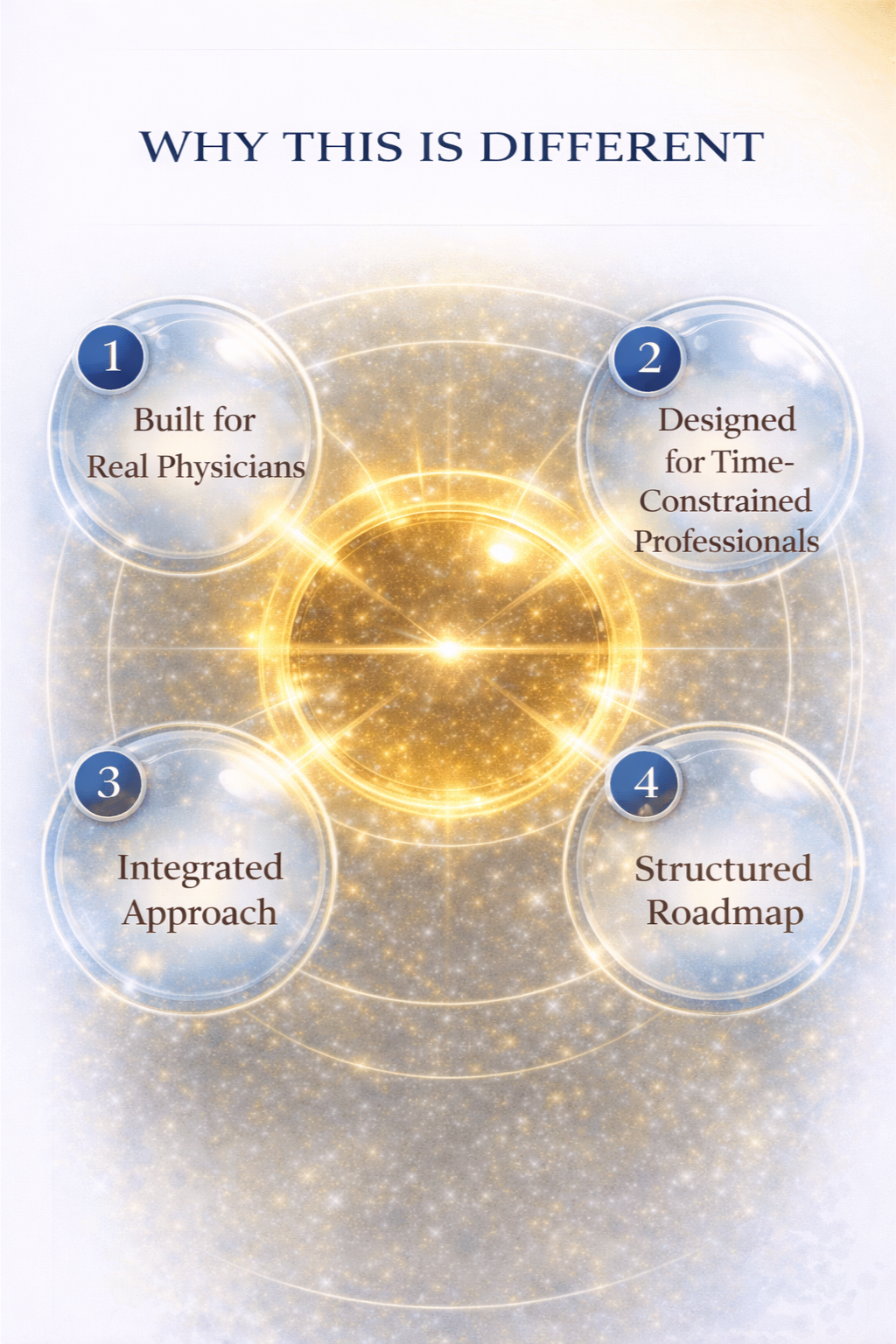
Built for Real Physicians
Designed for real-world clinical environments — no fellowship required.
Designed for Time-Constrained Professionals
Audio-first learning fits into your existing schedule instead of competing with it.
Integrated Approach
Neuroscience, trauma-informed care, and Strategic Recovery™ are unified into one coherent clinical model.
Structured Roadmap
A practical progression from assessment and stabilization through long-term recovery support.
This is not fragmented education.
It is a cohesive clinical system built for real use.
A clear, four-part clinical progression
This is not a collection of random modules. It is a structured progression designed to move you from understanding addiction… to treating it with clarity… to building a system around it.
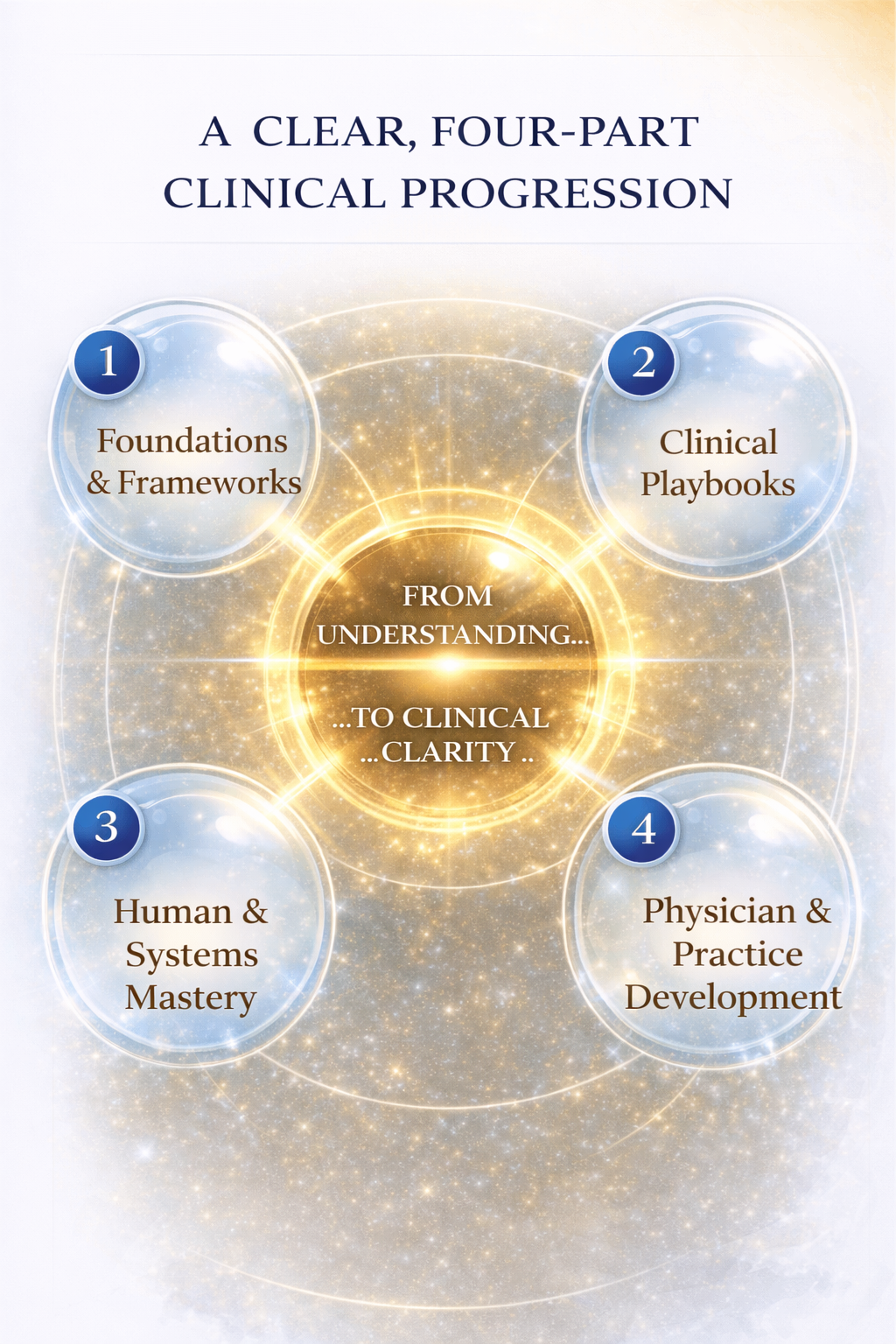
Reframe addiction and build a clear diagnostic and conceptual model.
Learn structured approaches for detox, stabilization, medication-assisted treatment, and real-world care.
Improve communication, navigate complexity, and apply the Strategic Recovery™ model in practice.
Build workflows, refine your niche, and integrate addiction care into a sustainable, ethical practice.
It is a step-by-step progression from confusion to clinical clarity.
The 12-Module Training Architecture Behind AMMP™
A four-track physician training system for modern addiction medicine — delivered through high-impact audio lessons designed for NET time (commutes, walks, between patients), so you can build real clinical mastery without adding more screen time.

Foundations & Frameworks
Rebuild the physician’s conceptual model of addiction so confusing, judgment-heavy cases become more understandable, more structured, and far more treatable.
The New Addiction Paradigm
Move from “Why the addiction?” to “Why the pain?”
Reframe addiction as an adaptive response to pain, reduce stigma, strengthen empathy, and upgrade the physician’s identity from detached prescriber to stabilizing clinical guide.
Mechanisms of Addiction
Understand what actually keeps people stuck.
High-yield neurobiology, biochemistry, stress physiology, nutrition, and trauma models — simplified into concepts physicians can use clinically and explain simply.
Assessment, Diagnosis & the Strategic Recovery Map
Turn intake confusion into a repeatable clinical map.
Learn a practical flow for assessment, risk recognition, red flags, referral thresholds, and matching findings to the 5 Pillars and 5 Phases.
Clinical Playbooks
Build clear, high-confidence frameworks for detox, withdrawal, MAT, harm reduction, and non-pharmacologic stabilization.
Comfort-First Detox & Withdrawal
Stop improvising and start stabilizing with structure.
Practical withdrawal models for alcohol, opioids, benzodiazepines, stimulants, cannabis, kratom, and behavioral addictions — plus safety, documentation, and boundaries.
Medication-Assisted Treatment & Harm Reduction Mastery
Make MAT more coherent, ethical, and clinically useful.
Clarify buprenorphine, methadone, naltrexone, off-label supports, harm reduction ethics, taper conversations, and how MAT integrates into the broader system.
Holistic & Functional Recovery Approaches
Use non-pharmacologic levers that make everything else work better.
Exercise, sleep repair, blood sugar stabilization, supplements, sunlight, breathwork, somatic tools, and other simple, high-yield recovery accelerators.

Human & Systems Mastery
Upgrade the physician’s communication, trauma lens, recovery mapping, and capacity to handle messy real-world addiction cases.
Psychology, Trauma & Bedside Manner
Turn awkward addiction encounters into therapeutic conversations.
Learn shame-reducing language, motivational interviewing for busy docs, trauma-aware communication, family boundaries, relapse conversations, and memorize-worthy scripts.
The 5 Phases of Strategic Recovery™ in Practice
Give every patient interaction a larger clinical context.
Apply Preparation, Detoxification, Repair, Rewire, and Transcendence to real patient care — with case walkthroughs and strategic replacement logic.
Special Populations, Complex Cases & Team-Based Care
Navigate real-world messiness with more confidence.
Chronic pain, co-occurring disorders, pregnancy, adolescents, older adults, inpatient settings, telemedicine, and how to build and leverage a strong team.
Physician & Practice Ascension
Translate your new addiction medicine skill set into sustainable practice design, cleaner systems, and long-horizon physician mastery.
Designing Your Addiction Medicine Practice or Service Line
Turn skill into a clear, ethical model.
Clarify niche, service model, cash vs insurance logic, revenue streams, differentiation, and the practical realities of building a signature addiction medicine offering.
Systems, Workflows & Scaling Your Impact
Build repeatable systems so addiction work does not become chaos.
Intake and follow-up workflows, documentation, outcomes tracking, digital tools, collaborations, reputation building, and how to think like a futurist in addiction care.
The Physician’s Own Mastery
Make sure the doctor does not burn out while doing meaningful work.
Apply the system to yourself: biochemical tune-up, burnout, moral injury, emotional hygiene, money, mission, boundaries, and your next 1–5 years in addiction medicine.
This is not a shallow CME-style overview. It is a four-track physician training architecture designed to build real addiction medicine judgment, confidence, systems, and leadership.
This is not more information.
It is a different way of practicing medicine.
This program does not simply add knowledge. It restructures how you see, assess, and treat addiction — transforming your role from reactive responder to clinical architect.

You are becoming a different kind of physician.

If this is not addressed
The cost is not only clinical. It is professional, strategic, and cumulative. Without a usable framework, even highly capable physicians often remain stuck at the edge of cases they could otherwise manage well.
-
Refer out cases you could manage with the right structure
-
Feel uncertain in complex situations where clarity should be possible
-
Miss a major clinical and professional opportunity in a rapidly expanding field
-
Remain undertrained in an area of medicine that is only becoming more important
Not because you lack intelligence.
Because you were never given a system.
Join the initial release of the program
This is the first physician cohort entering the Addiction Mastery Method™. Early participants do not just receive access — they receive founder-level advantages that will not be available in the same way again.

This is not just enrollment.
It is a chance to enter as a founding physician.
-
Early access to all modules as they are released
-
Lifetime access so you can revisit and deepen your mastery over time
-
Founder-level pricing that will not be offered again in the same form
-
The opportunity to provide input as the program evolves and expands
Modules are released progressively over approximately 6–8 weeks — creating steady momentum, practical implementation time, and a more integrated learning experience.
You get in early.
You get in for life.
And you get in at a level of access and pricing that will not be repeated.
Founder-level access through a curated physician cohort
This is not open enrollment. This founding cohort is selective by design — built for physicians who are ready to operate with greater clarity, structure, and clinical responsibility in addiction medicine.
If accepted, you receive founder-level pricing, lifetime access, and early positioning inside a system designed to compound in value over time.
-
Enter at the lowest level this program is expected to be offered
-
Secure your place before the pricing structure matures upward
-
Own lifetime access to the full physician training ecosystem as it expands
-
Access the full system before standard market pricing is reached
-
Strengthen your clinical edge in a field of medicine that is expanding fast
-
Make one strategic decision now that continues paying dividends for years
Planned pricing is designed to move up as the program advances
Founding participants enter before the full market repositioning. That matters because the value here is not static — it compounds as the curriculum, systems, and physician outcomes deepen.
The question is not simply what it costs.
The question is what it is worth to practice with more clarity, confidence, precision, and strategic advantage over the next decade.
Curated admission. Founder-level pricing. Lifetime access if accepted.
This is not simply an educational purchase.
It is an investment in how you think, how you practice, and who you become as a physician.
Built by Matt Finch — for the realities of addiction-related care
Matt Finch is a former addiction counselor, recovery coach, and founder of Strategic Recovery™. Over more than a decade in the recovery field, he has worked directly with people navigating withdrawal, relapse, stabilization, and long-term recovery.
Through that work, he repeatedly saw the same problem: physicians are expected to manage addiction-related complexity without being given a coherent system for doing so.
Former Addiction Counselor
Direct frontline experience supporting people through real substance use recovery — not just theory, but lived clinical reality.
Recovery Coach and Educator
Known for translating complexity into clear, strategic frameworks that people can actually understand and use.
Founder of Strategic Recovery™
A systems-based model integrating the biological, psychological, social, environmental, and spiritual dimensions of recovery.
Built to Bridge the Training Gap
Not replacing medicine — giving physicians a more usable system for practicing it more effectively in addiction-related care.

This is not fragmented education.
It is a cohesive clinical system built for real use.
Questions physicians ask before joining AMMP
This program is built for physicians who want a more structured, strategic, and usable way to approach addiction-related care. These answers are designed to help you assess fit, clarify expectations, and see how AMMP can strengthen both clinical competence and professional confidence.
AMMP is designed for physicians who regularly encounter addiction-related complexity and want a more effective way to think, assess, communicate, and intervene. That includes family medicine, internal medicine, psychiatry, pain, emergency medicine, hospital medicine, concierge, telehealth, and other physicians who are already treating these patients whether or not they were formally trained to do so.
It is especially valuable for doctors who feel they have responsibility without a usable system.
No. AMMP was built specifically for physicians who are not addiction specialists but still need to manage addiction-related care more skillfully.
The program helps you build stronger frameworks, clearer sequencing, better patient conversations, and more coherent clinical decision-making inside the reality of general practice.
Most addiction education is fragmented. You learn a few facts about substances, a few facts about withdrawal, a few facts about treatment, but not how to organize them into a real-world clinical system.
AMMP is different because it gives you an integrated operating framework. It helps you understand where the patient is, what phase they are in, what problems matter most now, what order to address them in, and how to communicate that clearly.
No. Detox is only one piece.
AMMP covers the broader architecture of addiction-related care: assessment, phase-based strategy, co-occurring issues, patient communication, recovery stabilization, relapse pattern recognition, systems thinking, documentation logic, and how to think more clearly in clinically messy situations.
Yes. One of the biggest benefits of AMMP is that it gives you a better language model for these conversations.
Instead of moralizing, overexplaining, or defaulting to generic advice, you learn how to explain addiction through a more strategic, precise, and compassionate lens. That often improves patient trust, buy-in, and follow-through.
No. AMMP does not replace medicine. It helps you practice it more coherently in addiction-related care.
The purpose is to strengthen your ability to think strategically about the patient in front of you, use appropriate tools more wisely, and understand where medication, behavioral support, referral, recovery structure, and ongoing follow-up fit into the larger picture.
Very practical. AMMP is designed to fit the reality of busy physicians, not the fantasy of unlimited study time.
The content is meant to be high-yield, clear, and usable. The goal is not to bury you in theory. The goal is to help you build frameworks that save time, reduce uncertainty, and improve clinical judgment in real encounters.
Yes. AMMP is not only about individual patient encounters. It also helps physicians develop a more coherent professional identity around this work.
That can support better positioning, clearer messaging, more meaningful differentiation, and a stronger long-term practice model for doctors who want to become known for doing this work well.
That is one of the central goals of the program.
Complexity feels overwhelming when there is no organizing logic. AMMP helps turn chaos into structure by giving you better categories, better sequencing, and better clinical pattern recognition. That often leads to calmer thinking and more confident action.
AMMP is likely a strong fit if you already know that addiction-related care is part of your reality, but you want a more refined and more strategic way to approach it.
If you want to feel more competent, more articulate, more useful, and less reactive with this population, this program was built for that exact upgrade.
AMMP helps physicians move from uncertainty and fragmentation to a clearer clinical system they can actually use.

You are already treating addiction.
At this level, the question is no longer whether addiction is in your practice.
The question is whether you are equipped to handle it with clarity, confidence, and a real system.
Five years from now, this will either be a core strength of your practice… or a gap you continued to work around.
You do not need more scattered information.
You need a system.
The Addiction Mastery Method™ for Physicians provides that system.
You are not late.
You are early.
This is not simply an educational purchase.
It is an investment in how you think, how you practice, and who you become as a physician.