
Ibogaine and the Five Survival Loops 🧭
How one intervention can help John Reverse opioid dependence, OCD, anxiety, burnout, and trauma
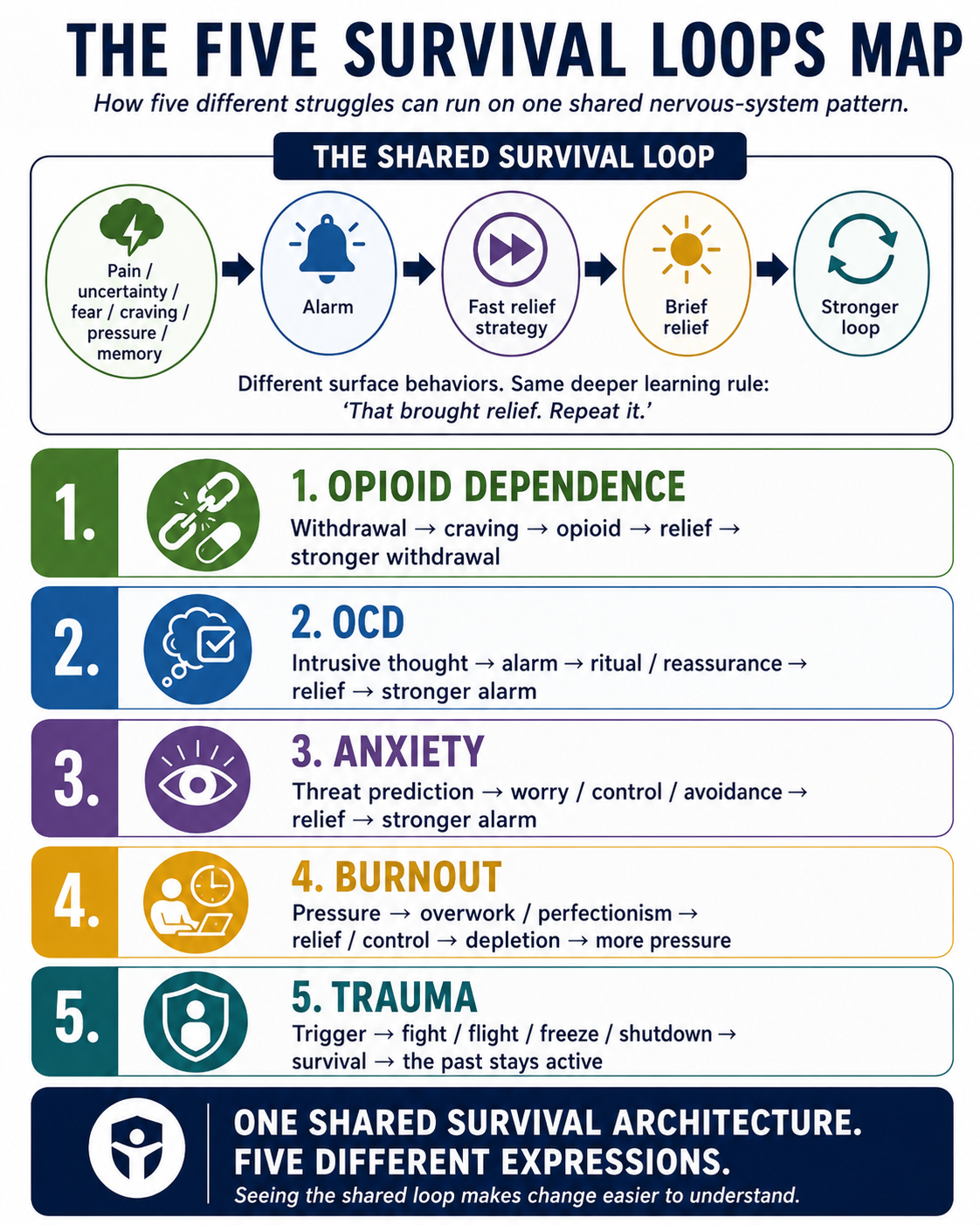
These are not the same problem.
But they can all become trapped in a similar nervous-system equation:
Pain, craving, uncertainty, fear, pressure, or memory
→ alarm
→ fast relief strategy
→ brief relief
→ the strategy becomes more automatic
The strategy changes:
- Opioid dependence: use the opioid
- OCD: check, research, seek reassurance, perform the ritual
- Anxiety: predict, control, avoid, scan, overthink
- Burnout: overwork, over-carry, overperform, prove
- Trauma: fight, flee, freeze, shut down, numb, disconnect
But the brain can learn the same rule:
“That brought relief. Repeat it.”
Over time, the strategy that once helped a person survive can become the thing that keeps them trapped.

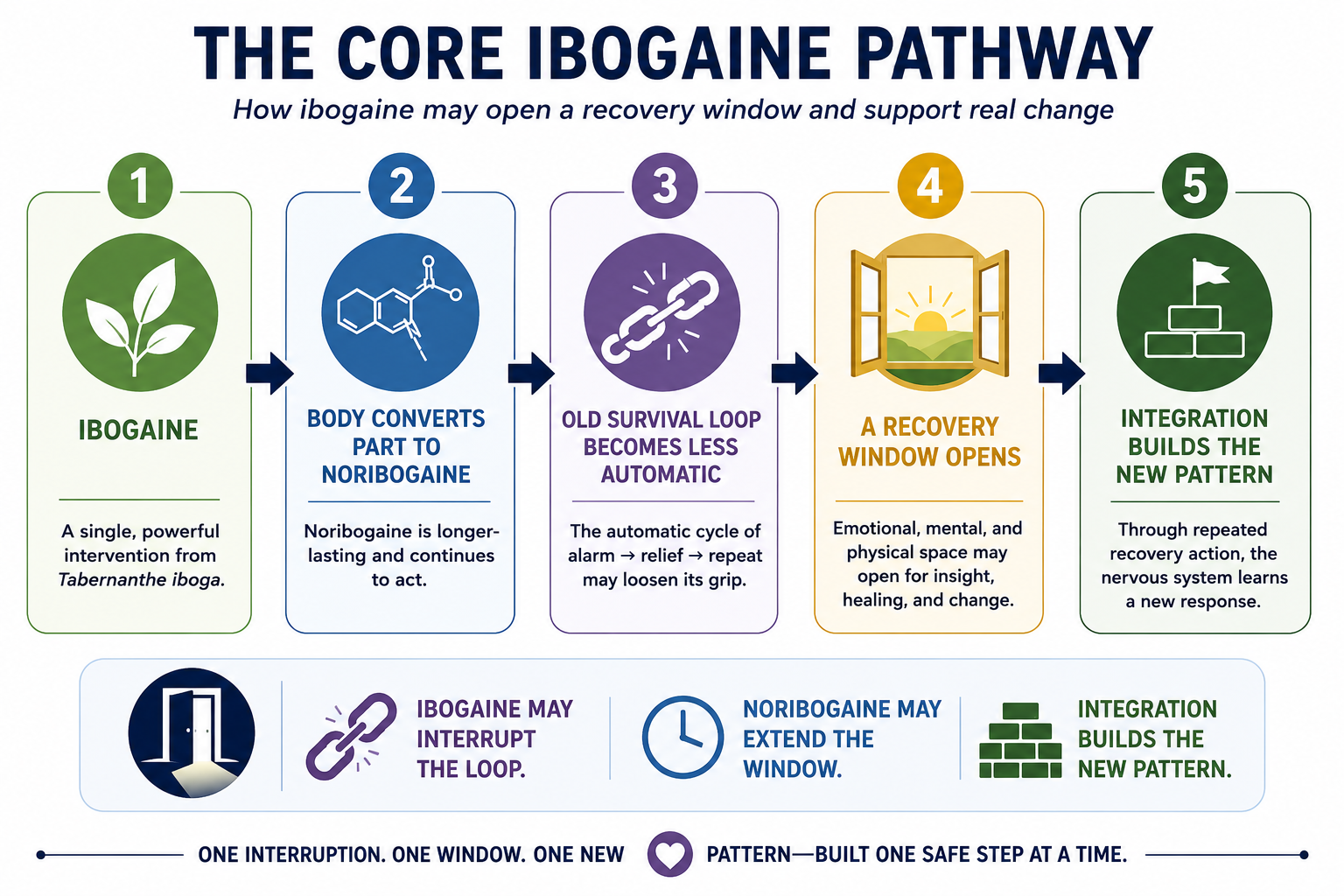
The Core Ibogaine Pathway
🌿 Ibogaine
↓
🧬 The liver converts part of it into noribogaine
↓
🔓 The old survival loop may become less automatic
↓
🪟 A recovery window may open
↓
🧱 Integration builds the new response
The simplest explanation
Ibogaine can interrupt the loop.
Noribogaine can extend the window.
Repeated recovery action teaches the nervous system what to do next.
Ibogaine is not one key opening one lock.
It is better understood as a systems-level switchboard intervention: one powerful intervention that can affect several systems involved in withdrawal, craving, reward, relief-learning, emotional tone, threat, habit, and self-observation.
That is why one intervention can be relevant across five very different-looking struggles.
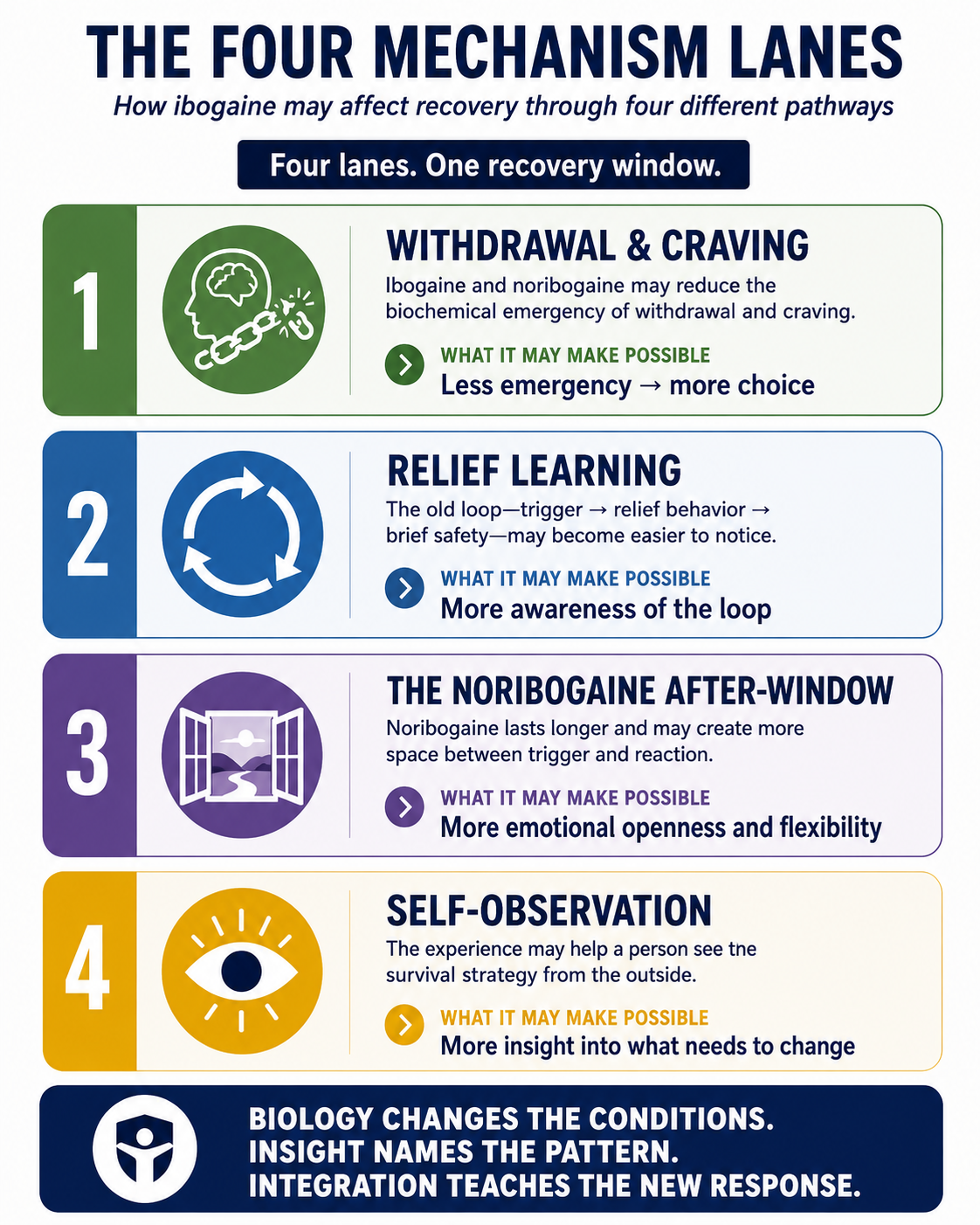
The Four Mechanism Lanes
1. Withdrawal and Craving 💊
This is the lane most directly connected to opioid dependence.
Ibogaine and noribogaine interact with opioid-related and reward-related systems involved in withdrawal, craving, and the learned pull toward relief.
For someone trapped in:
Withdrawal → craving → opioid → relief → stronger withdrawal
the possible shift is simple but profound:
The biological emergency may become less overwhelming.
Less emergency can create more choice.
2. Relief Learning 🔁
The brain repeats what brings fast relief.
That is true with opioids.
It is also true with compulsions, reassurance-seeking, avoidance, overthinking, perfectionism, and overworking.
Trigger → relief behavior → brief safety → stronger habit
Ibogaine may loosen this automatic sequence long enough for a person to recognize:
“This is a learned response.
It is not my only possible response.”
That recognition is where choice begins.
3. The Noribogaine After-Window 🌊
The body converts part of ibogaine into noribogaine, a longer-lasting active metabolite.
Noribogaine continues affecting serotonin-related and opioid-related systems after the most intense ibogaine phase has passed.
This may help create an after-window marked by:
- Less compulsive urgency
- More emotional openness
- More space between trigger and reaction
- More contact with grief, hope, motivation, or meaning
- More capacity to do the work a person already knows they need to do
When the inner weather becomes more workable, better choices become easier to access.
4. Self-Observation 🔎
Ibogaine’s acute experience is often described as visual, dreamlike, inward-facing, and autobiographical.
Its possible value is not simply “having visions.”
It is seeing the survival strategy from outside of it.
A person may recognize:
- What opioids were giving them
- What the OCD ritual was trying to prevent
- What anxiety has been trying to control
- What burnout has been costing
- What trauma trained the body to expect
“I am not broken.
I developed a strategy.
It helped me survive.
And now I need a better strategy.”

One Mechanism. Five Expressions.
1. Opioid Dependence 💊
From biochemical hostage to breathing room
The loop:
Withdrawal → craving → opioid → relief → tolerance → stronger withdrawal
For many people, opioids were never only about getting high.
They may have provided sleep, comfort, numbness, energy, confidence, emotional relief, or a way to feel normal.
Ibogaine may reduce the emergency long enough for the deeper question to become possible:
“What did opioids give me that I now need to build in healthier ways?”
Integration is how those needs get rebuilt without opioids.
2. OCD 🌀
From certainty-chasing to seeing the relief loop
The loop:
Intrusive thought → alarm → checking / reassurance / ritual → brief relief → stronger alarm
The thought is painful.
But the relief behavior is what teaches the brain that the thought was dangerous.
Ibogaine may create enough distance from the alarm for a person to recognize:
“This is a fear signal.
It is not a prophecy.
This urge is not an order.
The ritual brings relief—but it also trains my brain to stay afraid.”
That is the opening for the real OCD work:
Thought → pause → uncertainty tolerated → no ritual → new learning
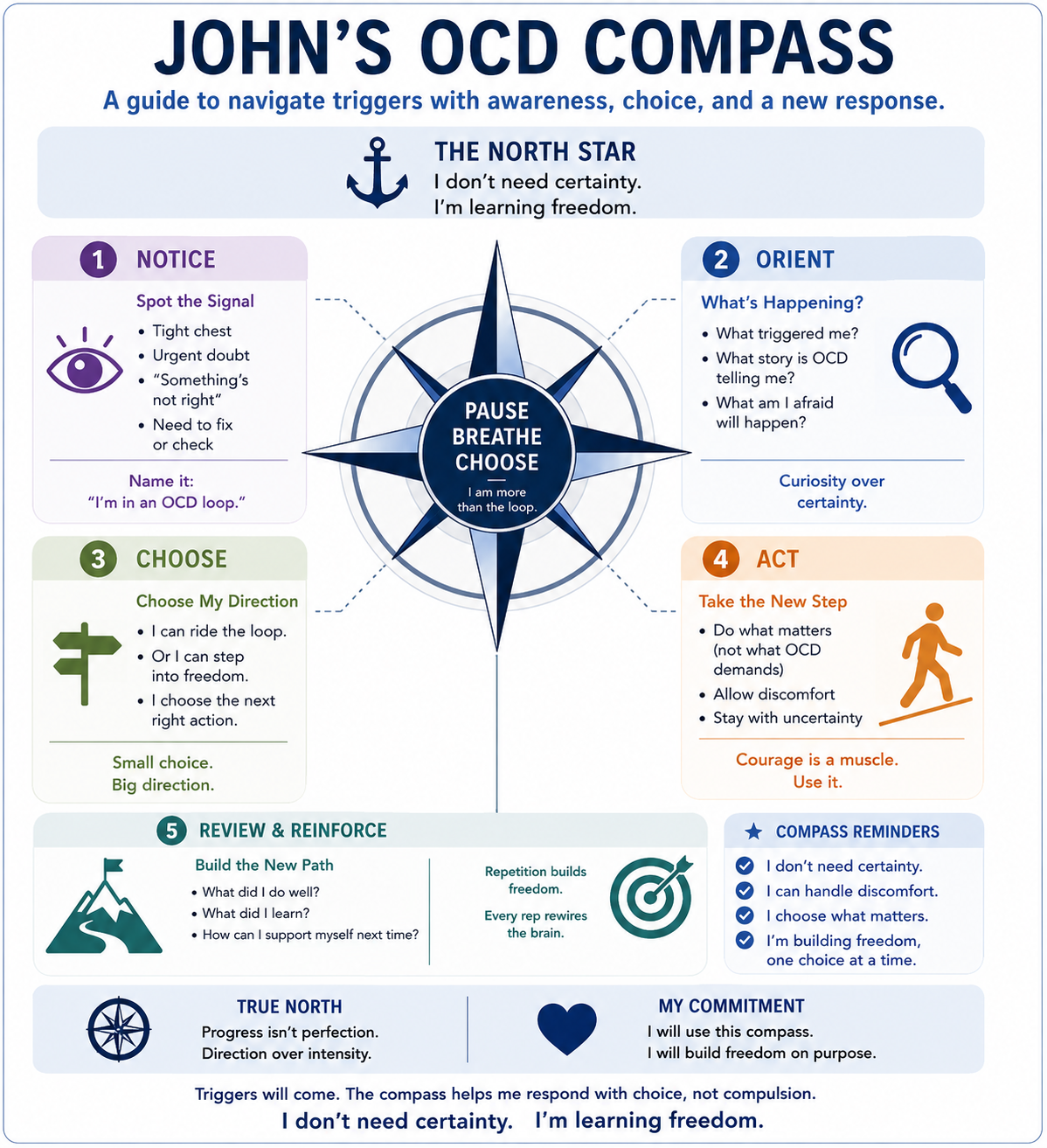
John’s OCD Compass
Do not turn this document, recovery planning, or more research into another reassurance ritual.
Use the map once.
Then return to the next real-life practice of uncertainty tolerance.
3. Anxiety 🚨
From future danger to present safety
The loop:
Threat prediction → worry / control / avoidance / hypervigilance → short relief → stronger alarm
Anxiety tries to protect the future by predicting and controlling it.
It says:
“Think harder.
Scan more.
Control everything.
Do not relax.”
Ibogaine may bring a person closer to what anxiety has been managing:
Fear.
Grief.
Conflict.
Shame.
Unmet needs.
Old emotional pain.
The goal is not:
“I must never feel anxiety again.”
It is:
“This feeling is intense.
But it is not automatically danger.
I can feel uncertainty without abandoning myself.”
4. Burnout 🔥
From overfunctioning for safety to living sustainably
The loop:
Pressure → overworking / over-caretaking / perfectionism → brief control or approval → depletion → more pressure
For a Type-A person, productivity can become a regulation strategy.
Achievement can create temporary control.
Usefulness can create temporary worth.
Perfectionism can create temporary safety.
Ibogaine may make the hidden contract easier to see:
“I have been using performance to feel safe, worthy, or in control.”
It may reconnect a person with signals they have learned to override:
Fatigue.
Anger.
Grief.
Resentment.
Limits.
Need.
Less proving. More truth.
Less self-abandonment. More restoration.
Less emergency. More life.
5. Trauma 🛡️
From “then” to “now”
The loop:
Trigger → fight / flight / freeze / shutdown / dissociation → temporary survival → the past keeps living in the present
Trauma is not only a memory.
It is when the body keeps responding as though an old danger is still happening.
Ibogaine may make grief, fear, memory, and unresolved emotional material more accessible.
The possible shift is not simply remembering what happened.
It is meeting the past from a different position:
Not only as the person trapped inside the original experience—
but also as the adult who can understand, grieve, protect, and care for that person.
Trauma recovery is the body learning:
“That was then. This is now.”
John’s Type-A Rule 🧱
Your recovery is not another performance project.
Do not wait for:
- The perfect plan
- Total certainty
- Every answer in advance
- The feeling that you have researched enough
- A flawless recovery process
Use this rule instead:
Choose the next safe, supported step.
Take it.
Do not re-check it ten more times.
Certainty is not the goal.
Trustworthy next steps are.
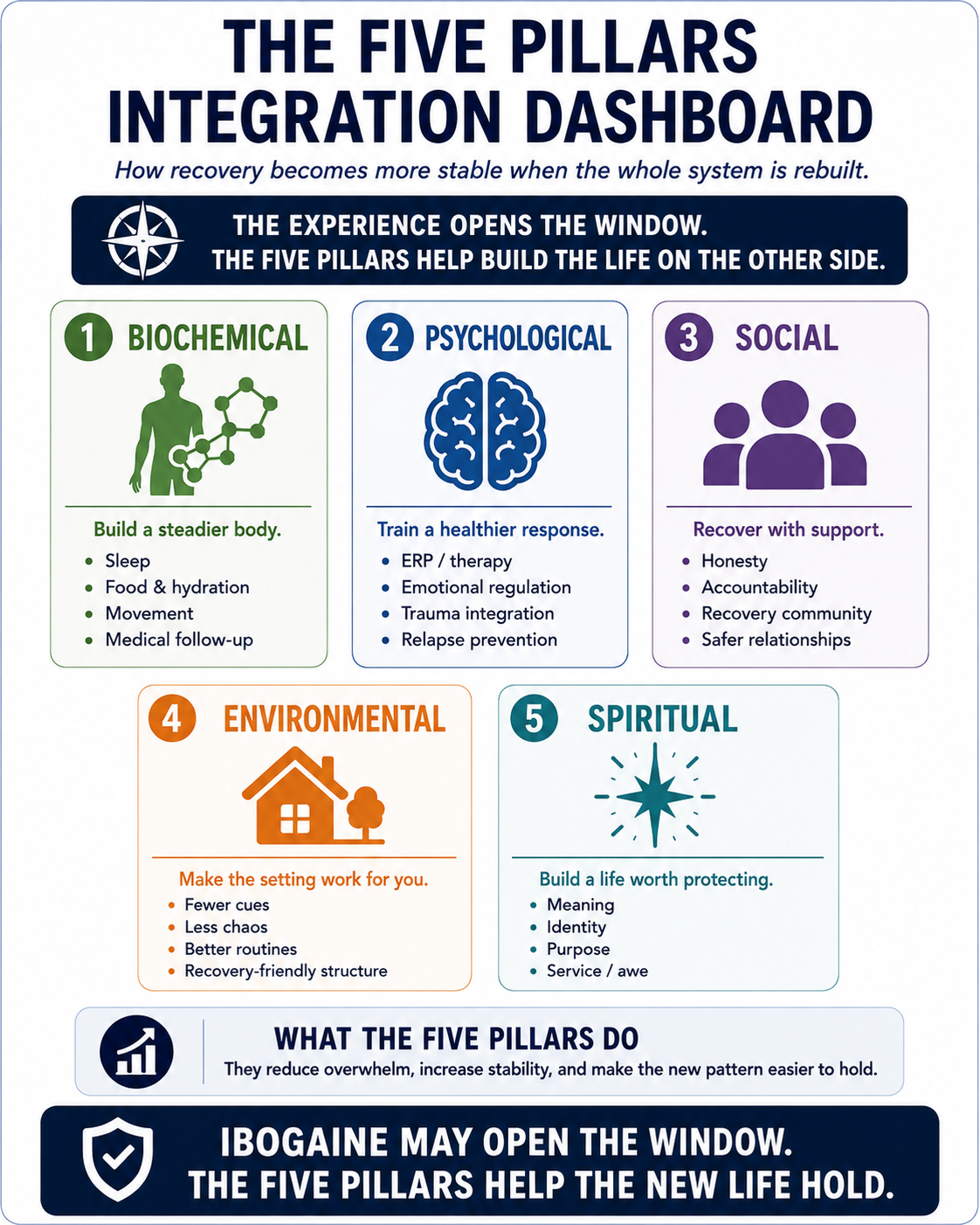
What Builds the New Loop
Biochemical
Sleep, nourishment, hydration, movement, medical follow-up, and steady physiology.
Psychological
ERP for OCD, therapy, emotional regulation, trauma integration, and relapse-prevention skills.
Social
Honesty, accountability, recovery community, safer relationships, and less isolation.
Environmental
Fewer cues, less chaos, better routines, and reduced access to old patterns.
Spiritual
Meaning, identity, service, forgiveness, awe, and a life worth protecting.
Ibogaine may open the window.
The Five Pillars help build the life on the other side.
Evidence and Medical Context
Strongest direct clinical signal
The clearest human research signal is in opioid withdrawal, craving, and substance-use outcomes.
Early but promising signals
Mood, anxiety, trauma-related symptoms, emotional regulation, and functioning have shown encouraging results in selected observational and multimodal settings.
Mechanism-based applications
For OCD and burnout, the relevance is not that ibogaine is an established treatment.
The relevance is the shared pattern:
Threat or pressure → fast relief strategy → reinforced loop
Medical context
Ibogaine has real potential and requires real medical precision.
It can affect cardiac conduction and interact with medications or substances.
That defines the standard for responsible consideration: comprehensive screening, medication review, cardiac assessment, monitoring, emergency capability, and a real integration plan.
A powerful recovery doorway deserves a serious medical container.
The Sentence to Remember
One survival loop.
One interruption.
One recovery window.
One new pattern—built one safe step at a time.