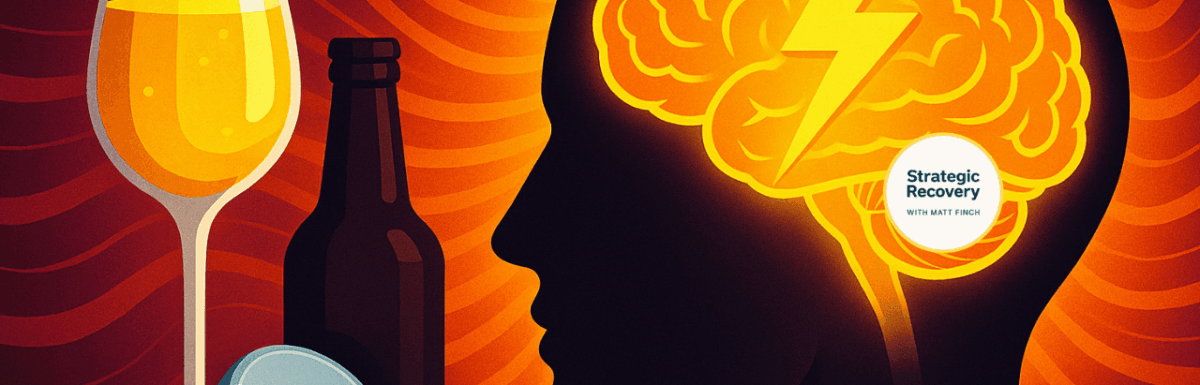
“Alcohol and opioids are depressants — so why do they sometimes make people feel unstoppable, energized, and euphoric instead of sleepy and calm?”
This paradox is at the heart of what I call The Hypomania Trap.
If you’ve ever felt superhuman after a few drinks or pills — full of energy, confidence, creativity, and resilience — you’ve touched this phenomenon.
And while it feels incredible, it’s also one of the biggest reasons alcohol and opioids are so addictive for certain individuals.
Why Depressants Can Act Like Stimulants 🚀
Both alcohol and opioids are classified as CNS depressants — but they achieve their effects through different mechanisms in the brain and body.
Alcohol’s Typical Effects 🍷
Alcohol rapidly enters the bloodstream and crosses into the brain. Its main actions include:
- 🧘♂️ Boosts GABA → slows brain activity (“natural Valium”) → sedation, relaxation
- 🎯 Raises Dopamine → reward, pleasure, motivation → can feel energizing
- 😊 Raises Serotonin → emotional relaxation, temporary well-being
- 💥 Releases Endorphins → pain relief, mild euphoria
- 🍬 Spikes Blood Sugar → quick burst of energy (especially pronounced in hypoglycemics)
Opioids’ Typical Effects 💊
Opioids (like oxycodone, hydrocodone, heroin, fentanyl, etc.) attach to mu-opioid receptors in the brain and body. Their main actions include:
- 0💢Inhibit Pain Signals → powerful endorphin analgesia (pain relief)
- 0🔥Increase Dopamine Release → reward, pleasure, “warm glow”
- 0🌙Slow Brainstem Activity → respiratory depression, slowed heart rate
- 0🧘♀️Reduce Stress Response → emotional numbing, sense of safety/comfort
- 0🌡️Cause Histamine Release (in many users) → warmth, flushing, relaxation
Where They Overlap 🔄
- 🎯Both alcohol and opioids boost dopamine → reward & motivation.
- 🧘Both calm anxiety/pain (alcohol via GABA + serotonin; opioids via mu-opioid receptors).
- 🌙Both can cause sedation in most people.
- ⚡Both can, paradoxically, energize a minority of users — unlocking hypomanic states.
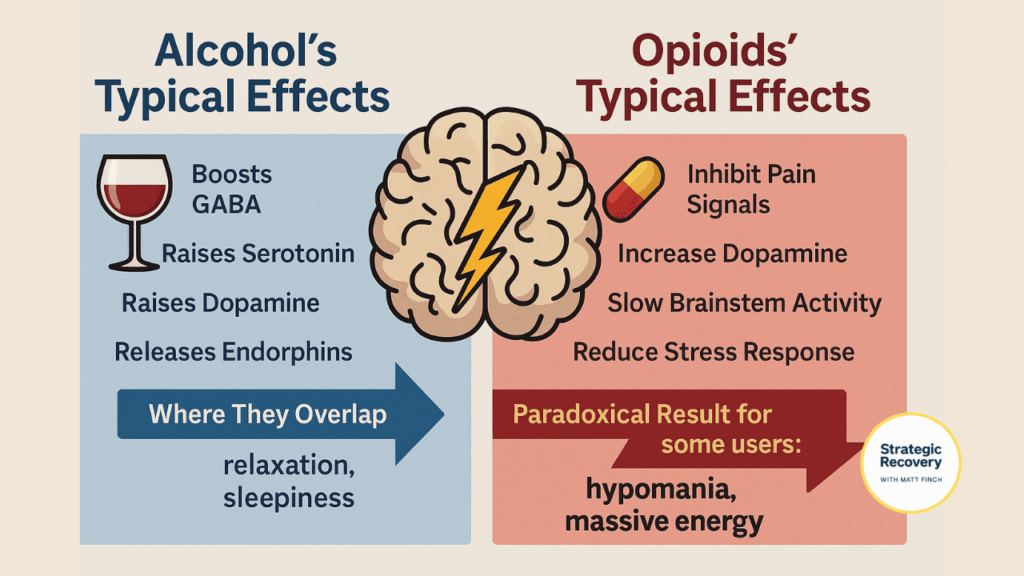
Both substances boost calming and reward neurotransmitters like GABA and dopamine — explaining why they can feel similar at first. But for some, the paradoxical result isn’t sedation at all… it’s hypomania, drive, and massive energy — a neurochemical trap that fuels hidden addiction cycles.
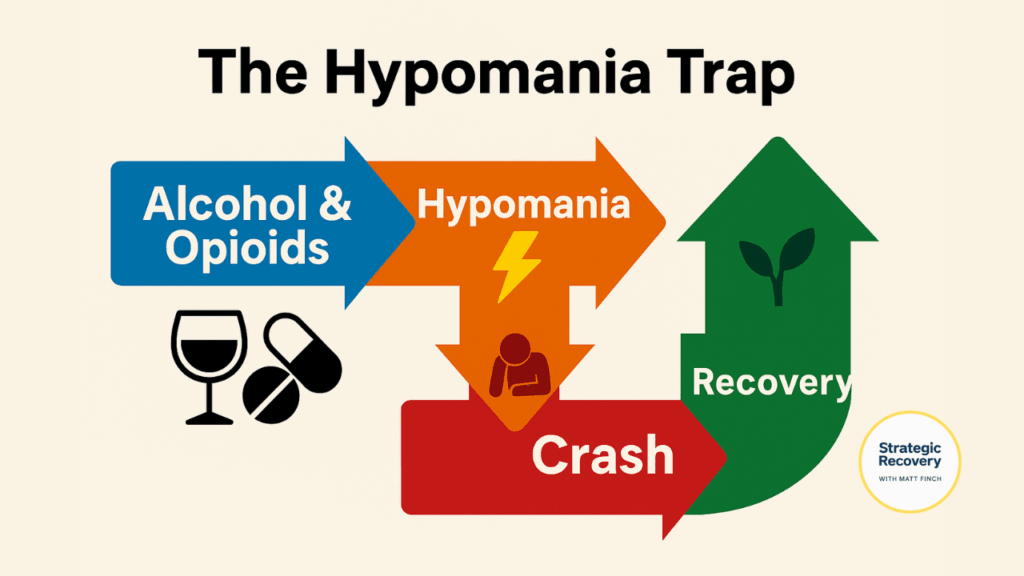
The Hypomania Trap ⚡
This paradox is what makes alcohol and opioids uniquely addictive for certain individuals — not because they’re simply “relaxing,” but because they supercharge life in ways that feel better than normal reality.
Dr. Gabor Maté reminds us:
“Addiction is not about the drug, but about the relationship between the person and the drug.”
or switch you on ⚡
The Hypomanic “Superhuman” State ⚡
When alcohol or opioids flip the switch from sedation into hypomania, the experience can feel like rocket fuel for life.
- ⚡Massive energy — instead of dragging, you feel charged like a battery.
- 💎Level-10 confidence — shyness, fear, or hesitation vanish.
- 🎨Creative flow — ideas and solutions pour in, problems feel solvable.
- 💪Stress resilience — deadlines, bills, arguments, and chaos suddenly feel manageable.
- 🌌Present-moment aliveness — you’re “on,” buzzing with vitality.
- 🧘♂️Emotional + physical relaxation at once — body calm, mind sharp.
No wonder people get hooked. It feels like the best version of yourself you’ve ever known.
⚡ Real-Life Examples of the Hypomania Trap
💼 Bill, the CEO
Bill is a 47-year-old business owner with over 100 employees and multimillion-dollar deals on his plate. On 30 mg oxycodone tablets, he doesn’t nod off — he lights up. His mind races with confidence, his meetings flow, and his anxiety about responsibility disappears. Oxy fuels his 12-hour days.
The thought of detox terrifies him, not because of pain, but because of the crushing fatigue and depression he knows will follow. Without that “superhuman” boost, how will he run his empire?
👩👧👦 Maria, the Single Mom
Maria is 29, raising two small kids alone. Every morning she mixes tequila with pineapple juice before the school rush. For her, alcohol doesn’t sedate — it sharpens. The fear, loneliness, and overwhelm of solo parenting fade as the drink gives her calm focus and energy to get through the day.
On weekends when her mom takes the kids, she crashes hard. But Monday morning, she’s back at it — because sobriety feels impossible in the face of nonstop survival.
🎨 Alex, the Artist
Alex is a 34-year-old painter who struggles with self-doubt and creative block. A few glasses of red wine don’t make him drowsy — they open the floodgates of inspiration. Suddenly, colors flow, ideas spark, and he paints until sunrise. Alcohol becomes his “creative unlock,” the key to his identity and purpose.
But the next day, his body is wrecked, his mood crashes, and the shame creeps back in. He tells himself he needs wine to access genius — a belief that keeps him stuck in the cycle.
💫 Lily, the Empath
Lily is a 40-year-old nurse who feels everything — her patients’ pain, her family’s stress, the world’s suffering. She’s a classic Highly Sensitive Person (HSP). One pill or one drink doesn’t knock her out; it flips the switch. Instead of overwhelm, she feels energized, social, and lighthearted.
For Lily, substances aren’t about escaping life but about finally fitting into it. The trap is that the very thing that lifts her also drains her reserves — leaving her emptier each time.

Why This State Becomes So Addictive 🔥
In a fast-paced world where:
- 💸Bills must be paid
- 👶Kids must be fed and protected
- 🛒Errands pile up
- 📈Businesses demand constant energy
- 💔Relationships stretch thin
…a hypomanic state can feel like salvation.
For entrepreneurs, executives, single parents, empaths, and anyone with a dysregulated nervous system, the paradoxical high of alcohol or opioids provides:
- ⚡The energy they crave
- 🧘♀️The calm they need
- 💎The confidence they lack
But that’s the trap: what feels like a secret weapon eventually becomes a prison. Because the higher hypomania lifts you, the deeper the crash pulls you down.

The Crash: Laws of Nature Always Win 🌊
But every high has its shadow.
✨ The Universal Laws Apply Here
- ⚖️ Polarity → Opposites: up vs. down, energized vs. exhausted.
- 🔁 Rhythm → The pendulum always swings back.
- 🎯 Cause & Effect → Every high has a corresponding crash.
👉 The more intense the hypomanic energy… the deeper the post-use depression, fatigue, and emptiness.
Or as I’ve told many clients to help hammer this home:
“What goes up… must come down.”
Why The Hypomania Trap Is Extra Addictive 🎢
-
1💥It works too well. Life suddenly feels easier, fun, fearless.
-
2🔷It’s multi-dimensional. Energy + relief + creativity + confidence all in one.
-
3🧠It rewires fast. Someone genetically prone to addiction can go from casual use to dependence within weeks.
-
4🔁The crash drives more use. To escape the low, the brain chases the high again.
Not everyone gets caught — but for those who do, it’s a powerful snare.
Beyond Alcohol & Opioids — The Pattern Repeats ♻️
This paradox shows up elsewhere too:
- 🎰 Gambling → thrill → crash
- 📱 Porn/social media → dopamine spike → depletion
- 🛒 Shopping → rush → regret
- 💊 Prescription drugs → paradoxical reactions
Different substances, same illusion of energy followed by collapse.
Breaking Free: Escaping the Trap 🛠️
Awareness is the first step. Once you name the cycle, counter it with strategies that rebuild natural energy:
-
🥦⭐Biochemical Repair: stabilize blood sugar, restore neurotransmitters (nutrients, amino acids, omega-3s).
-
🧘♂️✨Nervous System Healing: meditation, breathwork, yoga, cold exposure, exercise.
-
🤝💫Connection: therapy, peer groups, recovery coaching — replace isolation with support.
-
🧾🌟Track Triggers: notice when hypomanic urges hit.
-
🌱💖Create New Highs: music, flow states, service, spirituality — real energy without the crash.
These aren’t quick hacks — they’re foundations. Build them, and the trap loses its power.
Carl Jung once wrote:
“Every form of addiction is bad, no matter whether the narcotic be alcohol, morphine, or idealism. It simply stands in the way of authentic freedom.”
Recovery means reclaiming your authentic freedom and natural vitality.
Key Takeaway 💡
If alcohol or opioids made you feel superhuman, it wasn’t weakness that hooked you — it was your brain’s unique wiring colliding with powerful substances.
The key is learning how to cultivate natural hypomania (energy, creativity, confidence) without substances.
That’s where true recovery begins — not in resisting life, but in reclaiming your spark.
Next Step (Action) ✅
Take the assessment to measure your strengths and growth areas:
Rebuild your energy, protect your peace, and awaken your purpose. Strategic Recovery.
The Hypomania Trap: Understanding the Paradox of Depressants
Why alcohol and opioids can make some people feel unstoppable — and how to restore balance naturally.
What causes the “energized” feeling from alcohol or opioids?
Why do some people feel superhuman instead of sleepy?
Is The Hypomania Trap different from bipolar disorder?
Why do crashes feel so dark or hopeless afterward?
Who’s most likely to get trapped in this pattern?
Can you re-create this “flow state” naturally?
What’s the first step to breaking free from The Hypomania Trap?
Closing Reflection: The Power Within ✨
True recovery begins when we stop chasing energy from outside and start cultivating it from within — through rest, repair, connection, and purpose. When the nervous system stabilizes and the heart reopens, we rediscover the natural vitality that substances only ever imitated.
Your real power isn’t in the high — it’s in your ability to generate light without it. 🌞
“Real freedom begins when the fuel comes from within.” — Matt Finch
🌌 Join the Recovery Renaissance
Be part of the movement redefining recovery through
wisdom, science, and compassion.
Every step you take toward balance helps light the way for others. 🌠


Leave a Reply