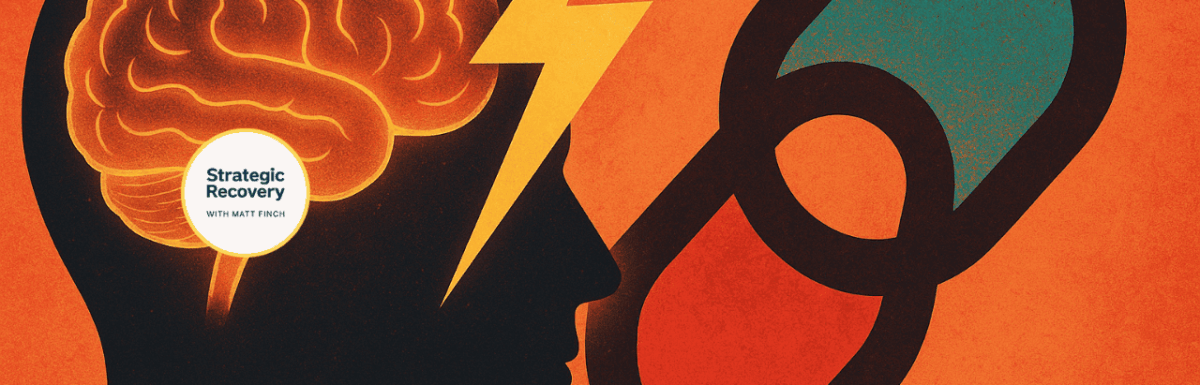
🧠 Rewiring Impulse: The Key to Lasting Freedom in Recovery
Imagine you’re standing at the edge of a cliff. You know stepping forward would be disastrous… yet something in you lunges before you’ve thought it through.
That’s impulsivity.
🗡️ In recovery, impulsivity is often the silent assassin.
It’s the “one quick decision” — 🍺 the drink after work, 💊 the pill on the nightstand, 💳 the reckless swipe of a credit card — that pulls you back into the cycle you swore you’d left behind.
But here’s the liberating truth: impulsivity isn’t a permanent flaw.
It’s a neurochemical habit that can be measured, understood, and transformed.
This article will show you how impulsivity fuels addiction, why traditional recovery often ignores it, and — most importantly — the Strategic Recovery™ tools you can use to break free.
🤔 What Is Impulsivity?
Impulsivity is the tendency to act quickly without weighing long-term consequences. It’s more than just being “spontaneous.”
True impulsivity is about:
- 🚀 Acting without thinking (motor impulsivity)
- 🔄 Living in the moment without planning (non-planning impulsivity)
- ⚡ Distracted, scattered thinking (attentional impulsivity)
From a brain perspective, it’s when the limbic system (your emotional brain) hijacks the wheel from the prefrontal cortex (your rational brain).
🧪 How Do You Measure It?
Psychologists use tools like the Barratt Impulsiveness Scale (BIS-11) to reveal how impulsive you are across the three domains above.
👉 Example: You might not be reckless with money (low motor impulsivity), but you struggle to focus (high attentional impulsivity). Understanding your profile is the first step to change.
🔗 The Relationship Between Impulsivity and Addiction
Why are impulsivity and addiction such close dance partners?
- 💥 Cravings demand immediate relief → impulsivity delivers.
- 🎯 Substances reward the “quick fix” brain → training it to bypass patience.
- 🔄 Relapse is often one snap decision away → “just one” becomes a spiral.
Addiction is basically impulsivity in overdrive, reinforced by brain chemistry.
🌀 Real-Life Examples of Impulsiveness Leading to Relapse
- Saying “yes” at a party when offered a drink after weeks of sobriety.
- Clicking “buy now” for pills online during a wave of anxiety.
- Telling yourself, “One time won’t hurt” — right before it hurts a lot.
Each of these isn’t a logical choice — it’s an impulse-driven reflex.
🧠 How Addiction Makes You More Impulsive
Here’s where it gets vicious: addiction itself rewires your brain to become more impulsive.
- 🎢 Dopamine hijack → teaches your brain to chase fast rewards.
- 🧩 Prefrontal cortex damage → weakens your ability to plan or resist.
- ⚡ Stress overload → floods the system, making snap reactions automatic.
So addiction doesn’t just feed on impulsivity — it creates more of it.
🐣 Which Comes First… the Impulsivity or the Addiction?
The answer is usually: both.
- Some people are genetically or temperamentally impulsive (think ADHD, trauma, family history).
- Others develop impulsivity as a symptom of long-term substance use.
- For most, it’s a feedback loop: impulsivity fuels addiction, addiction fuels impulsivity.
🏥 Why Mainstream Treatments Miss the Mark
Too often, treatment programs only say: “Just don’t pick up.” But telling someone to resist impulses without fixing the brain circuits that create those impulses is like telling someone with a broken leg to “just walk it off.”
That’s why relapse rates are high.
Because impulsivity isn’t addressed at its roots.
🧾 The Barratt Impulsiveness Scale: What’s Your Score?
Want to see where you land? The BIS-11 is a short questionnaire that breaks down your impulsivity profile.
👉 Knowing your score gives you clarity: Is impulsivity your biggest relapse risk? Or just a secondary factor?
🛑 How to Decrease Impulsivity (Without Losing Your Spark)
Impulsivity isn’t all bad — it can fuel creativity, courage, and spontaneity. The goal isn’t to erase it, but to channel it wisely.
🧘♂️ Core Practices:
- Mindfulness & Meditation → build the “pause button” into your nervous system.
- Breathing techniques → calm cortisol in seconds.
- CBT (Cognitive Behavioral Therapy) → replace “automatic thoughts” with conscious choices.
- Journaling & reflection → make unconscious impulses visible.
💊 Supplements & Biochemical Support
Impulsivity is rooted in neurotransmitters — so biochemical repair matters.
- ⚡ L-Tyrosine → boosts dopamine → focus, drive, motivation.
- 🌙 5-HTP / L-Tryptophan → raises serotonin → calm, patience.
- 🛡️ Magnesium → reduces stress-driven impulsive reactions.
- 🧠 Omega-3s → rebuild prefrontal cortex for self-control.
- 🔄 N-Acetylcysteine (NAC) → proven to reduce compulsive urges.
Combined with lifestyle (exercise, nutrition, sleep), these strategies rebuild impulse control from the ground up.
🌟 Strategic Recovery™ Takeaways
At Strategic Recovery™, we believe impulsivity is one of the hidden root causes of relapse — but also one of the most reversible.
Our framework focuses on:
- 🧬 Biochemical Repair → stabilize brain chemistry.
- 🧩 Psychological Tools → strengthen your pause-and-choose muscles.
- ✨ Spiritual Growth → cultivate patience, faith, and discernment.
- 🤝 Social Accountability → trusted allies to help you slow down when it counts.
🔑 Key Concepts to Remember
- Impulsivity is both a cause and a consequence of addiction.
- It can be measured, tracked, and reduced.
- Ignoring impulsivity = high relapse risk.
- With biochemical, psychological, and spiritual tools, impulsivity becomes manageable — even empowering.
🌈 Final Thoughts
Impulsivity doesn’t make you broken. It makes you human. The challenge is learning how to master it instead of being mastered by it.
When you build the skills to pause, reflect, and choose with intention, you transform impulsivity from your greatest weakness into your greatest ally.
Freedom is not about never feeling impulses again. It’s about choosing which ones deserve your energy, and which ones to let pass like waves on the shore. 🌊


Leave a Reply