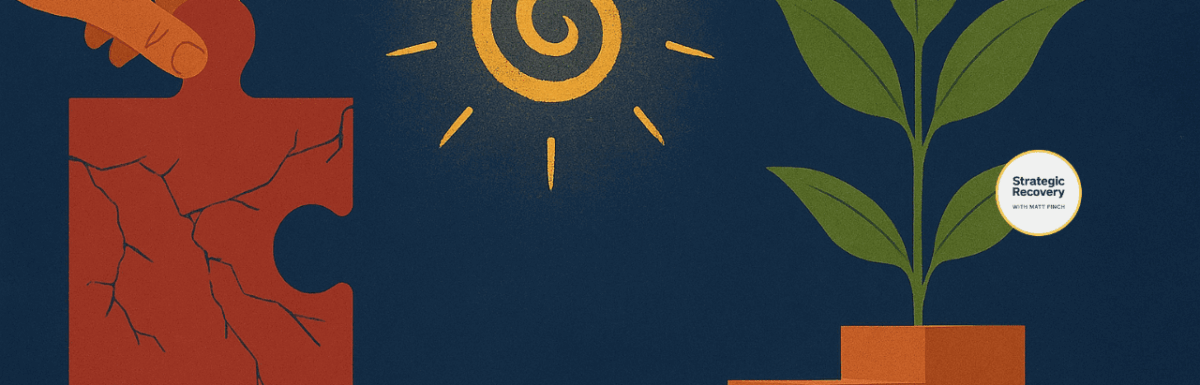
Now Playing: Episode #25 — The One-Path Recovery Lie & The New Many-Roads Paradigm
This page hosts the full Strategic Recovery Podcast audio episode (58:53 duration) on one of the most important mindset shifts in modern addiction healing: why the one-size-fits-all recovery story is breaking down — and how “any positive change” and multi-path freedom reflect how humans actually heal. Below the player you’ll find expanded show notes, harm-reduction and neuroscience resources, and a free companion workbook to help you design your own Strategic Recovery path across the 5 Pillars.
✨ This is your invitation to step out of the one-true-way recovery doctrine and step into a customized, compassionate, scientifically grounded path that actually fits your body, mind, nervous system, and soul.
Strategic Recovery Field Notes 🌱
Strategic Recovery with Matt Finch — Episode 25 Field Notes
🌍 In this episode, Matt dismantles one of the most damaging myths in addiction culture: the belief that there’s only one “real” way to recover. We explore what happens when you stamp “one size fits all” across recovery, medicine, diet, spirituality, and relationships — and how that mindset shames people, erases real progress, and even costs lives.
Then we rebuild from the ground up with a new vision: recovery as any positive change, rooted in science, compassion, and soul. These notes recap the major themes of the episode and give you reflection prompts to help you design your own Strategic Recovery path. ✍️
🧭 Quick Navigation
Field Guide · Episode 25 · Multi-Path Freedom
- 🌍 PART I — Opening: The One-Path Story We Were Sold
- 🌈 PART II — A Different Lens: “Any Positive Change” as Recovery
- 🧱 PART III — Why the One-Size-Fits-All Narrative Is So Seductive
- 🤝 PART IV — Groupthink, Dogma & the “AA Police”
- 🔭 PART V — Zooming Out: One-Size-Fits-All Fails Everywhere
- 🧬 PART VI — A More Honest View: Many Roads to Freedom
- 🌉 PART VII — Harm Reduction as a Bridge, Not a Betrayal
- 🧘 PART VIII — Integration: Exercises, Reframe, Affirmations & Closing
- 📚 Harm Reduction & Multi-Path Recovery Resources
🌍 PART I — Opening: The One-Path Story So Many of Us Were Sold
“One Size Fits All” Stamped Across Your Life 🧵
Matt opens by inviting you to imagine the phrase “one size fits all” stamped across your entire existence:
- 🧩 one-size-fits-all recovery
- 💊 one-size-fits-all medical treatment
- 🥗 one-size-fits-all diet
- 🙏 one-size-fits-all spirituality
- 💞 one-size-fits-all relationships
Then we zoom out to a planet of 8 billion different nervous systems, traumas, genes, cultures, and souls — and ask what happens when we try to force everyone into a single mold. You can almost hear the seams ripping.
In addiction and recovery, this fantasy isn’t just unrealistic — it’s actively harmful. When we insist there is only one acceptable way to heal, we erase people who don’t fit, shame those who need something different, and abandon those who tried “the approved path” and still suffered.
The One-Path Recovery Doctrine ⚖️
Many of us were handed a story that sounded like this:
- If you have an addiction, there is only one way to get better.
- You must abstain from all psychoactive substances forever.
- You must work a 12-step program forever.
- You must identify as an addict or alcoholic forever.
- If you don’t, the only alternatives are jails, institutions, or death.
Matt honors that this story has saved lives — and also names that it has harmed people who couldn’t or didn’t follow it. Questioning it often meant being labeled “in denial,” “unwilling,” or even “dangerous,” especially if you suggested that medications, moderation, or spiritual use of certain substances had any place in healing.
🌈 PART II — A Different Lens: “Any Positive Change” as Recovery
A Different Lens on Recovery 🔍
Matt shares the story of a journalist who kicked cocaine and heroin, only to later discover that the science of addiction didn’t match the dogma he’d been taught. Research shows that many people recover:
- without formal treatment or self-help groups,
- often not by quitting instantly and forever,
- but by gradually changing their use until it no longer wrecks their lives.
Recovery, seen through this lens, is less like a one-time event and more like a process of positive change unfolding over time.
The Chicago Recovery Alliance: A Revolutionary Definition 🌈
Matt introduces the Chicago Recovery Alliance, harm reduction pioneers who offered a simple, radical definition of recovery:
“Any positive change.”
From this perspective:
- Switching from dirty to clean needles counts. 💉➡️✨
- Going from a bottle of Scotch a day to one glass counts.
- Going from daily drinking to weekends-only counts.
- Starting methadone or buprenorphine and stopping overdoses absolutely counts. 🛟
These may not be final destinations — but they’re real steps toward life, health, and possibility.
The Crucial Truth: When We Expand Our Definitions, We Save Lives ❤️🔥
When we only celebrate “perfect” abstinence, we invisibilize millions of people who are actively healing. They’re reducing harm, stabilizing their nervous systems, and moving their lives in a healthier direction — but their progress is dismissed because it doesn’t look pure enough.
Widening the definition of recovery does not water it down. It makes it more accurate, humane, and neurologically honest — and it reduces shame, increases hope, and saves lives.
🧱 PART III — Why the One-Size-Fits-All Recovery Narrative Is So Seductive
Simple Answers to Complex Pain 🧠
Why did the one-path doctrine become so dominant? Matt points out that it offers something the human nervous system craves: certainty. If one program, one book, and one identity are “the answer,” then we don’t have to face the messy reality of individual differences.
Asking questions like “What if your trauma, genetics, culture, or spirituality are different?” is uncomfortable. The one-size narrative erases that discomfort by offering a single template — and blaming the individual if they don’t fit.
The Ego’s Favorite Addiction: Being Right 😤
When someone’s status and identity are tied to “I did it this way,” it becomes tempting to assume that their way must be the way. If another person’s path looks different — medication, moderation, non-12-step support, or spiritual practices — it can feel threatening.
Instead of getting curious, the ego wants to protect itself by judging, shaming, or dismissing the other person’s experience.
Ideological Possession: When the Tool Starts Using You 🧊
When a recovery framework becomes more important than the humans it’s supposed to serve, we’ve crossed into what Matt calls ideological possession.
The key shift is this:
- You stop asking, “Is this helping people?”
- You start asking, “Are people obeying the rules?”
At that point, the program is no longer a bridge to freedom. It becomes a gate that decides who is “in” and who is “out.”
🤝 PART IV — Groupthink, Dogma & the “AA Police”
The Shadow Side: When Support Turns into Policing 🕵️♂️
Matt makes it clear that the 12 steps and the Big Book have helped countless people, and that is beautiful. But he also names the shadow: in some abstinence-only spaces, people who relapse are treated as if their entire journey is erased — “back to zero.”
That mindset can intensify shame, increase all-or-nothing thinking, and actually make future relapses more dangerous.
The Medication Shaming Problem 💉
Some members and even entire programs still tell people on methadone, buprenorphine, or naltrexone that they’re “not really sober” or “just substituting one addiction for another,” despite overwhelming evidence that these meds dramatically reduce overdose deaths.
For someone to stop life-saving medication just to prove they’re “clean” is not recovery — it’s ideology trumping neuroscience.
The Spiritual Narrowing 🙏
People who explore other forms of spiritual growth — meditation, somatic work, mysticism, non-traditional paths — can be side-eyed or shamed, as if the Divine only speaks through one book or one set of steps.
Spirituality is not proprietary. It’s a universal human capacity.
Enter: The “AA Police” 🚨
Half-jokingly, half-seriously, Matt describes the “AA police”: people who use the program more like a badge and a weapon than a tool. They quote slogans instead of listening, shame instead of support, and gatekeep who is “really in recovery.”
Groupthink: The Silent Force That Pulls Everyone In 🌊
Groupthink is making decisions as a group in a way that discourages creativity or individual responsibility. If you’ve ever sat in a room nodding along to something that didn’t feel right because you didn’t want to rock the boat — you’ve felt groupthink in your body.
The cost of long-term silence is losing your inner compass. 🧭
🔭 PART V — Let’s Zoom Out: One-Size-Fits-All Fails Everywhere
One-Size-Fits-All Medicine? 💊
People metabolize meds differently, have different genetic polymorphisms, and carry wildly different gut microbiomes. Two people can take the same drug at the same dose and have opposite responses.
Medicine is moving toward personalization — not templates.
One-Size-Fits-All Diet? 🥗
Some people thrive on higher carbs, some on higher fats, some on ancestral or culture-specific foods. What heals one person’s body can inflame another’s. There is no single “human diet” that works for everyone.
One-Size-Fits-All Spirituality? 🌙
Trying to tell 8 billion people there’s only one acceptable way to relate to the Divine, meaning, or consciousness is absurd. Human souls do not come off an assembly line.
One-Size-Fits-All Relationship Model? 💞
Monogamy, poly, marriage, no marriage, kids, no kids — these are all different configurations for different nervous systems and values. There is no universal relationship template either.
So of Course: One-Size-Fits-All Recovery Doesn’t Work 🧨
Once you see how diversity shows up in medicine, diet, spirituality, and relationships, it becomes obvious that recovery can’t be one-size-fits-all either.
Here’s How the Machine Works 🏭
Matt explains that one reason the one-path approach still appears dominant is that massive corporate rehab centers built their business models around it. They spend millions on:
- SEO and Google ads,
- “warm” sales calls that poke your pain,
- and then run the same cookie-cutter program for nearly everyone.
When it doesn’t work, the script is, “You weren’t ready. You didn’t want it badly enough.” Then they’re happy to take you back — and bill your insurance again.
The truth: you didn’t fail. The system failed to honor your uniqueness. 💔➡️💡
🧬 PART VI — A More Honest View: Many Roads to Freedom
Designing Your Own Path 🛤️
Matt sums it up in one line: There are many roads to freedom — and you get to design yours. Your healing might include:
- traditional 12-step plus therapy and abstinence,
- medication-assisted treatment and harm reduction,
- holistic tools like nutrient repair and somatic work,
- deep spiritual practice and life redesign,
- or some beautiful hybrid no rehab brochure could have predicted. ✨
The 5 Pillars of Strategic Recovery™ — Your Personalized Freedom Architecture 🏛️
Matt revisits the 5 Pillars and frames them as the architecture you can use to design a custom path:
- Biochemical – brain, body, nutrients, hormones, sleep, nervous system.
- Psychological – beliefs, mindset, emotional patterns, coping tools.
- Social – relationships, community, boundaries, attachment patterns.
- Environmental – surroundings, routines, triggers, cues.
- Spiritual – meaning, purpose, connection to something bigger.
There is no single “correct” combo of tools in these pillars. What matters is whether your life force is coming back online and your capacity for love, presence, and contribution is expanding. 🌟
The Common Denominators (What Almost Everyone Needs) 🔐
Even though paths differ, Matt lays out meta-rules that show up almost everywhere:
- It won’t be perfectly easy; emotional storms are part of being human. ⛈️
- It usually takes longer than you want; brains move in seasons, not 30-day sprints. 🌱
- You’ll “mess up” at least once; slips are data, not moral failure.
- Habits and routines will make or break you. 📆
- Your nervous system needs support — biologically and emotionally.
- You can’t do it entirely alone; humans heal in connection. 🤝
- Your identity and worldview will shift.
- It is worth the struggle. 💪
Deprogramming from the One-Path Matrix 🧽
Matt invites you to lovingly question any internalized messages like “If I don’t recover this one way, I’m doomed” or “My path only counts if it looks like theirs.” Deprogramming doesn’t mean you abandon what works — it means you stop treating it as the only way.
🌉 PART VII — Harm Reduction as a Bridge, Not a Betrayal
Medications & Staying Alive Long Enough to Heal 🛟
Matt addresses the myth that methadone, buprenorphine, or naltrexone are “just swapping addictions.” In reality, these medications are among the only treatments proven to slash overdose deaths.
People stabilized on the right dose aren’t “high all the time” — they’re able to work, parent, create, and connect without chasing the next fix. Harm reduction is not about abandoning abstinence; it’s about saying, “You deserve to stay alive long enough to heal.”
An Example: Redefining Recovery on Your Own Terms (Sara’s Story) 🌸
Matt shares the story of Sara, who drank heavily for years and didn’t resonate with 12-step or pure willpower. Instead, she:
- starts naltrexone with a doctor,
- uses harm reduction and tracks gradual progress,
- does nutrient repair and gut support,
- starts trauma therapy,
- joins a non-12-step support group,
- builds a nightly calming ritual. 🌙
Six months later she’s drinking far less, sleeping better, feeling more in control, rebuilding trust, and actually liking herself. Under old doctrine, some would say she’s “not really in recovery.” Under Strategic Recovery — and any sane human standard — she absolutely is.
Life After Addiction: You Don’t Owe Anyone a Script 📜
You don’t owe anyone a lifetime of meetings, a specific label, a perfect streak, or a rehearsed narrative about your past.
You are allowed to stop counting days if it stresses you, drop labels that no longer feel true, change your relationship with substances over time, and decide that your “recovery story” is not the central headline of your life anymore.
Addiction is something you went through — not who you are. 🌱
For People Who Love AA or NA 💙
If AA or NA saved your life and still nourishes you, nothing in this episode is meant to take that away. This is not an attack on what works — it’s an invitation to release the one-true-way mentality that keeps others from finding what works for them.
Your path is beautiful. So is the fact that other humans are wired differently.
🧘 PART VIII — Integration: Exercises, Reframe, Affirmations & Closing
Exercises: Designing Your Own Strategic Recovery Path ✍️
Matt invites you to journal on a few prompts:
- Which parts of the one-path narrative have I secretly internalized?
- Where have I already made “any positive change” that I haven’t given myself credit for? 🌈
- Looking at the 5 Pillars, which one needs the most love right now?
- If I could design my own path with zero shame or dogma, what would it look like?
Short Guided Reframe (You Can Close Your Eyes If It’s Safe) 🌬️
In the episode, Matt guides you through a brief visualization: imagining the “one-size-fits-all” label peeling off your chest and dissolving, while a new phrase appears over your heart: “Many roads. One soul.” You picture your path as a living, adaptable map instead of a rigid track.
Affirmations for Multi-Path Freedom 💖
Matt shares affirmations such as:
- Every positive change I make counts.
- My nervous system, history, and soul are unique — and my path can honor that.
- I release shame-based rules that were never designed for me.
- I am not a label. I am a living, evolving human being.
- There are many roads to freedom, and I am allowed to find mine.
Closing: Many Roads, One Direction 🌅
Matt closes by reminding you that while there are many different routes, they all point in the same ultimate direction: less suffering, more presence, more love, more freedom.
Recovery is not about earning purity points. It’s about reclaiming your life force, your dignity, your creativity, and your capacity to give and receive love.
You were never meant to squeeze your soul into someone else’s mold. You were meant to build a path that fits you — and to walk it with courage, curiosity, and compassion. 🚶♀️🚶♂️
📚 Harm Reduction & Multi-Path Recovery Resources
If this episode resonated with you, these resources can deepen your understanding of harm reduction, “any positive change,” and the many pathways people take to lasting freedom. All links open in a new tab. ✨
-
🌈Chicago Recovery Alliance — Any Positive Change
AnyPositiveChange.orgThe originators of the “any positive change” definition of recovery and pioneers in harm reduction.
-
📄Harm Reduction Protocol (Chicago Recovery Alliance)
50-page Harm Reduction Protocol PDFA detailed look at how harm reduction is practiced on the ground — practical, compassionate, and science-informed.
-
⚖️Principles of Harm Reduction
harmreduction.org/about-us/principles-of-harm-reductionA concise overview of the core values and principles behind harm reduction work around the world.
-
🔥The Dark Ages of Addiction Treatment — And the Coming Renaissance of Recovery (Ep. 23)
getstrategicrecovery.com/dark-ages-of-addiction-treatment-renaissance-of-recoveryA deep dive into how the current treatment system fails — and what the new paradigm of recovery can look like.
-
🌍The 3 Pathways of Addiction Recovery: A Complete Guide
getstrategicrecovery.com/addiction-recovery-pathways-clinical-community-self-directedStrategic Recovery’s guide to clinical, community, and self-directed pathways — and how to combine them.
-
💫“People recover from addiction. They also go on to do good things.”
STAT News articleA hopeful, data-backed look at life after addiction — including purpose, contribution, and thriving.
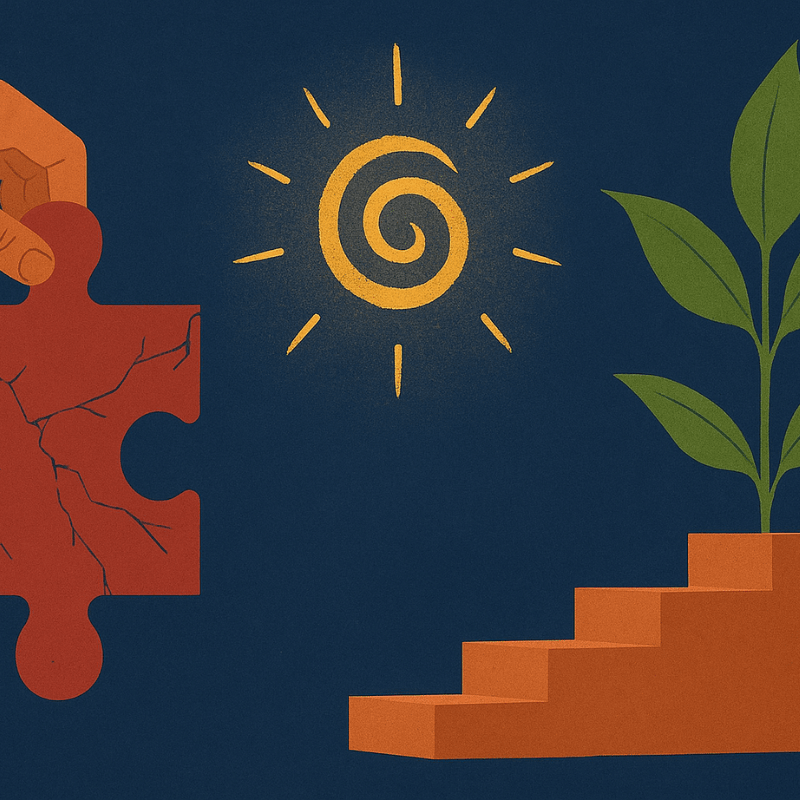
Episode 25 Companion Workbook
Download the Strategic Recovery™ Personal Pathway Design Workbook — a guided journal to help you define what “living free after addiction” means for you, map the 5 Pillars, and start making any positive change that fits your unique nervous system and soul.
FAQ — Many Roads to Recovery
These questions go deeper into the heart of Episode 25: breaking the one-path myth and honoring your unique, multidimensional way of healing.
What does “many pathways to recovery” actually mean in real life?
⌄
It means recovery is not a single staircase everyone must climb in the same way. It’s more like a network of trails that all move in the direction of greater freedom, connection, and coherence.
You might see people recover through:
- Abstinence-based programs like AA or NA.
- Medication-assisted treatment with buprenorphine, methadone, or naltrexone.
- Holistic approaches centered on nutrient repair, herbs, somatic therapy, and lifestyle change.
- Spiritual paths focused on meditation, prayer, or contemplative practice.
- Self-directed frameworks combining education, support, and experimentation.
“Many pathways” means we measure a path by its results in your life, not by whether it fits a dogma.
Isn’t using medication like methadone or buprenorphine just “replacing one addiction with another”?
⌄
This is one of the most harmful myths in addiction culture. Medications used properly are not simply “replacement addictions” — they’re stabilizing tools for a hijacked nervous system.
For many people, opioid use disorder is like having a blown fuse in the brain’s pain and reward circuits. Long-acting medications can:
- Reduce or eliminate withdrawal symptoms.
- Lower cravings to a manageable level.
- Cut overdose risk dramatically.
- Make space for therapy, connection, and long-term healing.
Are they perfect? No. Can they be misused? Yes. But for countless people, they are the difference between staying alive long enough to heal and not surviving at all.
To explore the harm reduction lens further, check out the Principles of Harm Reduction →
If I’m still using sometimes, can I honestly say I’m “in recovery”?
⌄
Yes. In the Strategic Recovery™ framework, recovery is not an on/off switch — it’s a direction of travel.
Ask yourself:
- Is my overall use trending down, more conscious, or less chaotic?
- Is my life becoming more stable, meaningful, and connected?
- Am I building skills, supports, and tools I didn’t have before?
If the answer to those is “yes,” then you’re actively recovering — even if the process includes ambivalence, slips, or gradual reductions instead of instant perfection.
How do I actually choose a pathway that fits my brain, body, and soul?
⌄
Think in terms of experiments, not lifelong vows. You don’t have to marry a method — you can date it.
Here’s a simple process:
- 1. Identify your biggest pain points. Is it cravings, anxiety, loneliness, trauma, spiritual emptiness, or all of the above?
- 2. Match tools to pillars. Use the 5 Pillars (Biochemical, Psychological, Social, Environmental, Spiritual) to see where you’re most under-supported.
- 3. Choose 1–2 modest experiments. A medication consult + a supplement protocol. A support group + somatic therapy. A therapist + a spiritual practice.
- 4. Review every 30–60 days. Is your suffering going down? Is your capacity going up?
The right pathway is the one that works for you in real life, not the one that gets the most applause in any particular room.
What if AA or NA helped me in some ways, but I don’t resonate with the dogma?
⌄
It’s completely valid to be grateful for what helped you *and* outgrow certain aspects of it. You can:
- Keep the fellowship but release the labels.
- Keep the structure but let go of “one true way” thinking.
- Keep the tools of inventory, amends, and service while expanding your spiritual framework.
Maturity in recovery often means integrating what worked, discarding what didn’t, and realizing that no single program gets to define your entire spiritual or psychological map.
Where do supplements, herbs, and nutrient repair fit into all of this?
⌄
Biochemistry isn’t the whole story — but it’s a huge part of it. Many people are trying to do deep emotional and spiritual work on a brain that’s running on fumes.
Strategic use of nutrients and herbs can help:
- Rebuild depleted neurotransmitters (dopamine, GABA, serotonin).
- Stabilize blood sugar, sleep, and energy.
- Reduce anxiety and irritability that often trigger relapse.
A more detailed overview lives in the Ultimate Guide to Supplements for Addiction Recovery →
What if I keep “slipping” — does that mean I’m doomed or not serious enough?
⌄
No. Slips and returns are built into how humans change complex behaviors. They’re not proof of moral failure — they’re information about your system.
Instead of asking “What’s wrong with me?” try:
- What was I trying to regulate or escape? Pain, boredom, loneliness, shame?
- What pillar was under-supported? Biochemical (sleep, food), psychological, social, environmental, or spiritual?
- What’s one system upgrade I can make now? A boundary, a supplement, a support call, a new ritual.
In this model, a slip is a diagnostic moment, not the end of your story.
Can I ever stop calling myself an “addict” or “alcoholic”?
⌄
Yes. If a label keeps you humble and grounded, you can use it. If it feels like a life sentence, you’re allowed to evolve beyond it.
Some people keep the language forever and it works for them. Others shift to:
- “I went through a period where substances were out of control.”
- “I’m someone who has healed a lot around addiction.”
- “I’m a human who used substances to cope until I learned better tools.”
You are not obligated to organize your entire identity around the hardest chapter of your life.
Why are big rehab centers often so attached to the one-size-fits-all model?
⌄
In many cases, it’s not about evil people — it’s about entrenched systems and business models. It’s cheaper and easier to run one scripted model than to individualize care for each nervous system.
When a model is profitable, familiar, and culturally endorsed, it can become institutionally dogmatic, even if the science has moved on.
That’s why the coming “renaissance of recovery” involves people demanding options that respect their biology, psychology, and spirituality — not just their insurance coverage.
For a deeper exploration, see The Dark Ages of Addiction Treatment — And the Coming Renaissance of Recovery (Ep. 23) →
What does “any positive change” actually look like day-to-day?
⌄
It’s often much smaller and more practical than people expect:
- Using clean supplies instead of risky ones.
- Going from daily heavy use to a few days a week.
- Switching from drinking alone to having one friend you can be honest with.
- Adding breakfast, electrolytes, and magnesium so your nervous system isn’t wrecked all day.
- Spending 3 minutes in silence before bed instead of doomscrolling.
These look “small” to outside eyes, but they are foundational nervous system upgrades that often make later, bigger changes possible.
How do I start deprogramming from the one-path, all-or-nothing mindset?
⌄
Three simple practices can help:
- Notice the “shoulds.” Write down beliefs like “I should never struggle again” or “If I need meds, I’ve failed.” Then question each one.
- Expose yourself to alternate narratives. Read stories of people who recovered through different pathways so your nervous system sees new possibilities.
- Use more flexible language. Shift from “I must” to “Right now it feels wisest to…” — which keeps you in the driver’s seat.
Over time, you’ll feel the difference between internal guidance and external programming.
Where can I go next if this episode really resonated with me?
⌄
If Episode 25 hit home, here are powerful next steps:
- Explore how people truly heal in The 3 Pathways of Addiction Recovery →
- Download the Episode 25 Companion Workbook and design your own path.
- Begin a gentle audit of your 5 Pillars and pick one “any positive change” to start this week.
The point is not to copy anyone’s formula — it’s to honor the deeper truth: your path is valid when it brings you back to life.
🙏 Thank you for being part of the Strategic Recovery community.
👉 Click Here and Right Click to Save As to Download>>
🎧 Available on your favorite platform:




Leave a Reply