
Now Playing: Episode #32 — The Performance Trap: Pervitin, Dopamine Debt, and Why Regulation Always Wins
This page hosts the full Strategic Recovery Podcast audio episode (40:25 duration) — a cinematic, recovery-intelligence masterclass using history as the case study. We explore how Nazi Germany distributed Pervitin (pharmaceutical methamphetamine) to force endurance, suppress fear, and accelerate output — and why the crash was inevitable: sleep debt, dopamine depletion, nervous-system dysregulation, and psychological collapse. The deeper lesson is timeless: when a system prioritizes performance over regulation, it eventually collapses… and recovery begins when we restore rhythm, repair, and sustainable power.
⚗️ What Nazi Germany’s Meth Experiment Reveals About Addiction, Burnout, and the Cost of Chemical Shortcuts
Strategic Recovery Field Notes 🎭
Strategic Recovery with Matt Finch — Episode 32 Show Notes
In this episode, we explore a lesser-known historical case study with a modern recovery lesson: Pervitin (pharmaceutical methamphetamine) and the hidden cost of chemically forcing performance. The deeper takeaway is timeless — any system that prioritizes output over regulation eventually collapses.
Use these notes as a reflection guide, not a checklist. Take what resonates. Leave what doesn’t. Your nervous system comes first.
🧭 Quick Navigation
History · Neurobiology · Recovery
🧪 Intro
This is not a sensational episode — it’s a nervous-system masterclass using history as the case study. We’ll look at how “performance chemicals” can create short-term momentum, while quietly building long-term collapse: dopamine depletion, sleep debt, fear suppression, and nervous-system dysregulation.
- Why speed can masquerade as strength
- How chemicals interrupt the body’s feedback loops
- What “dopamine debt” looks like in real life
⚠️ Part I — The Uncomfortable Truth
Nazi Germany publicly condemned drugs while quietly distributing Pervitin (methamphetamine) to sustain output, aggression, and endurance. The contradiction reveals a universal law: when regulation is ignored, systems reach for chemistry.
- Ideology vs biology — the hidden contradiction
- How “performance” becomes chemical enforcement
- Addiction as a survival adaptation, not a character flaw
💊 Part II — Pervitin
What was Pervitin, how did it work, and why did it “succeed” short-term? We break down the neurobiology: dopamine + norepinephrine — action chemicals that intensify focus, suppress fatigue, and mute fear.
🧠 The Mechanism
- Dopamine flood → urgency + drive
- Norepinephrine spike → vigilance
- Pain/fear signals muted → reckless momentum
⚠️ The Illusion
- “Limitlessness” is often numbness
- Feedback silenced ≠ capacity increased
- Borrowed energy always demands repayment
🧾 Part III — The Crash
Collapse doesn’t arrive loudly — it arrives as dysregulation: paranoia, mood swings, hallucinations, impulsivity, and severe exhaustion. Withdrawal is not weakness — it’s the nervous system recalibrating after extended override.
- Sleep debt + dopamine depletion → instability
- Withdrawal: fatigue, depression, anxiety, cravings
- When stimulation turns into chaos
🪞 Part IV — Control, Stimulation, and the Leadership Mirror
Extreme control often requires chemical support. This section explores the difference between control (override the system) and regulation (work with the system), and why modern “internal dictatorship” can push people into stimulant reliance, alcohol dependence, or burnout cycles.
- Control vs regulation (the core distinction)
- Why rigid systems can look powerful — but are fragile
- The “internal dictator” voice that fuels relapse
🫁 Part V — Regulation, Not Resistance
Recovery isn’t won by white-knuckling — it’s built by restoring the infrastructure: sleep, stress physiology, neurotransmitter balance, rhythm, meaning, and connection. When the system heals, cravings soften because emergency chemistry becomes unnecessary.
🛠️ Regulation Foundations
- Sleep repair
- Stress-cycle completion
- Stable nourishment + hydration
- Nervous system downshifting
🌱 The Goal
- Abstinence as a byproduct
- Compulsion loosens as coherence returns
- Sustainability over speed
🧭 Part VI — From Collapse to Consciousness
Collapse often marks the end of a lie: the belief that you can override biology forever. This closing integrates the modern stimulant world, burnout culture, and the deeper truth: real power is the ability to regulate your state and choose — not compulsively react.
- Collapse as a signal, not a verdict
- Why modern life is “stimulant by default”
- Real power = regulation, rhythm, and meaning
🧠 Key Concepts
- 🧪 Performance Trap: “Output first” systems reward short bursts and punish regulation — until collapse forces a reset.
- 💊 Borrowed Energy: Stimulants don’t create capacity — they override signals. The body always collects the debt.
- ⚡ Dopamine Debt: Artificial peaks create real troughs: low motivation, depression, anxiety, cravings, and anhedonia.
- 🛌 Sleep as Command: Sleep isn’t optional recovery — it’s the central repair protocol for mood, impulse control, and resilience.
- 🧠 Fear Suppression: Muting fear and fatigue can look like “confidence,” but it often increases risk-taking and impulsivity.
- 🔁 Feedback Loops: Healthy systems respond to signals. Addictive systems silence signals and demand more force.
- 🫁 Regulation First: The fastest way out is restoring physiology: downshift the nervous system and compulsion loosens.
- 🪞 Internal Leadership: Control-based self-talk (“push harder”) creates relapse terrain; regulation-based leadership creates stability.
- 🌱 Sustainable Power: Real strength is rhythm, nourishment, boundaries, meaning, and connection — not perpetual acceleration.
- 🧭 The Goal: Build a life where chemistry is not required to function — and sobriety becomes the natural state.
Bottom line: You don’t fight the crash — you stop building the debt.
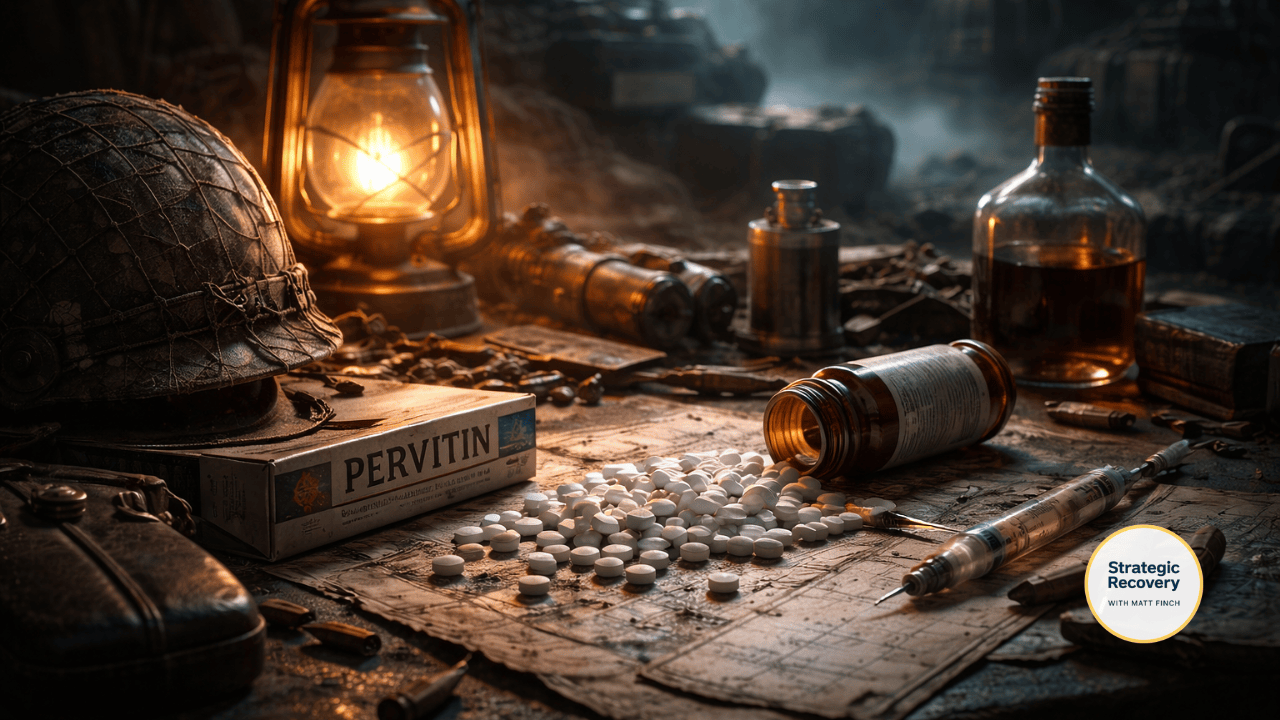
When performance is chemically forced, the body keeps score — and the bill always comes due.
Frequently Asked Questions — ⚗️ Pervitin, Power, and Collapse
Clear, grounded answers to help you integrate the episode: stimulant “borrowed energy,” dopamine debt, nervous-system regulation, and how to turn the lesson into a real recovery advantage.
-
Is this episode glorifying meth or stimulant use?
No. This episode is a cautionary case study — a high-contrast example of what happens when a system forces output through chemicals.
The purpose is education: to show how “performance drugs” can temporarily mute fatigue and fear, while creating sleep debt, dopamine depletion, and instability.
Bottom line: we’re not promoting stimulation — we’re teaching regulation-first recovery.
-
What does “borrowed energy always collects interest” mean in real life?
It means when you override your biology, you don’t escape the cost — you delay it.
The “interest” often looks like: irritability, anxiety, insomnia, emotional volatility, cravings, burnout, or relapse pressure.
Recovery advantage: once you see the pattern, you can stop paying the bill with your life — and start rebuilding stable energy.
-
How is Pervitin different from modern meth — and why does it matter?
Pervitin was a pharmaceutical preparation of methamphetamine used medically and militarily in that era.
Modern illicit meth can vary widely in purity and contaminants — but the key recovery lesson is the same: stimulant-driven override produces nervous-system debt.
Translation: the delivery system changes; the biology doesn’t.
-
What is “dopamine debt” and how do I know if I’m in it?
Dopamine debt is the low-motivation, high-craving state that can follow chronic overstimulation.
Common signs: flat mood, low drive, needing “something” to start, impulsive urges, pleasure blunting, and stronger cravings at night.
Good news: debt can be repaid through sleep repair, nervous-system downshifting, stable nourishment, and reducing artificial stimulation.
-
Why does willpower fail when I’m dysregulated?
Because willpower is a top-down function — and dysregulation is a bottom-up emergency.
When your nervous system perceives threat or exhaustion, it prioritizes relief and survival over long-term goals.
Strategic Recovery rule: regulate first, then decide. Regulation restores choice.
-
I’m sober but still stuck in “hustle mode.” Is that part of the problem?
Often, yes. Hustle mode can be a socially-approved form of stimulation addiction.
If your baseline is urgency, pressure, and output, your system may crave alcohol/benzos at night to “come down” — or caffeine/stimulants to “go up.”
Upgrade: build a rhythm where you don’t need chemicals to change gears.
-
What are the most practical “regulation first” steps after listening?
Start with simple reps that lower nervous-system load:
1) Exhale-long breathing (inhale 4, exhale 6) for 2–3 minutes • 2) earlier bedtime by 20–30 minutes • 3) morning light + hydration • 4) protein at breakfast • 5) reduce late-night screens/stimulation.
Small changes done daily repay dopamine debt faster than big plans done once.
-
How do I reduce cravings without “fighting” them?
By lowering the conditions that create urgency: sleep debt, blood-sugar instability, overstimulation, and stress load.
Cravings often soften when you build nervous-system safety and restore baseline dopamine function.
Key reframe: cravings are not proof you’re failing — they’re proof your system wants regulation.
-
Is this episode only for stimulant users — or does it apply to alcohol and other addictions too?
It applies broadly. The pattern is universal: override → debt → crash → cravings.
Alcohol can function as the “downshift drug” after chronic upshift. Porn/gaming can be dopamine anesthesia. Work can become a stimulant. The substance changes — the nervous-system math doesn’t.
Lesson: build a life that doesn’t require chemical gear-shifting.
-
What should I do if this episode triggers anxiety or cravings?
Pause and regulate. Put one hand on chest, one on belly. Exhale longer than inhale for 90 seconds. Look around and name 5 things you can see.
Then do one grounded action: drink water, eat something, step outside, text a safe person, or schedule support.
Rule: you don’t push through dysregulation — you return to safety first.
These FAQs are guidance, not commandments. Keep what increases stability and clear choice — and remember: regulation restores sovereignty.
🙏 Thank you for being part of the Strategic Recovery community.
👉 Click Here and Right Click to Save As to Download>>
🎧 Available on your favorite platform:




Leave a Reply