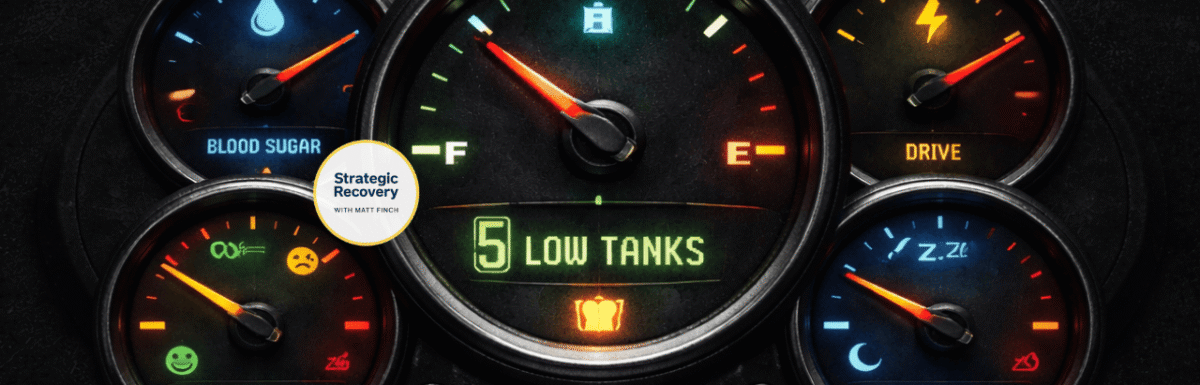
Now Playing: Episode #39 — The 5 Low Tanks of Recovery: Why You Still Feel “Off” — and How to Rebuild Internal Stability
This page hosts the full Strategic Recovery Podcast audio episode [1hr 25min 🎙️] — a precision upgrade to the “Mood Tanks” model. In Episode 39, we map the 5-gauge recovery dashboard and show why relapse often isn’t a moral collapse — it’s a predictable outcome of depletion. You’ll learn how to read the five tanks: blood sugar (metabolic stability), catecholamines (drive/torque), serotonin (emotional safety), GABA (brakes/downshift), and endorphins (relief buffer). We then lay down the Phase 2 relapse equation (Depletion → Dysregulation → Narrowing → Urgency → Compulsion) and give you a simple diagnostic tool: State (today), Trait (baseline), Trigger (what flips you) — so you can match the right stabilizers to the right tank.
⚙️ You’re not failing recovery — you’re reading the wrong gauge. Stabilize the system… and choice returns.
Strategic Recovery Field Notes ⛽
Strategic Recovery with Matt Finch — Episode 39 Show Notes
If you’re in recovery but still feel off — unstable, uneven, low-grade uncomfortable — this episode gives you a Phase 2 diagnostic lens. Not a pep talk. Not a “try harder” speech. A way to read what your system is actually asking for.
You’re not failing recovery. You’re reading the wrong gauge. And once you can read the dashboard, you can stabilize the system.
🧭 Quick Navigation
Problem · Model · Dashboard · Tanks · Equation · Tool · Challenge · Phase 2 Arc
- 🎬 Act I — The “Still Off” Problem
- 🧠 Act II — Why This Episode Exists
- ⚙️ Act III — The Recovery Dashboard
- 🩸 Act IV — Blood Sugar (Multiplier Tank)
- ⚡ Act V — Catecholamines (Drive Deficit)
- ✨ Act VI — Serotonin (Emotional Safety)
- ⚖️ Act VII — GABA (Brake Failure)
- 🌊 Act VIII — Endorphins (Relief Deficit)
- 🔁 Act IX — The Relapse Equation
- 🧭 Act X — The 3-Layer Diagnostic Tool
- 🚀 Act XI — Phase 2 Promise
- 🧘 Act XII — 7-Day Tank Check Challenge
- 🔑 Key Concepts
🎬 Act I — The “Still Off” Problem
You can be in recovery — fully — and still feel unstable. Not dramatic. Not catastrophic. Just… off.
- Uneven mood, fragile stress tolerance, urges that feel like ambushes.
- From the outside you “should be fine,” but inside your system feels on thin ice.
- Reframe: you’re not failing recovery — you may be running on one or more low tanks.
Signature Moment #1: “If a tank is low, your craving isn’t evil. It’s a signal.”
🧠 Act II — Why This Episode Exists
This is not Episode 16 repeated. Episode 16 explained the Four Mood Tanks. Episode 39 upgrades the model and adds the missing multiplier: blood sugar / metabolic stability.
The 5-Tank Dashboard
- Blood Sugar — metabolic stability
- Catecholamines — drive / engagement
- Serotonin — emotional safety
- GABA — inhibitory brakes
- Endorphins — relief buffer
Phase 2 Core Principle
Before you optimize your life, you stabilize your internal fuel system.
- You do not build discipline on depletion.
- You do not build identity on instability.
- You stabilize first — then behavior gets easier.
⚙️ Act III — The Master Metaphor: The Recovery Dashboard
Think of recovery as a five-gauge dashboard. When two gauges are low, you don’t feel dramatic — you feel off. And off people relapse.
The 5 Gauges
- 🩸 Blood Sugar = Power Supply
- ⚡ Catecholamines = Engine Torque
- ✨ Serotonin = Suspension System
- ⚖️ GABA = Braking System
- 🌊 Endorphins = Internal Cushion
Read the gauge, not the story
- Low tanks compress decision windows.
- Depletion makes urges feel urgent.
- Stability restores options.
Signature Moment #2: “You’re not failing recovery. You’re reading the wrong gauge.”
🩸 Act IV — Tank #1: Blood Sugar (The Multiplier Tank)
Blood sugar is the multiplier. When glucose drops, your system shifts into threat chemistry.
- Stress hormones rise
- Prefrontal cortex drops
- Impulse control weakens
- Urgency spikes
Teaser Tools (Ep. 40): anchor breakfast, protein timing, predictable meals, fewer “gaps,” fewer spikes, fewer crashes.
Key concept: Metabolic Anxiety — “I’m anxious” is often “I’m under-fueled.”
Line: “Blood sugar doesn’t create pleasure. It creates safety.”
⚡ Act V — Tank #2: Low Catecholamines (Drive Deficit)
This is the “no torque” tank. You’re not lazy — your engine is underpowered.
- Flat, effortful, unmotivated, bored, procrastinating
- “I need something to initiate life.”
- Stimulation → depletion loop
- Burnout as dopamine exhaustion
- Productivity addiction
Teaser Tools: L-tyrosine, mucuna pruriens (L-Dopa), cold immersion (strategic), decreasing catecholamine drainers (sleep loss, chronic stress, overstimulation).
Line: “When life feels flat, stimulation feels like oxygen.”
✨ Act VI — Tank #3: Low Serotonin (Emotional Safety Deficit)
Low serotonin often doesn’t feel sad. It feels unsettled.
- Restless, mentally sticky, irritable, emotionally unsafe
- External comfort → internal suppression
- Replacements: alcohol, sugar, reassurance, scrolling, comfort behaviors
Teaser Tools: tryptophan, Kanna/Zembrin®, rhythm + sunlight, gut health.
Line: “Serotonin doesn’t make life exciting. It makes life livable.”
⚖️ Act VII — Tank #4: Low GABA (Brake Failure)
This is the braking tank. Not weakness. Downshift failure.
- Wired, restless, hypervigilant
- Can’t sleep, can’t settle, can’t exhale
- Alcohol & benzos: work → adapt → backfire
- Calm feels inaccessible without sedation
Teaser Tools: magnesium (glycinate or threonate), L-theanine, structured breathwork (Ep. 42), evening light reduction, removing GABA drainers (chronic stress, late screens, stimulant overuse).
Line: “Some nervous systems aren’t addicted to pleasure. They’re addicted to braking.”
🌊 Act VIII — Tank #5: Low Endorphins (Relief Deficit)
This is the relief tank. Not drama. Low tolerability threshold.
- Pain-sensitive, emotionally thin-skinned
- Overwhelmed by normal life load
- “I need relief” becomes the hidden driver
- Numbing, intensity, or opioid traps
Teaser Tools: DPA, DLPA (used strategically and cautiously), rhythmic movement, sunlight exposure, cold-to-warm contrast, laughter, safe connection, earned relief.
Line: “Endorphins don’t create euphoria. They create tolerability.”
Core: Relief without escape.
🔁 Act IX — The Relapse Equation
Here’s the Phase 2 math:
Depletion → Dysregulation → Narrowing → Urgency → Compulsion
- Low tanks compress the urge window (bridge to Ep. 37).
- When the window compresses, choice shrinks.
- Stability widens the window again.
🧭 Act X — The 3-Layer Diagnostic Tool
Assess three layers: State (today), Trait (baseline), Trigger (what flips you).
Quick matching
- Shaky + urgent between meals → blood sugar
- Flat + bored → catecholamines
- Uneasy + looping → serotonin
- Wired + can’t sleep → GABA
- Raw + relief-seeking → endorphins
Signature Moment #3
“If a tool feels urgent or pushy, it’s stimulation — not stability.”
- We’re building calm baseline power, not adrenaline dependence.
- Tools should feel grounding, not compulsive.
🚀 Act XI — Phase 2 Promise
The next arc builds baseline stability — so cravings stop feeling like emergencies.
Upcoming Episodes (40–45)
- 40 — Low-Hanging Fruit Stabilization
- 41 — Sunlight as Supplement
- 42 — Breathwork Regulation
- 43 — Tool-to-Tank Precision
- 44 — Natural Optimization
- 45 — Identity Shift
Anchor line
“We’re about to rebuild your baseline so cravings stop feeling like emergencies.”
🧘 Act XII — 7-Day Tank Check Challenge
For seven days, convert shame into data. Rate each tank from 0–10, and note what flips you.
- 🩸 Blood sugar stability
- ⚡ Drive
- ✨ Mood steadiness
- ⚖️ Calm / sleep
- 🌊 Emotional resilience
Patterns become obvious fast — and once you can see them, you can stabilize them.
🔑 Key Concepts
- 🧭 Still-Off Problem: in recovery, but unstable — often a depletion signal, not a character flaw.
- ⚙️ Recovery Dashboard: read the gauge, not the story; stabilize the system beneath behavior.
- 🩸 Blood Sugar Multiplier: under-fueled brains feel urgent; safety rises when meals are predictable.
- ⚡ Catecholamines (Torque): flatness drives stimulation-seeking; burnout mimics “laziness.”
- ✨ Serotonin (Suspension): emotional safety makes life livable; comfort behaviors can suppress internal stability.
- ⚖️ GABA (Brakes): downshift capacity reduces relapse risk; alcohol/benzos backfire through adaptation.
- 🌊 Endorphins (Cushion): tolerability prevents escape; intensity addiction is often relief-seeking in disguise.
- 🔁 Relapse Equation: Depletion → Dysregulation → Narrowing → Urgency → Compulsion.
- 🧭 3-Layer Tool: State (today), Trait (baseline), Trigger (flip) to match tools to tanks.
- 🔥 Stimulation vs Stability: if it feels pushy, it’s not regulation — it’s a new chase.
Bottom line: You don’t fix addiction by becoming intense. You fix it by becoming regulated.
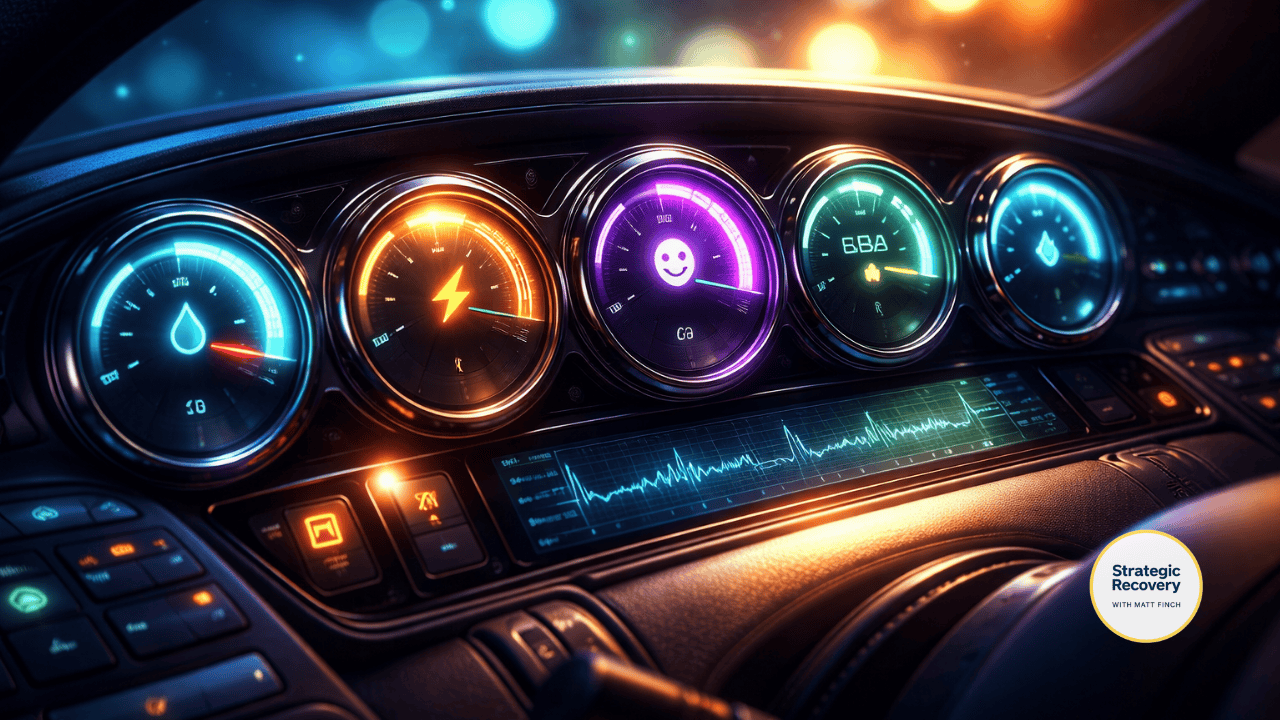
The recovery dashboard doesn’t judge you.
It simply tells the truth.
If a tank is low, the signal isn’t shame — it’s information.
Stabilize the system, and choice returns. ⚙️⛽
The 7-Day Tank Check Challenge (Printable Tracker)
A simple, stabilizing worksheet to turn “something feels off” into clear data — so you can spot patterns, name triggers, and rebuild your baseline with precision.
Episode 39 Resources
Precision links for the 5 Low Tanks model — use these to diagnose which “gauge” is low, stabilize your baseline, and widen your urge window.
- Ep. 16 — The 4 Mood Tanks The original model • dopamine/serotonin/GABA/endorphins • foundation for this upgrade
- The Blood Sugar Tank Metabolic stability • stress hormones • “metabolic anxiety” multiplier
- The Catecholamines Tank Drive chemistry • flatness/boredom • stimulation → depletion loop
- The Serotonin Tank Emotional safety • restlessness/looping • external comfort → internal suppression
- The GABA Tank Brakes & downshift • sleep/calm • “brake failure” relapse vulnerability
- The Endorphins Tank Relief buffer • rawness/pain sensitivity • “relief without escape”
- Ep. 37 — The Urge Window Impulsivity timing • state vs trait • low tanks compress the decision window
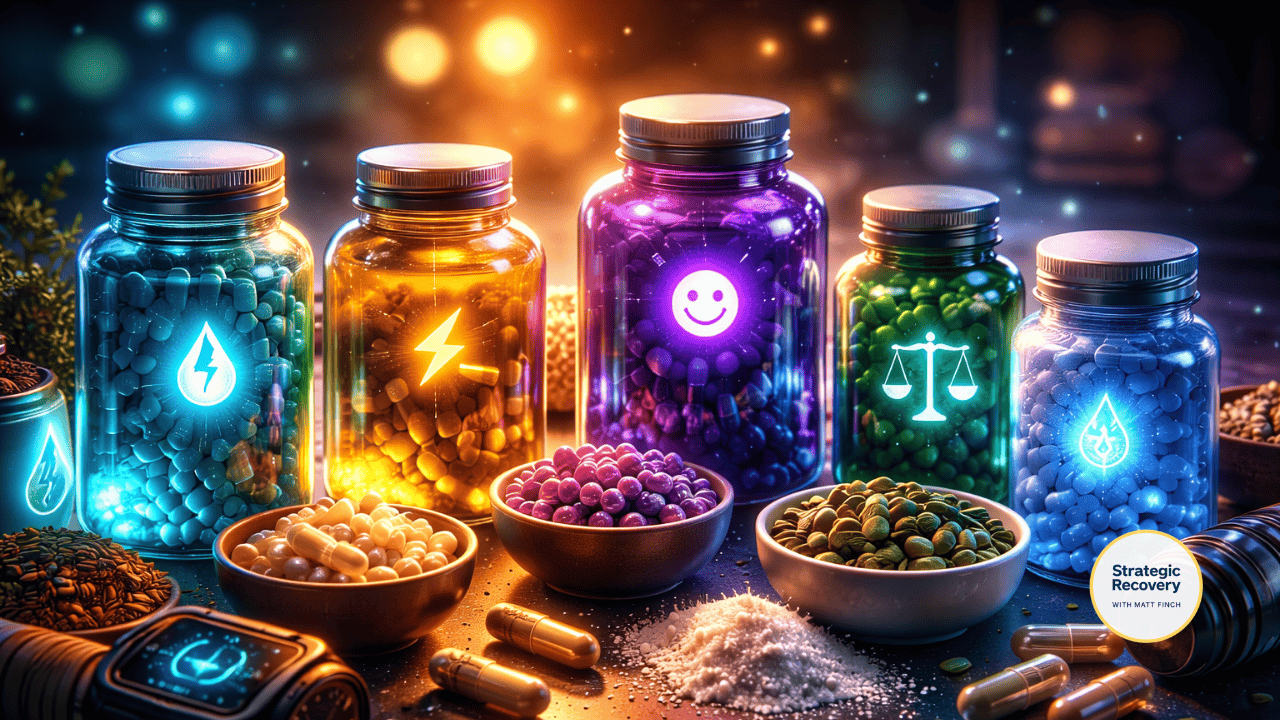
Regulation isn’t abstract. It’s biochemical. It’s measurable. It’s trainable. When your internal systems are fueled and balanced, cravings lose urgency — and stability becomes your default. ⚙️⛽
Frequently Asked Questions — ⛽ The 5 Low Tanks of Recovery
Clear, stabilizing answers to help you apply the episode in real life: why you can be sober but still feel “off,” how to read the recovery dashboard, and how to rebuild internal stability without shame.
-
What does it mean to feel “off” even though I’m in recovery?
It usually means depletion + dysregulation, not “failure.”
You can be doing many things right — and still have one or more low tanks (blood sugar stability, drive chemistry, emotional safety, braking capacity, or relief buffer).
Key reframe: if a tank is low, your craving isn’t evil — it’s a signal.
-
How is Episode 39 different from Episode 16 (The 4 Mood Tanks)?
Episode 16 explained the chemistry. Episode 39 explains the architecture.
We expand the dashboard to five tanks and treat stability as a fuel-system problem first — because blood sugar and baseline regulation can multiply (or sabotage) everything else.
Phase 2 principle: before you optimize your life, you stabilize your internal fuel system.
-
Which tank is the “multiplier” tank — and why?
Blood sugar stability.
When you’re under-fueled, stress hormones rise, impulse control drops, and urgency spikes — which can make anxiety feel “psychological” when it’s actually metabolic.
Translation: blood sugar doesn’t create pleasure — it creates safety.
-
How do I quickly identify which tank is low for me?
Use the “state–trait–trigger” diagnostic:
State: what’s true today? • Trait: what’s my baseline pattern? • Trigger: what flips me fast?
Quick matching: shaky + urgent between meals → blood sugar • flat + bored → catecholamines • uneasy + looping → serotonin • wired + can’t downshift → GABA • raw + relief-seeking → endorphins.
-
What’s the difference between low drive and “laziness”?
“Lazy” is a story. Low torque is a system state.
Low catecholamines can feel like: flatness, effortfulness, boredom, procrastination, initiation trouble — and then stimulation starts to feel like oxygen.
Stabilizing move: build rhythm and clean stimulation (light, movement, purpose) instead of emergency stimulation.
-
I’m not “sad,” but I feel unsettled and mentally sticky. Which tank is that?
That’s often a serotonin (emotional safety) deficit.
It can show up as restlessness, irritability, looping thoughts, and feeling emotionally “unsafe” in your own body — even if life looks fine on paper.
Key line: serotonin doesn’t make life exciting — it makes life livable.
-
Why do alcohol, benzos, or “numbing” habits feel so appealing when I’m wired?
Because they temporarily provide what a low GABA system can’t: braking.
Some nervous systems aren’t addicted to pleasure — they’re addicted to downshift.
The goal is to rebuild braking capacity so calm becomes available without escape.
-
What does low endorphins feel like (and why does it drive relapse)?
Low endorphins feels like rawness — pain-sensitive, emotionally thin-skinned, overwhelmed by normal life.
Endorphins don’t create euphoria. They create tolerability.
When relief is missing, the brain looks for fast relief. The move is: build relief without escape (connection, laughter, movement, rhythm, and targeted support).
-
How do low tanks compress the “urge window” (Episode 37)?
Depletion creates dysregulation — and dysregulation creates narrowing.
When you’re under-fueled, under-slept, stressed, or emotionally overloaded, time compresses and urgency rises — so the gap between activation and action shrinks.
Phase 2 takeaway: stabilize the tanks, and the urge window widens.
-
What’s the simplest starting point if I want results fast?
Start with fuel + rhythm before intensity.
Anchor breakfast, predictable meals, hydration + minerals, sleep timing, and daily light/movement. Then run the 7-day tank check to convert shame into data.
Reminder: you don’t fix addiction by becoming intense — you fix it by becoming regulated.
These FAQs are guidance, not medical advice. If you have medical conditions or take medications, consult a licensed professional. Keep what increases stability and clear choice — and remember: the dashboard doesn’t judge you. It shows you where to fuel. ⛽
🙏 Thank you for being part of the Strategic Recovery community.
👉 Click Here and Right Click to Save As to Download>>
🎧 Available on your favorite platform:




Leave a Reply