Learn how to harness the hypnotic state to calm the nervous system, retrain automatic habits, and build a resilient recovery mindset that supports lasting ✨freedom.
What if one of the most powerful tools for addiction recovery was something you already experience every single day?
🚫 Not a pill…
🛋️ Not a therapy session…
🧪 Not a complicated protocol…
🧠 But a natural state of consciousness your brain enters regularly.
You experience it when you become deeply absorbed in a movie…
When you drive for miles and suddenly realize you don’t remember the last few turns…
When your mind drifts between waking and sleep…
This state is called hypnosis.
And when used intentionally, it can become one of the most powerful tools for rewiring addictive patterns, strengthening recovery identity, reducing cravings, and restoring deep sleep.
Addiction is not only biochemical…
It is also subconscious conditioning.
Over time, the brain learns powerful associations:
These patterns become automatic.
They operate below conscious awareness.
And this is exactly where hypnosis works.
Subconscious operating system: hypnosis helps you access the level of the brain where habits, emotional reactions, and identity beliefs are formed.
🧭 In this Strategic Recovery guide, you’ll learn:

By the end of this article, you will understand how hypnosis can become a powerful ally in your recovery journey.
Let’s begin by understanding what hypnosis actually is.
🌀 What Is Hypnosis?
Hypnosis is a naturally occurring state of focused attention and increased receptivity to suggestion.
In this state, the brain becomes more open to new ideas, mental associations, and behavioral patterns.
Bridge between conscious and subconscious: hypnosis acts as the connection between the thinking mind and the deeper systems that shape habits, emotions, and beliefs.
Your conscious mind handles:
- Logic: rational thinking and mental organization
- Analysis: comparing, evaluating, and interpreting information
- Decision making: choosing actions in the present moment
- Short-term focus: holding attention on what feels immediate and intentional
Your subconscious mind controls:
- Habits: repeated patterns that run automatically
- Emotional reactions: fast feeling states triggered beneath awareness
- Conditioned behaviors: responses learned through repetition and association
- Identity beliefs: deep assumptions about who you are
- Automatic responses: default reactions that happen before conscious reflection
Addiction is largely driven by subconscious programming.
Hypnosis allows you to access this deeper level of the mind and begin installing new patterns that support recovery.
During hypnosis, people often experience:
- deep physical relaxation
- calm alertness
- vivid mental imagery
- heightened focus
- reduced internal chatter
Despite how it is portrayed in movies, hypnosis does not involve losing control. You remain aware the entire time and can stop the process whenever you want.
🧬 The Neuroscience of Hypnosis (Brainwave States Explained)
To understand why hypnosis works, it helps to understand brainwave states.
Your brain operates at different electrical frequencies depending on your level of alertness and consciousness.
These states are measured in Hertz (cycles per second). Each state corresponds to a different mode of mental functioning.
⚡ Beta: Normal Waking Consciousness
Beta brainwaves dominate when you are fully awake and thinking analytically.
Typical characteristics include:
- focused problem solving
- active thinking
- decision making
- mental chatter
Beta state: the analytical mind is strongest here, which can sometimes block new subconscious programming.
🌊 Alpha: Relaxed Awareness
Alpha brainwaves occur when the mind begins to relax.
This state appears during:
- meditation
- light relaxation
- calm focus
- daydreaming
Alpha brain state: often called the gateway to the subconscious, where the brain becomes more receptive to suggestion and new associations.
🌀 Theta: The Hypnotic Learning State
Theta brainwaves are commonly associated with:
- deep meditation
- hypnosis
- dream imagery
- early stages of sleep
Subconscious learning state: in this state, the brain becomes highly receptive to emotional processing and new subconscious associations.
Many hypnosis sessions intentionally guide the listener toward this theta state, where new ideas can be integrated more easily.
This is why hypnosis can be effective for:
- habit change
- emotional healing
- identity shifts
- trauma processing
🌙 Delta: Deep Restorative Sleep
Delta waves dominate during deep sleep.
This is when the brain performs major recovery processes such as:
- tissue repair
- hormone regulation
- immune restoration
Theta into delta: some guided sleep hypnosis recordings gently transition listeners into deeper sleep states, helping facilitate more restorative rest.
🔑 Why These States Matter for Recovery
Addiction creates strong neural pathways through repetition.
Hypnosis helps access the brain states where new pathways can be formed.
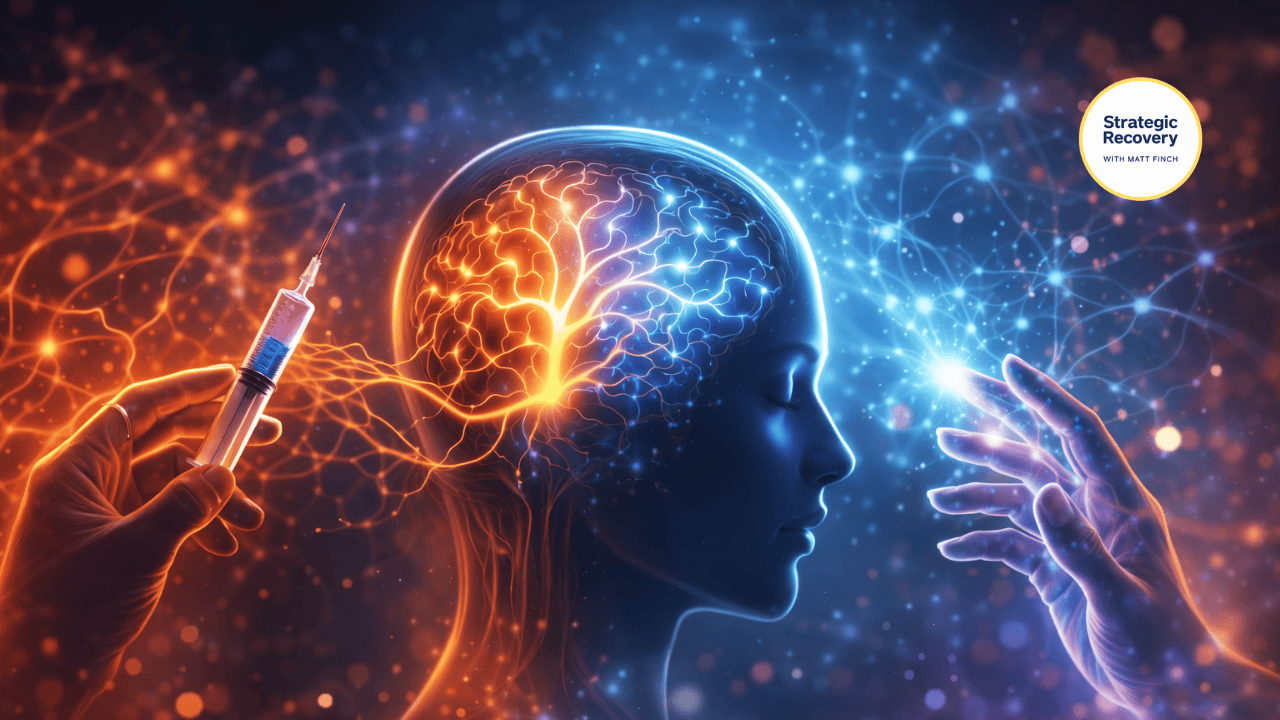
Subconscious programming: hypnosis works by updating the deeper patterns that drive behavior, rather than relying on willpower alone.
🧠🌀 Why Hypnosis Can Be Powerful for Addiction Recovery
Addiction is a learned pattern.
The brain repeatedly pairs certain triggers with certain behaviors.
Examples include:
- Stress → alcohol
- Loneliness → drugs
- Boredom → gambling
- Emotional discomfort → escape
Over time these associations become automatic.
Hypnosis helps retrain the brain by introducing new subconscious responses.
For example:
Hypnosis supports recovery in several key ways.
🔄 Rewiring Automatic Thoughts
Hypnosis allows recovery-supportive beliefs to be reinforced repeatedly, such as:
These beliefs gradually replace destructive internal narratives.
🧯 Reducing Stress and Nervous System Activation
Stress is one of the strongest relapse triggers.
Hypnosis activates the parasympathetic nervous system, helping shift the body into a state of safety and relaxation.
🪪 Strengthening Recovery Identity
Sustainable recovery requires a shift from:
“I’m trying to quit.”
“I am a person who lives free from addiction.”
Hypnosis can reinforce this identity at a deep psychological level.
😴 Improving Sleep
Sleep disruption is extremely common in early recovery.
Guided sleep hypnosis helps retrain the brain to associate bedtime with relaxation rather than anxiety or racing thoughts.
🎧 Guided Hypnosis vs Self-Hypnosis
Hypnosis can be practiced in two primary ways.
🎙️ Guided Hypnosis
Guided hypnosis involves listening to a trained voice guiding you through:
- relaxation techniques
- visualization
- positive suggestions
- recovery affirmations
Consistent repetition: guided recordings make hypnosis easier to follow and help reinforce new subconscious learning patterns over time.
🧘 Self-Hypnosis
Self-hypnosis involves guiding yourself into a hypnotic state using learned techniques.
This may include:
- slow breathing
- progressive relaxation
- mental imagery
- repeating suggestion phrases
Guided recordings: these are often easier for beginners, while self-hypnosis can become a powerful skill as experience develops.
🌙 Hypnosis for Sleep Restoration
Sleep disturbances are extremely common in addiction recovery.
Substances like alcohol, opioids, stimulants, and sedatives disrupt normal sleep architecture.
Even after quitting, people often experience:
- insomnia
- nighttime anxiety
- restless sleep
- racing thoughts
Guided sleep hypnosis helps retrain the brain through conditioning.
Over time, the brain begins associating the hypnosis recording with:
Conditioned relaxation: after repeated use, many people find that simply hearing the opening music or voice cue automatically triggers a calm state.

⚖️ Myths and Truths About Hypnosis
Hypnosis has been misunderstood for decades.
Let’s clear up some common myths.
📚 What Research Says About Hypnosis
Hypnosis has been studied for decades in areas such as:
- pain management
- anxiety reduction
- sleep improvement
- habit change
- smoking cessation
Research suggests hypnosis can be effective for behavioral change and stress reduction, particularly when used alongside other treatments.
In addiction treatment, hypnosis appears most effective as a complementary therapy, combined with:
- counseling
- cognitive behavioral therapy
- lifestyle changes
- relapse prevention strategies
Not a standalone cure: hypnosis works best when integrated with broader recovery strategies.
Recovery amplifier: when combined with nutrition, mindset work, and lifestyle change, it can strengthen the impact of other recovery practices.
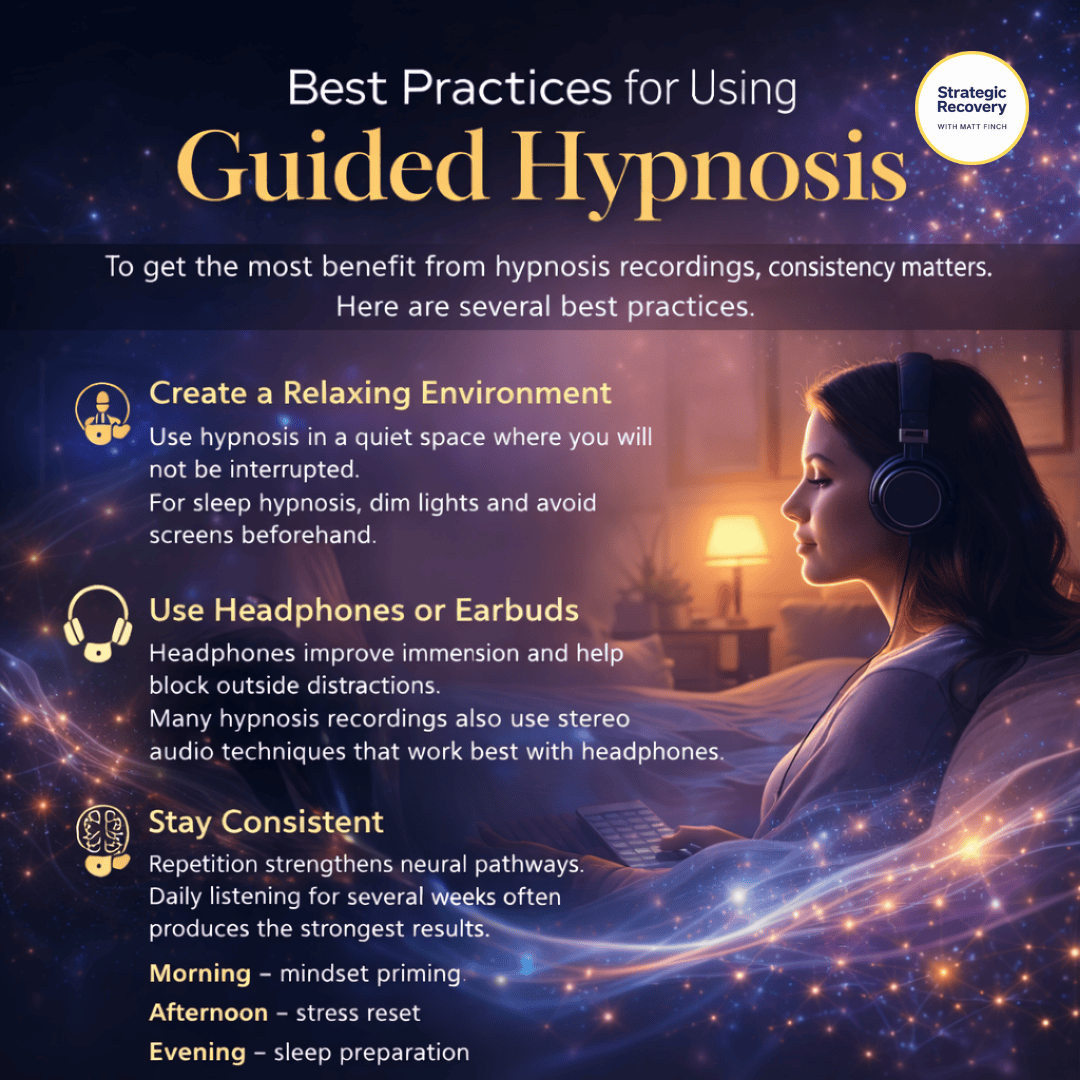
🧭 Best Practices for Using Guided Hypnosis
To get the most benefit from hypnosis recordings, consistency matters.
Here are several best practices.
🕯️ Create a Relaxing Environment
Use hypnosis in a quiet space where you will not be interrupted.
For sleep hypnosis, dim lights and avoid screens beforehand.
🎧 Use Headphones or Earbuds
Headphones improve immersion and help block outside distractions.
Many hypnosis recordings also use stereo audio techniques that work best with headphones.
📆 Stay Consistent
Repetition strengthens neural pathways.
Daily listening for several weeks often produces the strongest results.
⏱️ Use Strategic Timing
Common times include:
- Morning — mindset priming
- Afternoon — stress reset
- Evening — sleep preparation
⚠️ Are There Risks or Contraindications?
Hypnosis is generally considered safe for most people.
However, individuals with certain psychiatric conditions — particularly severe dissociative disorders or untreated psychosis — should consult a qualified professional before using hypnosis.
Emotional release: some people may experience temporary emotional processing as subconscious material surfaces, which is usually brief and often part of the healing process.
🧩 Strategic Recovery™ Stacks for Hypnosis
One of the most powerful ways to use hypnosis is to combine it with complementary practices.
This creates a multi-layered recovery ritual.
🌙 Evening Recovery Stack
- Dragon Balm Tea
- Light journaling
- Guided sleep hypnosis
- Gratitude reflection
Sleep preparation: this signals to the nervous system that the day is complete and prepares the body for restorative sleep.
🌅 Morning Identity Activation Stack
- sunlight exposure
- guided mindset hypnosis
- positive affirmations
- light movement
Motivation priming: this helps prepare the brain for stronger motivation and greater emotional stability.
🧯 Craving Reset Stack
Dual craving drivers: this approach addresses both the biochemical and psychological forces that fuel cravings.
🔎 What to Look for in a Hypnosis Audio Program
Not all hypnosis recordings are created equal.
When choosing a program, look for:
- a calm, clear voice
- structured relaxation induction
- positive suggestion language
- identity reinforcement themes
- recordings designed for repeated listening
Session length: most hypnosis sessions typically range from about 5–30 minutes depending on the purpose.
✨ Final Thoughts: Reprogramming the Mind for Freedom
Addiction recovery is not just about removing a substance.
It is about rewiring the brain and nervous system.
Hypnosis provides a unique way to access the deeper layers of the mind where habits, emotional reactions, and identity beliefs are formed.
Through repetition and intention, hypnosis can help retrain those patterns toward clarity, stability, and resilience.
Over time, the old voice of addiction becomes quieter.
And a new voice grows stronger.
One that says:

And that voice becomes the one that guides your future.



Leave a Reply