PAWS Is Not a Disorder 🚫. It’s a Neurobiological Healing Process 🧠. Here’s How to Move Through It Faster, Smarter, and Stronger Than Ever Before 🚀.
Nothing is “wrong” with you.
Your brain and nervous system are recalibrating after prolonged stress and overstimulation…
And that process can be supported—intelligently and compassionately.
🧭 How to Use This Guide
(Feel free to skip this section if you don’t need it)
Use this page based on your customized unique needs.
🎯 Let it guide you — and provide clarity plus real strategies for healing.
How to Use This Guide
(Please read this first if you’re in PAWS)
You don’t need to read this all at once. Use it like a course — or jump to what you need.
Start with the core definitions and the “why” behind symptoms. Keep it simple, stabilizing, and low-pressure.
Go straight to the timeline, nervous system, and “what to do next.” This reduces suffering fast.
Read from top to bottom, slowly. Treat it like training — not a blog post.
- Read top → bottom
- Go slow
- Take notes
- Implement weekly
These sections help you understand symptoms, reduce blame, and build the right support environment.

📖 Table of Contents
Use this clickable table of contents to automatically scroll to your desired section.
This way, you can customize your PAWS learning journey with ease. ⤵️
Table of Contents
Jump to any section instantly.
Pro tip: if you’re in PAWS, use this like a course — small wins, steady inputs.
🧠 I. Introduction — The Hidden Stage That Makes or Breaks Recovery
For most people, detox is not the hardest part of recovery.
Yes—acute withdrawal can be brutal.
It can be uncomfortable, frightening, and physically intense.
But it usually has a beginning, a middle, and an end. You brace yourself, you endure it, and eventually the worst of it passes.
Then comes the part no one prepared you for.
Weeks after quitting—sometimes right when you think you should be getting better—something shifts.
Your mood drops.
Your energy decreases.
Sleep becomes irregular.
Motivation declines.
Pleasure feels muted or absent.
Anxiety increases without warning.
Thoughts become foggy, heavy, or hopeless.
❓ And you start questioning everything.
You might hear yourself thinking:
- “What’s wrong with me?”
- “Why do I feel worse now than I did at first?”
- “Maybe recovery isn’t actually working.”
- “Maybe I need alcohol or drugs just to function.”
This phase has a name.
Post-Acute Withdrawal Syndrome (PAWS).
And it is the most misunderstood…
under-explained…
and relapse-driving stage of recovery.
This phase has a name: Post-Acute Withdrawal Syndrome (PAWS).
It’s not failure — it’s a neurological recalibration.
💥 Why PAWS Breaks So Many Recoveries
People don’t usually relapse during PAWS because they want to.
They relapse because:
- Their brain and nervous system are still healing
- Their reward system is temporarily offline
- Their stress system is unstable
- And no one ever taught them what that healing actually feels like
❓ Without context, PAWS feels like failure.
🧱 Without education, it feels permanent.
🫂 Without support, it feels unbearable.
🧠 PAWS is where people abandon recovery—not out of weakness, but out of misinterpretation.
🔁 The Most Important Reframe in This Entire Guide
Read this slowly:
If you feel worse after quitting, it does not mean recovery failed.
It means healing has begun.
PAWS is not a sign that something is wrong with you.
It is a sign that your system is recalibrating after prolonged overload.
🧠 Your brain is relearning how to regulate without chemical overrides.
🛡️ Your nervous system is relearning safety.
🔋 Your body is restoring depleted resources.
🧩 Your psyche is reorganizing after years of artificial relief.
That process is uncomfortable—but it is meaningful.
🧭 Why This Guide Exists
When PAWS is misunderstood, people relapse unnecessarily.
When it’s understood correctly, something powerful happens:
Clarity changes the entire nervous system response.
- Fear drops
- Self-blame fades
- Panic turns into strategy
- Recovery becomes cooperative instead of combative
This guide exists to show you:
A clear, reality-based map for understanding PAWS — and supporting recovery without forcing it.
- What PAWS actually is
- Why it feels the way it does
- Which systems are healing — and when
- How to support those systems in the right order
- How to shorten the timeline without forcing the process
PAWS does not have to last as long.
It does not have to feel as intense.
And it does not have to end in relapse.
When biology, nervous system regulation, psychology, environment, and meaning are supported in the correct sequence, PAWS becomes manageable, intelligible, and temporary ❤️🩹.
🛠️ That’s exactly what this guide is here to help you do.

🛡️ II. Important Disclaimer (Please Read — This is Empowering, Not Scary)
🤍 This guide is for educational and informational purposes only.
It is not medical advice, diagnosis, or treatment.
📌 That said, let’s be very clear about something important:
Strategic Recovery™ = Informed Self-Advocacy
🔬 Pro-science • 🤝 Pro-support • 🧠 Pro-you understanding your biology
Understanding your system isn’t “anti-medicine.”
It’s how you make cleaner, wiser decisions ✨
Understanding your biology is not anti-medicine. ✅
Asking better questions is not rejecting help. 🧭
Wanting to repair your brain before medicating symptoms is not irresponsible. 🧬
- Learning how addiction actually affects the brain and nervous system 🧠
- Understanding why symptoms occur instead of blindly suppressing them 🔍
- Collaborating with qualified professionals from a place of knowledge, not fear 🤝
This guide does not tell you what you “should” or “shouldn’t” take. It gives you frameworks, principles, and options so you can make clear, grounded, individualized decisions—ideally with professional support.
Healing is not dogmatic. 🌿
Healing is strategic, personalized, and adaptive. ⚡
🧩 III. What is Post-Acute Withdrawal Syndrome (PAWS)?
To understand PAWS clearly—and without fear—we need to strip the term down to its essentials.
In the section below…
🥜 You’ll discover what PAWS is in a nutshell.
Breaking the Term Down Simply
Fast clarity — built for brain fog 🧠
If your mind feels overloaded, start here.
Understanding reduces fear — fast 🧭
-
Post= After
-
Acute= Severe or intense
-
Withdrawal= Stopping a substance or behavior
-
Syndrome= A cluster or pattern of symptoms
Put together, Post-Acute Withdrawal Syndrome refers to:
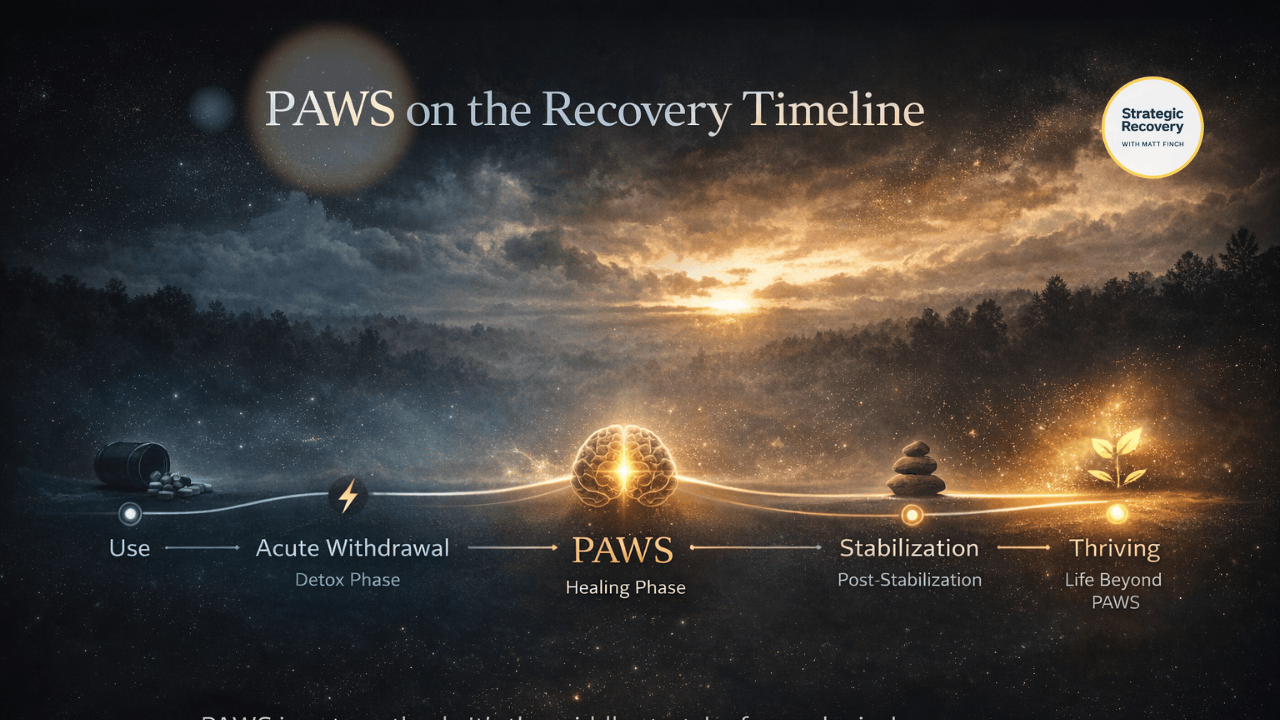
💡 The Classic Definition (And Why It Was a Breakthrough)
In 2012, I learned about PAWS from a book on relapse prevention written by Terence Gorski, as it was one of the suggested readings for drug and alcohol counseling.
It was the first time I started to somewhat understand the phenomenon.
Here is the definition and description of PAWS he gave.
Post-acute withdrawal is a group of symptoms of addictive disease that occur as a result of abstinence from addictive chemicals.
In the alcoholic/addict these symptoms appear seven to fourteen days into abstinence, after stabilization from the acute withdrawal.
Post-acute withdrawal is a bio-psycho-social syndrome.
It results from a combination of damage to the nervous system caused by alcohol or drugs, and the psychosocial stress of coping with life without drugs or alcohol.
This definition was revolutionary for its time.
It acknowledged something critical that many recovery models ignored:
People weren’t relapsing because they were weak 🚫💪.
They were relapsing because their nervous systems were injured and overwhelmed 🧠⚡.
However, decades later, we now know something more.
⬆️ The Strategic Recovery™ Upgrade: A More Complete Model of PAWS
The traditional bio-psycho-social model is helpful—but incomplete.
🧩 PAWS is a multi-system recalibration — not a thought problem
From a Strategic Recovery™ perspective, PAWS is better understood as a temporary, multi-system recalibration process.
It involves the brain, nervous system, hormones, metabolism, psychology, environment, and meaning system — all responding after prolonged dopamine and stress-system dysregulation.
In other words, PAWS is not just happening in your thoughts.
It is happening in your systems.
This is why trying to “think your way through PAWS” almost always fails.
And this is why Strategic Recovery™ views PAWS not as a disorder to suppress…
🛠️ But as a healing phase to support intelligently.
📌 The Most Important Truth About PAWS (Bookmark This)
PAWS symptoms are not random 🎲🚫.
They are signals 📡.
The Most Important Truth About PAWS
Bookmark this — it prevents fear spirals fast 🧭
Symptoms aren’t proof you’re failing.
They’re signals your system is healing.
And that’s exactly where we’re headed next.

🌌 IV. The PAWS Symptom Constellation
(Why It Feels So Confusing, Unpredictable, and Overwhelming)
One of the hardest parts of Post-Acute Withdrawal Syndrome isn’t just the symptoms.
🌫️ It’s the confusion.
PAWS rarely shows up as a single, clear issue.
Instead, it appears as…
🌊 A shifting constellation of mental, emotional, physical, and neurological symptoms that come and go in waves.
One day you feel almost normal.
The next, you feel anxious, flat, exhausted, or disconnected.
Then a few hours later, it shifts again.
This unpredictability leads many people to ask:
When symptoms shift day to day, the mind looks for a clear explanation.
- “Why is this happening?”
- “Why do my symptoms keep changing?”
- “Why can’t I clearly explain what feels wrong?”
Here’s the relieving truth:
PAWS symptoms are not random.
They are layered signals from multiple systems healing at the same time.
When several core systems are recalibrating simultaneously, symptoms don’t arrive neatly. They overlap, fluctuate, and change form — not because something is wrong, but because healing is happening on multiple levels at once.
🔍 Let’s clarify what those patterns look like.
A. Cognitive Symptoms 🧠🌫️
(When Your Mind Feels Slower or Less Reliable)
Many people in PAWS feel like their mind has “lost its edge.”
🧠🌫️ Common cognitive symptoms include:
- Brain fog or mental cloudiness
- Difficulty concentrating or organizing thoughts
- Poor short-term memory
- Trouble finding words
- Feeling mentally overwhelmed by simple tasks
This can be especially distressing for people who once relied heavily on their intellect — professionals, students, creatives, and high-functioning individuals.
What matters most to understand is this:
Your intelligence hasn’t disappeared 🧠.
Your brain is temporarily redirecting resources toward repair 🔄.
During PAWS, the brain prioritizes stabilization over performance. Cognitive sharpness typically returns as neurotransmitters, sleep, and nervous system regulation normalize ⚖️.
Trying to push through brain fog often backfires ⚠️.
Supporting the biology underneath it works far better 🌿.
B. Emotional & Mood Symptoms 💔🌊
(When Feelings Feel Too Intense — or Absent)
PAWS often alters emotional experience in contradictory ways.
Some people feel everything more intensely.
Others feel almost nothing at all.
💔🌊 Common emotional symptoms include:
- Anxiety or internal restlessness
- Low mood or hopelessness
- Irritability or emotional overreactions
- Emotional numbness or flatness
- Sudden mood swings
- Reduced stress tolerance
These are not character flaws or failures of coping.
They reflect temporary changes in:
- Dopamine signaling
- Serotonin balance
- GABA activity
- Stress hormone regulation
In simple terms, your emotional “volume knob” is being recalibrated 🎚️.
Until it stabilizes, emotions may feel too loud, too dull, or wildly inconsistent.
This phase is not permanent.
It is transitional.
C. Physical & Neurological Symptoms ⚡🧠
(When the Body Feels “Off”)
PAWS is not just psychological.
It shows up clearly in the body.
⚡🧠 Common physical and neurological symptoms include:
- Persistent fatigue
- Muscle tension or weakness
- Head pressure or headaches
- Sensitivity to light or sound
- Increased pain sensitivity
- Temperature dysregulation
- Poor coordination
These symptoms reflect shifts in:
- Nervous system tone
- Energy production
- Inflammatory signaling
- Electrolyte balance
Many people worry something new is “wrong” with them.
In reality, the body is temporarily more reactive as stress and regulation systems recalibrate.
D. Sleep, Energy, and GI Dysregulation 🌙🔋
(The Hidden Amplifiers)
Sleep disruption is one of the most underestimated drivers of PAWS distress.
It can often prolong healing more than anything.
🌙🔋 Common issues include:
- Trouble falling or staying asleep
- Vivid or disturbing dreams
- Non-restorative sleep
- Daytime exhaustion
At the same time, many experience:
- Digestive discomfort or bloating
- Appetite changes or sugar cravings
- Blood sugar instability
These systems are tightly connected.
Poor sleep worsens anxiety, mood, cognition, and cravings.
GI dysfunction worsens neurotransmitter production and nervous system regulation.
This is why Strategic Recovery™ prioritizes sleep, nutrition, and circadian rhythm early.
They are not secondary issues.
They are core drivers of recovery.
E. Cravings, Drug Dreams, and Memory Loops 🔁🧠
(Why the Past Feels Close)
Cravings and substance-related dreams can feel surprisingly vivid during PAWS — sometimes even more than during early abstinence.
🔁🧠 Common experiences include:
- Sudden cravings
- Emotional longing for relief
- Vivid drug or alcohol dreams
- Nostalgic or distorted memories of use
This does not mean you want to relapse.
It means:
- Dopamine pathways are under-stimulated
- Memory circuits tied to relief are reactivating
- The brain is searching for familiar regulation
Cravings during PAWS are signals, not commands.
They reflect a system seeking balance — not a lack of commitment.
F. The Core Driver Beneath It All: Anhedonia 🌫️⚪
(“Pleasure Deafness”)
Of all PAWS symptoms, anhedonia — the inability to feel pleasure — is often the most destabilizing.
🌫️⚪ People describe anhedonia as:
- Emotional flatness
- Loss of interest in previously enjoyable activities
- Disconnection from motivation or meaning
- A gray, muted emotional world
This symptom alone drives many early relapses.
Why?
Because humans are not wired to endure prolonged pleasure deprivation.
Anhedonia occurs because dopamine receptors are temporarily downregulated and need time — and proper inputs — to regain sensitivity.
This is not a permanent loss of joy.
It is a retraining period.
When supported correctly — through nutrition, nervous system regulation, sunlight, movement, and meaning — pleasure doesn’t just return.
For many people, it returns cleaner, steadier, and more resilient than before.
🧠 Why PAWS Is So Hard to Explain
💡 This section will help clear up why post-acute withdrawal syndrome is so difficult to articulate.
As your knowledge goes up…
Fear goes down.
Understanding PAWS
The clarity shift that dissolves fear
When the nervous system is healing, the mind often tries to “story” it.
We’re replacing story with strategy.
PAWS feels confusing because you’re trying to interpret biological healing using psychological language.
Not a thought problem.
Not a motivation problem.
Not a character problem.
It’s a system-wide recalibration process.
And once you understand what these symptoms actually represent, something powerful happens:
Fear drops. Self-blame fades. Recovery becomes strategic instead of reactive.
And that’s exactly what we build next.
⏳ V. The PAWS Timeline
(What’s Normal, What’s Not, and Why It Rarely Moves in a Straight Line)
One of the most destabilizing parts of PAWS is not knowing how long it will last.
This can increase confusion, doubt, fear, and take the mind to some wild places.
When people aren’t given a realistic timeline, the mind fills the gap with fear:
- “This is never going to end.”
- “I should be better by now.”
- “Something must be permanently wrong with me.”
Those conclusions aren’t accurate — but they can feel accurate when dopamine is low, hope feels muted, and your system is still healing.
💡 So let’s bring clarity.
🌫️ Why PAWS Timelines Are Hard to Predict
PAWS doesn’t follow a clean, linear recovery curve because:
- Multiple systems are healing at the same time
- Different systems heal at different speeds
- Stress, sleep, nutrition, and environment can amplify or reduce symptoms from day to day
That’s why PAWS typically unfolds in waves, not straight lines.
You might feel better for several days… then worse again… then better in a different way.
That’s not regression.
It’s another layer recalibrating.
🚦 When PAWS Typically Begins
For many people, PAWS starts:
- 7–21 days after stopping alcohol, drugs, or addictive behaviors
- After acute withdrawal stabilizes
- Right when external support often decreases
This timing is confusing because people expect steady improvement once detox is over.
Instead, they may experience:
- A delayed emotional crash
- Rising anxiety or flatness
- Cognitive fog or fatigue
This isn’t “recovery failing.”
It’s the nervous system shifting from emergency mode into repair mode 🚨➡️🛠️.
🌱 The Early PAWS Window (Weeks 2–6)
This is often the most relapse-prone period — not because people want to use, but because they weren’t trained for this phase.
Common features include:
- Emotional volatility
- Anxiety or depression
- Sleep disruption
- Brain fog
- Strong cravings or drug dreams
🔑 Key truth:
Early PAWS is intense because the brain is rebalancing neurotransmitters without chemical assistance for the first time.
This is where education + biochemical support can reduce suffering dramatically.
🔄 The Middle PAWS Phase (Months 2–6)
This stage is usually less intense — but more mentally frustrating.
You may notice:
- Fewer extreme symptoms
- Ongoing low motivation or muted pleasure
- Fatigue that comes and goes
- Emotional flatness
- Increased stress sensitivity
Many people describe it like this:
- “I’m not miserable anymore… but I’m not myself yet.”
That’s a real phase — and it’s easy to misread.
Because this is when progress is often subtle, not dramatic:
- Dopamine receptors are rebuilding
- Nervous system regulation improves
- Stress tolerance slowly returns
You may not feel the gains day-to-day — but they’re accumulating.
🪫 The Late PAWS Phase (6–24 Months, If Unsupported)
Without strategic intervention, some people experience lingering symptoms for a year or more, such as:
- Persistent anhedonia
- Periodic anxiety or low mood
- Reduced resilience under stress
🔁 Important reframe:
Long PAWS is not inevitable 🚫.
It’s usually a sign that key inputs are still missing 🧩.
When nutrition, nervous system regulation, sleep, environment, and dopamine retraining are addressed, this phase often shortens dramatically ⚙️.
⚡ The Fastest PAWS Timeline (With Strategic Support)
With intentional, holistic intervention, many people experience:
Hopeful, reality-based timelines
- Noticeable relief within days to weeks
- Major improvement within 1–3 months
- Emotional stability and pleasure returning steadily over 3–6 months
This doesn’t mean PAWS vanishes overnight.
It means the process becomes workable — and the nervous system stops feeling like an emergency.
It means:
- Symptoms become manageable
- Hope returns
- Momentum builds
- Recovery becomes self-reinforcing instead of exhausting
🧱 When PAWS Lasts the Longest (And Why)
In rarer cases, PAWS symptoms can linger for years.
When that happens, it’s usually tied to:
These are the most common “bottlenecks” that keep PAWS louder or longer than it needs to be.
- Chronic stress or unresolved nervous system dysregulation
- Poor nutrition or ongoing deficiencies
- Sleep deprivation (or unaddressed sleep fragmentation)
- Lack of dopamine retraining (no replacement sources of reward)
- Continuous overstimulation (scrolling, caffeine, chaos, constant “input”)
- Repeated relapse–abstinence cycles that re-trigger dysregulation
This isn’t a life sentence.
It’s information.
It means the conditions need to change — not that you’re defective.
🔄 The Timeline Reframe That Changes Everything
Here’s the shift that protects recovery:
PAWS does not heal on a clock — it heals in response to conditions.
The better the conditions — nutritional, neurological, psychological, environmental, spiritual — the faster the system stabilizes.
🕰️ Why PAWS Feels Longer Than It Is
During PAWS:
- Dopamine is low (reward feels muted, effort feels heavier)
- Time perception warps (days feel long, progress feels invisible)
- Hope circuits feel muted (the future looks “flat” even when you’re healing)
So due to the reasons I mentioned above — weeks can feel like months.
But… as dopamine and nervous system regulation improve, time perception normalizes — and people are often shocked by how far they’ve already come.
🎯 What This Means for You (Right Now)
This is where you frame your role within PAWS healing.
🌬️ Take a deep breath first — you’ve already covered a lot of ground.
WHAT THIS MEANS FOR YOU
A quick anchor for the moment you’re in.
If you’re in PAWS, your job isn’t to “figure yourself out.”
It’s to support the system.
- You are not late.
- You are not defective.
- You are not failing.

⚖️ VI. PAWS vs. Relapse
(The Most Dangerous Confusion in Recovery—and How to Avoid It Completely)
One of the biggest reasons people relapse has nothing to do with weakness or lack of commitment.
It comes down to misinterpretation.
People mistake PAWS for relapse.
Or worse — they mistake PAWS for proof that sobriety “isn’t working.”
That misunderstanding has quietly undone more recoveries than cravings ever could.
Let’s remove it.
🎭 Why PAWS Can Feel Like Relapse
From the inside, PAWS can feel eerily similar to the emotional state that once drove using.
During PAWS, you may experience:
- Anxiety that feels like pre-use anxiety
- Depression that feels deeper than expected
- Brain fog that mimics withdrawal or intoxication
- Numbness that whispers, “I need something to feel normal”
- Cravings that arrive suddenly and convincingly
When those sensations hit, the brain does what it’s wired to do:
It looks for a cause.
And it looks for a solution.
And because your nervous system learned for years that substances brought relief, the mind can draw a faulty conclusion:
“I felt better when I was using… maybe that was my baseline.”
That’s not insight.
That’s dopamine deprivation talking.
🧠 The Core Truth (read this twice)
PAWS symptoms are evidence of healing — not evidence of failure.
Relapse is a behavioral return to alcohol/drugs/compulsions.
PAWS is a biological recovery process unfolding because you stopped.
They can feel similar emotionally.
But they are not the same process.
⚠️ What Relapse Actually is
Relapse involves:
- Resuming alcohol, drugs, or addictive behaviors
- Re-engaging dopamine-hijacking pathways
- Reinforcing old neural circuits
- Interrupting neurological repair
Relapse restarts the injury cycle.
PAWS, by contrast, exists only in recovery.
PAWS means:
- Dopamine receptors are rebuilding
- Stress systems are recalibrating
- The nervous system is relearning baseline regulation
PAWS doesn’t mean you’re back at zero 🚫.
It means…
You’re in the middle of repair 🔧.
PAWS = Repair.
Stay in repair mode.
🧠🌀 Why the Brain “Lies” During PAWS
During PAWS, the mind often runs under three predictable distortions.
The first… is a distorted sense of reward.
1. Reward Distortion 🧠⚡
PAWS Distorts “REWARDS”
Low dopamine makes the present feel empty — and the past feel falsely golden.
- relief
- comfort
- numbness
And conveniently forgets:
- consequences
- escalation
- loss of control
- the crash
2. Time Distortion ⏳🌀
PAWS Distorts “TIME”
Days feel endless.
Weeks feel unbearable.
3. Identity Distortion 🪞🧬
PAWS Distorts “IDENTITY”
- “Maybe I’m just an addict forever.”
- “Maybe this is who I am without substances.”
💭 The Most Common Relapse Thought (decoded)
“I can’t live like this.”
What it usually means is:
- My nervous system is dysregulated.
- My dopamine is low.
- My brain hasn’t finished recalibrating.
It does not mean:
- I need alcohol or drugs.
- Sobriety doesn’t work.
- I failed.
Many relapses at this stage aren’t a choice for pleasure.
They’re an attempt to escape PAWS — without understanding what PAWS is.
🪤 Why Relapse Temporarily “Works” (and why it’s a trap)
Using during PAWS can create brief relief — but the cost is predictable.
The nervous system may feel “better” for a moment because it’s being overridden — not because it’s healed.
Why it can feel like relief
- dopamine spikes artificially
- stress signals get numbed
- the nervous system gets overridden
The predictable cost
- re-injure dopamine pathways
- extend PAWS timelines
- deepen nervous system instability
- make the next attempt harder
…when it actually reset the healing clock.
🧭 The Strategic Recovery™ Reframe
Here’s the distinction that protects recovery:
If symptoms appear after quitting, they’re part of recovery.
If symptoms appear because you resumed using, that’s relapse.
PAWS symptoms say:
“Stay the course — support the system.”
Relapse symptoms say:
“The system has been re-injured.”
One requires support and patience 🫂.
The other requires course correction 🧭.
Two different processes. Two different responses.
🛡️ How to Respond When PAWS Feels Like Relapse
PAWS Relapse Prevention Decision Matrix Tool
“Should I go back to using?”
“Which system is asking for support right now?”
Then respond strategically:
- Low mood→dopamine rebuilding inputs
- Anxiety→nervous system regulation
- Fatigue→nutrition, sleep, minerals
- Cravings→stabilize blood sugar, reduce stress load
⚖️ The Final Distinction That Changes Everything
Relapse reinforces addiction.
PAWS prepares you for freedom.
When you confuse the two, you interrupt healing.
When you understand the difference, healing accelerates.
And that understanding alone has saved countless people from relapsing unnecessarily.
🌍 VII. Why PAWS is Harder Today Than Ever Before
(The Dystopian Shift No One Is Talking About)
If you’ve ever wondered why recovery feels harder now than it seems to have been decades ago, you’re not imagining it.
PAWS is objectively more difficult today for most people — not because humans have changed, but because the environment has.
Strategic Recovery™ calls this the Dystopian Shift:
a convergence of modern conditions that place unprecedented strain on the brain, nervous system, and reward circuitry — especially during recovery.
Understanding this matters deeply.
Because without this context, people turn the difficulty inward.
They think:
- “I should be stronger than this.”
- “Other people recovered — why can’t I?”
- “Maybe I’m just defective.”
Here’s the relieving truth:
You are trying to heal a nervous system in an environment that actively works against regulation.
🏋️ Recovery Didn’t Get Harder Because You Got Weaker
A generation or two ago, people in recovery unintentionally benefited from conditions that supported healing:
Then: the environment helped regulation
- Less constant stimulation
- Fewer ultra-processed foods
- More natural movement
- More daylight exposure
- Slower pace of life
- Less dopamine hijacking
Now: most people enter PAWS in a world that is
- Chronically overstimulating
- Nutrient-depleted
- Sleep-disrupting
- Stress-saturated
- Dopamine-overloaded
This matters because PAWS is fundamentally a regulation problem — and modern life is profoundly dysregulating.
Strategic Recovery™ is about rebuilding regulation on purpose.

Recovery didn’t get harder because people got weaker —
it got harder because the environment stopped supporting regulation.
1. The Ultra-Processed Food (UPF) Environment 🥗
1. The Ultra-Processed Food Environment
Modern diets are radically different from those of even 40–50 years ago. Highly processed foods tend to:
- Deplete micronutrients needed for neurotransmitter repair
- Destabilize blood sugar (fueling anxiety, fatigue, and cravings)
- Increase inflammation that worsens brain fog and low mood
- Impair gut health, where many neurotransmitters are produced
2. Chronic Stress as the Default Setting ⚡
2. Chronic Stress as the Default Setting
PAWS unfolds on top of an already overloaded stress system. Modern life includes:
- Constant notifications
- Financial pressure
- Information overload
- Social comparison
- Cultural and political instability
But PAWS requires safety, predictability, and rest to resolve.
When stress remains high, symptoms linger — not because recovery failed, but because the nervous system never receives the signal that it’s safe to complete repair.
3. Blue Light, Screens, an Sleep Disruption 🌙
3. Blue Light, Screens, and Sleep Disruption
Sleep is one of the most powerful healers of PAWS.
Yet modern environments actively undermine it through:
- Anxiety
- Depression
- Cognitive fog
- Cravings
- Emotional instability
4. Dopamine Overload Everywhere You Look ⚡
4. Dopamine Overload Everywhere You Look
Perhaps the biggest shift of all:
We now live inside a constant dopamine delivery system.
• Too little dopamine internally
• Too much artificial stimulation externally
- Worsened anhedonia
- Increased cravings
- Slower reward-system repair
5. Loss of Natural Regulation Inputs 🌿
5. Loss of Natural Regulation Inputs
Many of the simplest, most powerful regulators of the nervous system have quietly disappeared from daily life:

It unfolds inside a modern environment that quietly undermines regulation at every level.
🔎 Why This Matters for You
If PAWS feels especially hard right now, it does not mean:
- You’re weaker
- You lack discipline
- You’re failing at recovery
It means:
- You’re healing in a dysregulating environment
- You need better conditions, not more willpower
That realization alone often brings immense relief.
Because once you stop blaming yourself, you can start engineering an environment that supports healing 🏗️.
🚀 The Strategic Recovery™ Advantage
Strategic Recovery™ was built for this era.
It does not assume:
It does not assume:
- A calm world
- Perfect nutrition
- Built-in community
- Low stress
Instead, it teaches you how to:
- Reduce stimulation intelligently
- Restore regulation intentionally
- Feed depleted systems strategically
- Rebuild joy without relapse
PAWS doesn’t just require abstinence.
It requires counter-cultural healing in a culture that profits from dysregulation.
🔑 The Key Takeaway
Here’s the reframe that changes everything:
If recovery feels harder today, it’s because the world has changed — not because you are failing.
Once you account for the Dystopian Shift, PAWS stops feeling mysterious.
And healing stops feeling impossible.

🧭 VIII. Why 12-Step & Mainstream Rehab Miss PAWS
(And Why So Many People Feel Like They’re “Doing Everything Right” but Still Struggling)
Many people enter recovery believing that if they:
- Follow the program
- Attend meetings
- Stay abstinent
- “Do the work”
…their symptoms will naturally resolve.
So when PAWS appears—and lingers—they often draw painful conclusions:
- “I’m not working the program hard enough.”
- “I must be spiritually broken.”
- “There’s something uniquely wrong with me.”
None of these are true.
The real issue is simpler—and far more relieving:
🧠 Most mainstream recovery models were never designed to address PAWS at the biological and nervous-system level.
That doesn’t make those models useless.
It makes them incomplete 🧩.
🧩 What 12-Step Programs Do Well (And Where PAWS Falls Through the Cracks)
Let’s be clear and fair.
12-Step programs offer powerful benefits:
These are invaluable—especially for breaking isolation and preventing early relapse.
But PAWS exposes a critical gap.
12-Step programs offer powerful benefits:
- Community and belonging
- Structure and accountability
- Meaning, humility, and spiritual orientation
- A framework for honesty and responsibility
Traditional programs are not designed to repair:
- Dopamine depletion
- Neurotransmitter imbalance
- Nervous system dysregulation
- Sleep architecture disruption
- Nutrient deficiencies
- Stress-hormone imbalance
🪫 Why Willpower, Insight, and Motivation Don’t Resolve PAWS
PAWS is not:
- A motivation problem
- A lack-of-insight problem
- A moral or spiritual deficiency
PAWS is a systems-level recovery problem.
You cannot:
- Think your way out of low dopamine
- Affirm your way out of nervous-system hyperarousal
- Meditate your way out of severe nutrient depletion
Insight helps after regulation begins—not before.
This is why so many intelligent, committed, spiritually sincere people feel confused and discouraged during PAWS.
They’re using the right tools—but on the wrong layer.
🏚️ Where the Mainstream Rehab Model Breaks Down
The $50 billion profit-driven rehab industry uses a cookie-cutter template.
The template, sadly, still doesn’t include healing the chronic brain physiology dysfunction caused by addiction.
Most residential rehab programs follow a familiar structure
These components can be helpful — but they often address behavior and coping without fully addressing post-detox brain repair.
What’s included
- Acute detox
- Group therapy
- Psychoeducation
- Meetings
- Medication management
- Highly processed institutional food
What’s often missing
- Targeted nutritional repair
- Amino-acid or neurotransmitter support
- Nervous-system regulation training
- Circadian rhythm restoration
- A coherent plan for post-detox brain repair
This can:
- Mask true recovery needs
- Delay natural reward-system healing
- Create additional withdrawal layers later
The issue is sequence — not medication itself.
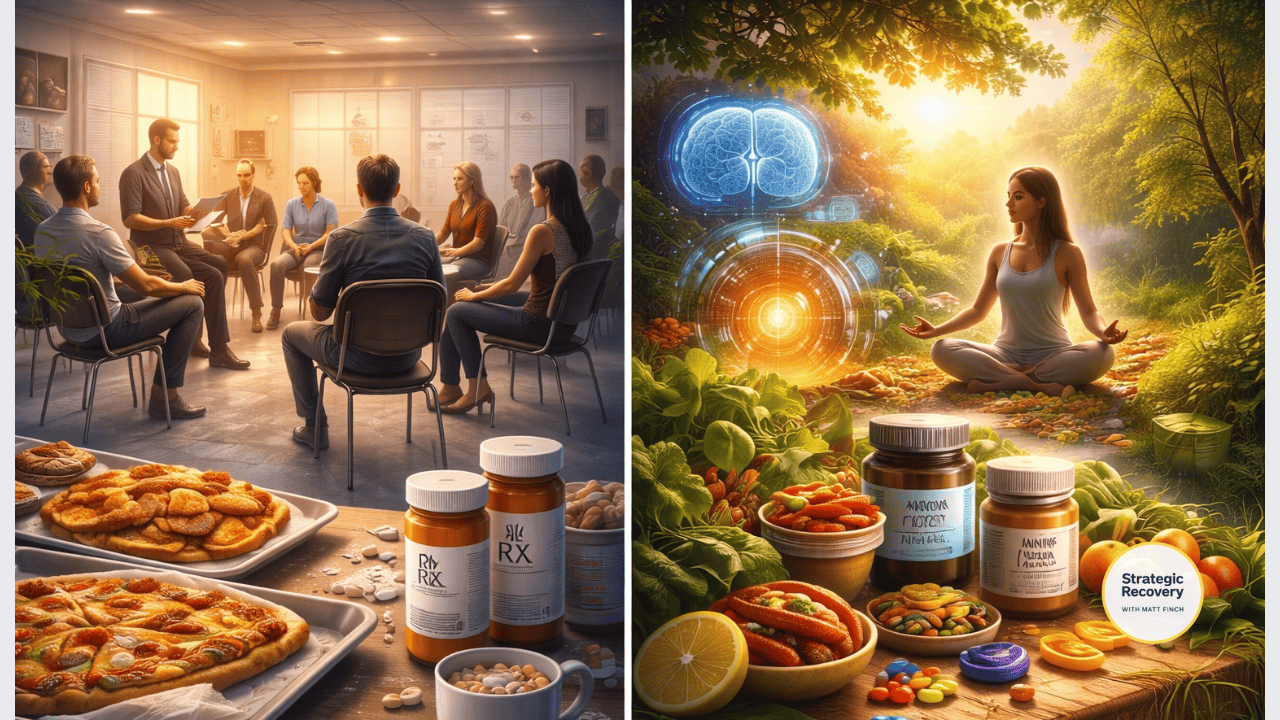
true recovery begins when the biology is repaired first.
⏳ Why “Clean Time” Alone Doesn’t Heal PAWS
One of the most persistent myths in recovery is:
“If you just stay sober long enough, everything will balance out.”
Time helps—but time without proper inputs heals slowly, inconsistently, or incompletely.
PAWS doesn’t resolve because the calendar advances 📆.
It resolves because conditions change ⚙️.
PAWS improves when:
When those conditions aren’t present, people can stay sober for months—or years—while still feeling depleted, flat, anxious, or disconnected.
It’s a failure of the model.
💸 The Cost of Missing PAWS
When PAWS isn’t properly addressed:
- Relapse risk rises unnecessarily
- Shame increases
- Hopelessness deepens
- Recovery feels like punishment instead of liberation
Worst of all, many people walk away believing:
“I tried everything. Nothing worked.”
In reality, no one ever addressed the root layers of their healing 🌱.
🔭 The Strategic Recovery™ Perspective
Strategic Recovery™ doesn’t reject — it integrates.
Strategic Recovery™ doesn’t reject:
Meetings support connection
Therapy supports insight and emotional processing
Supplements support neurochemical repair
Nutrition supports brain and gut healing
Nervous-system practices restore regulation and safety
Meaning + spirituality provide direction and purpose
📍 The Bottom Line
Here’s the truth most people were never told:
If recovery felt harder than it should have,
it’s not because you failed the system—
it’s because the system failed to address PAWS.
Once PAWS is understood and supported properly, recovery stops feeling like a test of endurance.
It starts feeling like a guided return to wholeness 🧭.

🧠 IX. How Strategic Recovery™ Views PAWS
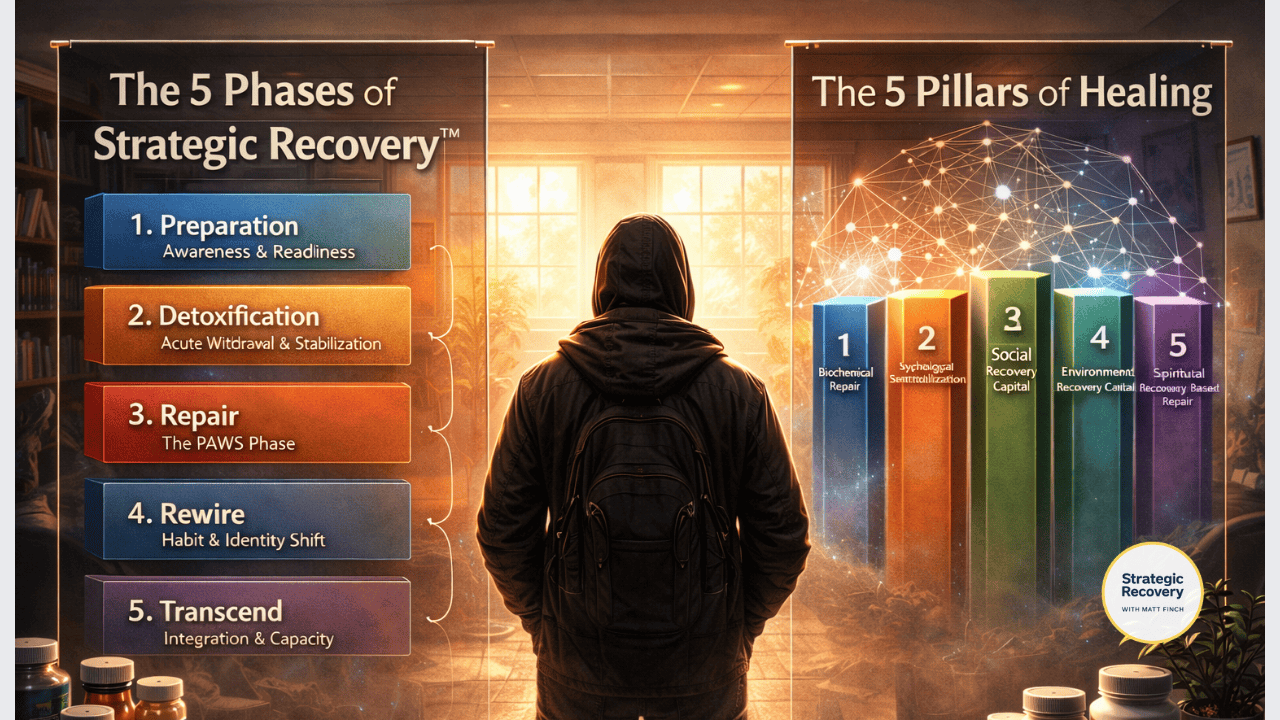
(Through the 5 Phases and 5 Pillars of Healing)
Once you understand what PAWS is, the next question becomes far more practical:
Where does PAWS fit in recovery—and what actually heals it?
This is where many people get stuck.
They know:
- They don’t feel well
- Acute withdrawal is over
- Something deeper is happening
But they don’t know:
- What phase they’re in
- What to focus on next
- Or why their efforts feel scattered or ineffective
Strategic Recovery™ solves this confusion by using two complementary lenses:
- The 5 Phases of Strategic Recovery™ — when healing unfolds
- The 5 Pillars of Strategic Recovery™ — what heals at each stage
When PAWS is placed correctly within these frameworks, it stops feeling like a vague suffering period
and starts feeling like a specific, predictable phase with clear priorities.
A. The 5 Phases of Strategic Recovery™ 🗺️
(Where PAWS Fits — and What Each Phase is Really for)
Recovery is not a single event.
It is a progressive biological, neurological, psychological, and identity-based process.
The most common mistake people make is not lack of effort—it’s using the right tools at the wrong time.
Strategic Recovery™ avoids this by organizing healing into five distinct phases, each with a clear purpose.
Phase 1: Preparation — Awareness & Readiness 👁️
Understanding the Prepare Phase
The pre-quit phase: when awareness turns into readiness.
🧠 Not action yet — orientation + preparation
Phase 1 is the pre-quit phase — the moment when awareness turns into readiness. This is when a person begins to recognize:
“Something has to change.”
“My current pattern isn’t sustainable.”
But Phase 1 is not about action yet. It’s about truth, clarity, and informed decision-making — not willpower.
This phase includes:
- Learning about addiction, recovery, and PAWS
- Understanding what detox and early recovery actually involve
- Choosing a quit or detox date
- Arranging support, time off, or medical care
- Gathering supplements, resources, and education
It ends when the decision is made — and action begins.
Phase 1 ends when the quit decision is made and the person enters detox / early recovery.
Phase 2: Detoxification — Acute Withdrawal & Stabilization 🌊
Understanding the Detox Phase
Phase 2 begins when the substance or behavior stops.
🎯 Goal: safe stabilization (not optimization)
This phase is often intense — but temporary. The nervous system is focused on one thing: survival + recalibration.
This phase involves:
- Acute withdrawal symptoms
- Neurochemical disruption
- Nervous system survival mode
The goal is safe stabilization — protecting the body, calming danger signals, and getting through the acute window.
PAWS begins after acute withdrawal has resolved.
Phase 3: Repair — The PAWS Phase 🛠️
Understanding the Repair Phase
This is where PAWS lives. The repair chapter of the nervous system.
🧠 Goal: restore regulation (not “power through”)
Phase 3 begins when acute withdrawal has stabilized, the substance or behavior is no longer present, and the brain and nervous system must relearn natural regulation.
Phase 3 begins when:
- Acute withdrawal has stabilized
- The substance or behavior is no longer present
- The brain and nervous system must relearn natural regulation
During Phase 3:
- Dopamine receptors rebuild
- Neurotransmitters rebalance
- Stress systems recalibrate
- Sleep architecture restores
- The nervous system relearns safety
They are the work of the phase — the nervous system completing repair in real time.
Phase 4: Rewire — Habit & Identity Shift 🔄
Understanding the Rewire Phase
Overlapping with late PAWS. This overlap is intentional.
🧠 Repair stabilizes → rewiring accelerates
As repair stabilizes, the brain gains enough bandwidth to build new patterns.
As repair stabilizes:
- New neural pathways form
- Healthy reward circuits strengthen
- Compulsive patterns lose dominance
This is where:
- Habits change
- Motivation returns gradually
- Identity begins to shift
PAWS may still appear — but with:
- Less intensity
- Less fear
- More clarity and confidence
Phase 5: Transcend — Integration & Capacity 🕊️
Understanding the Transcend Phase
Not “maintaining recovery.” Living well.
✨ Beyond abstinence: capacity + coherence
Phase 5 is not about “maintaining recovery.” It’s about living well — with an integrated identity, stable regulation, and sustainable meaning.
• Integrated identity beyond addiction
• Stable nervous system regulation
• Sustainable joy, motivation, and meaning
By this stage:
- PAWS has resolved or is minimal
- Stress no longer hijacks the system
- Pleasure is no longer fragile or compulsive
What defines Phase 5:
- More bandwidth for life
- Resilience under stress
- Joy that doesn’t require escape
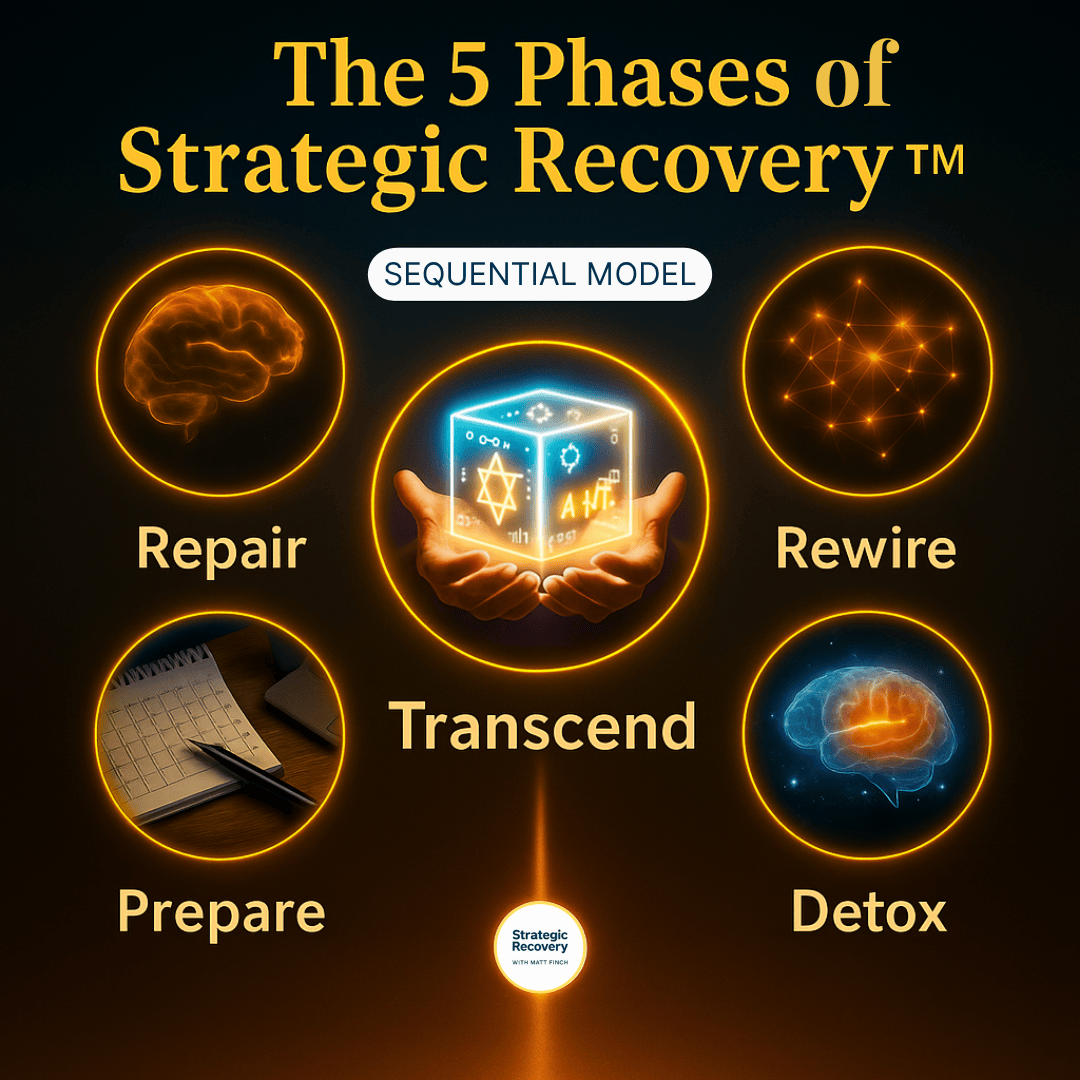
Follow the phases in order, and your nervous system gets the message: it’s safe to complete repair.
🧭 Why the Phases Matter
Most recovery frustration comes from:
- Trying to rewire before repairing
- Forcing growth while the nervous system is dysregulated
- Expecting Phase 5 outcomes during Phase 3
Once you know which phase you’re in, the path forward becomes obvious.
And PAWS stops feeling mysterious
—and starts feeling manageable.
B. The 5 Pillars of Strategic Recovery™ 🏛️
(What Actually Heals PAWS)
Knowing when you are in recovery matters.
But healing requires knowing what systems need support.
PAWS does not resolve because time passes.
It resolves because the right systems receive the right inputs.
Pillar 1: Biochemical Repair 🧬
Understanding the Biochemical Pillar
The primary driver of PAWS healing.
🏗️ Foundation first: feed the brain before forcing the mind
It is a biochemical repair process.
This pillar focuses on:
- Neurotransmitter rebuilding (dopamine, serotonin, GABA, endorphins)
- Dopamine receptor recovery
- Amino acid availability
- Micronutrient repletion
- Omega-3 and membrane repair
- Mitochondrial energy restoration
It is the foundation.
Pillar 2: Psychological Stabilization 🧠
Understanding the Psychological Pillar
Containment, not overanalysis.
🧯 Early PAWS: calm interpretation → calm nervous system
In early PAWS, psychology’s job is to reduce threat — not create more thinking.
During early PAWS, psychology should:
- Reduce fear and misinterpretation
- Contain distress
- Prevent rumination and self-blame
Pillar 3: Social Recovery Capital 🤝
Pillar 4: Environmental Recovery Capital 🏡
Understanding the Environmental Pillar
Designing conditions that allow healing.
🏡 Your environment is never neutral
It either supports regulation — or quietly re-injures the system.
Sends consistent signals of safety.
Keeps stress responses activated.
This pillar includes:
- Sleep consistency
- Light exposure and circadian rhythm
- Digital stimulation levels
- Cognitive and work demands
- Daily rhythm and predictability
It is a biological signal.
Pillar 5: Spiritual & Meaning-Based Repair ✨
Understanding the Spiritual Pillar
Accurate interpretation of the experience.
🧭 Meaning reduces despair
Meaning doesn’t remove discomfort — it removes despair.
Specifically, this pillar provides:
- Direction
- Identity beyond addiction
- Understanding why PAWS exists
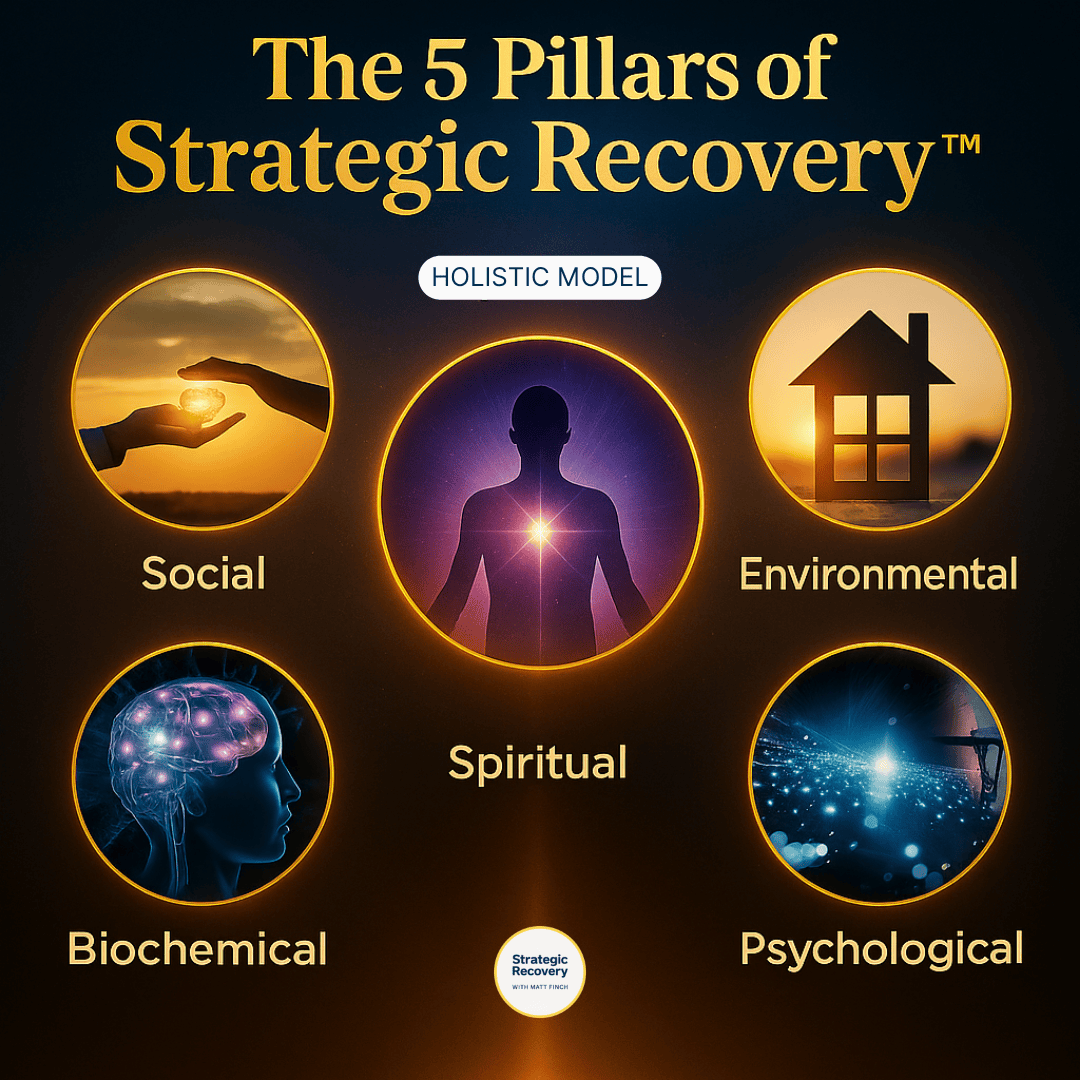
Feed the brain, stabilize the mind, build safe connection, design a regulating environment, and anchor it all in meaning.
⚙️ How the Pillars Shift Across Phases
All five pillars matter—but not equally at all times.
- Phase 3 (PAWS): Biochemical + environmental pillars lead
- Phase 4 (Rewire): Psychological and social pillars rise
- Phase 5 (Transcend): All pillars integrate
Most recovery struggles come from sequencing errors, not effort.
Strategic Recovery™ corrects that.
⚡ The Shift That Changes Everything
Once you stop asking:
- “What’s wrong with me?”
And start asking:
- “Which system needs support right now?”
Recovery stops being an endurance test
and becomes intelligent cooperation with healing.
⚡ X. PAWS as Nervous System Dysregulation
(The Missing Link Between Symptoms, Relapse, and Healing)
If you understand only one thing about PAWS, let it be this:
PAWS is not primarily a mindset problem 🚫.
It’s a nervous system regulation problem ⚖️.
That single distinction changes everything.
Because most people try to think their way through PAWS…
motivate their way through PAWS…
discipline their way through PAWS…
And when that fails, they conclude:
- “Something is wrong with me.”
- “I’m weak.”
- “I can’t do recovery.”
But the truth is simpler—and far more relieving:
A dysregulated nervous system can overpower even the strongest intentions.
Not because you don’t care.
Because your system doesn’t feel safe yet.
🧠 Why the Nervous System Matters So Much in PAWS
Your nervous system is your body’s command center for:
- safety
- stress
- energy
- rest
- craving intensity
- emotional volume
- sleep depth
It decides whether you feel:
- calm or anxious
- grounded or flooded
- motivated or flat
- safe enough to heal… or stuck in survival mode
Addictive substances and behaviors don’t just hijack dopamine.
They override regulation.
Over time, your system adapts to that override.
So when the substance or behavior is removed, your nervous system has to relearn something it hasn’t practiced in a long time:
Baseline regulation.
That relearning period is PAWS.
🔄 The Two Main Dysregulation Patterns in PAWS
PAWS doesn’t look the same for everyone.
Most people either:
- lean heavily toward one state, or
- swing back and forth between both.
1) Hyperarousal (Fight-or-flight dominance) 🔥
Understanding Hyperarousal (Upgregulated)
This is a nervous system stuck in “on guard” mode.
🔥 High activation • low safety signal
The system is running threat-mode when it needs repair-mode.
Common signs:
- anxiety or panic
- racing thoughts
- insomnia / restless sleep
- muscle tension
- irritability or anger
- intense stress sensitivity
How it feels:
“Staying busy” can become a form of stimulation that keeps the system activated.
2) Hypoarousal (Shutdown / freeze dominance) 🧊
Understanding Hypoarousal (Downregulated)
This is a nervous system that has moved into conservation mode.
🫧 Low energy • low access to pleasure
The system is conserving resources when it doesn’t yet feel safe enough to mobilize.
Common signs:
- emotional numbness
- fatigue / heaviness
- flat mood, low drive
- brain fog
- disconnection from pleasure
- “nothing matters” feeling
How it feels:
It typically deepens collapse.

Some nervous systems are stuck in overdrive — others in shutdown.
Both are signs of dysregulation, not failure.
🌊 Why PAWS Symptoms Fluctuate So Much
Many people don’t stay in one state.
They cycle:
- anxiety → exhaustion
- restlessness → numbness
- overstimulation → collapse
This is why PAWS can feel so confusing.
But here’s the key:
These shifts aren’t random.
They are your nervous system searching for equilibrium.
Even when it feels awful, it’s an attempt at self-regulation.
🚫 Why Willpower Backfires During PAWS
Willpower is a cognitive tool.
PAWS is a physiological state.
When the nervous system is dysregulated:
- stress hormones are unstable
- dopamine is unstable
- prefrontal function drops
- emotional reactivity rises
- cravings intensify
That’s why people in PAWS often say:
“I know what I should do… but I can’t do it.”
That’s not laziness.
That’s not a moral flaw.
That’s a nervous system that hasn’t regained regulation yet.
Trying to force change too early often:
- increases anxiety
- deepens fatigue
- triggers cravings
- extends the timeline
Regulation comes first.
Then motivation returns.
⚖️ What Nervous System Regulation Actually Means
Regulation does not mean:
- suppressing emotions
- staying busy to avoid feelings
- “positive thinking”
- ignoring discomfort
Regulation means:
- increasing internal safety
- lowering unnecessary stimulation
- restoring rhythm and predictability
- teaching the body: the danger has passed
🛡️ When safety increases, symptoms decrease.
🌿 How Regulation Accelerates PAWS Healing
Understanding Regulation & PAWS
When the nervous system feels safer, the brain can finally complete repair.
✅ Safety signal first
As regulation improves:
- sleep deepens
- neurotransmitters stabilize
- cravings soften
- emotional resilience returns
- pleasure becomes accessible again
This is why Strategic Recovery™ emphasizes:
- breath + rhythm
- sleep timing consistency
- sunlight / circadian support
- nutrition + blood sugar stability
- gentle movement
- reducing stress before heavy self-optimization
💡 Why This Explains Relapse So Clearly
When people relapse during PAWS, they’re rarely chasing pleasure.
They’re seeking regulation.
Substances temporarily:
- quiet hyperarousal
- lift hypoarousal
- create artificial “safety”
Understanding this removes shame and replaces it with strategy:
Relapse is often an attempt to self-regulate with the wrong tool 🔧.
🧭 The Strategic Recovery™ Reframe
Here’s the reframe that changes everything:
Cravings during PAWS are not proof you “want” to use.
They are signals that your nervous system needs support.
➡️ What This Means Going Forward
So the core question isn’t:
“How do I stay sober through PAWS?”
It becomes:
“How do I help my nervous system feel safe enough to finish healing?”
And that question leads to better choices, faster relief, and a much stronger recovery trajectory.
🛠️ XI. The Strategic Recovery™ PAWS Healing Plan
(What to Do, In What Order, and Why It Actually Works)
By this point in the guide, something important should feel different.
You’re no longer asking:
- “What’s wrong with me?”
- “Why isn’t this ending?”
- “Do I just have to white-knuckle this?”
You now understand what PAWS is, why it happens, and where you are in the recovery process.
So the question becomes practical:
What do I actually do—starting now—to help this heal?
This is where Strategic Recovery™ departs from most recovery advice.
Instead of vague encouragement, rigid rules, or one-size-fits-all routines, it offers a sequenced, systems-based plan that mirrors how the brain and nervous system actually recover.
Because during PAWS:
- Not everything matters equally
- Not everything should be done at once
- Order matters
🧩 The Core Principle of PAWS Healing
Everything in this plan follows one simple rule:
PAWS heals fastest when you stabilize the body and nervous system first,
then repair the biology,
then retrain regulation and behavior.
Most people reverse that order—and suffer unnecessarily.
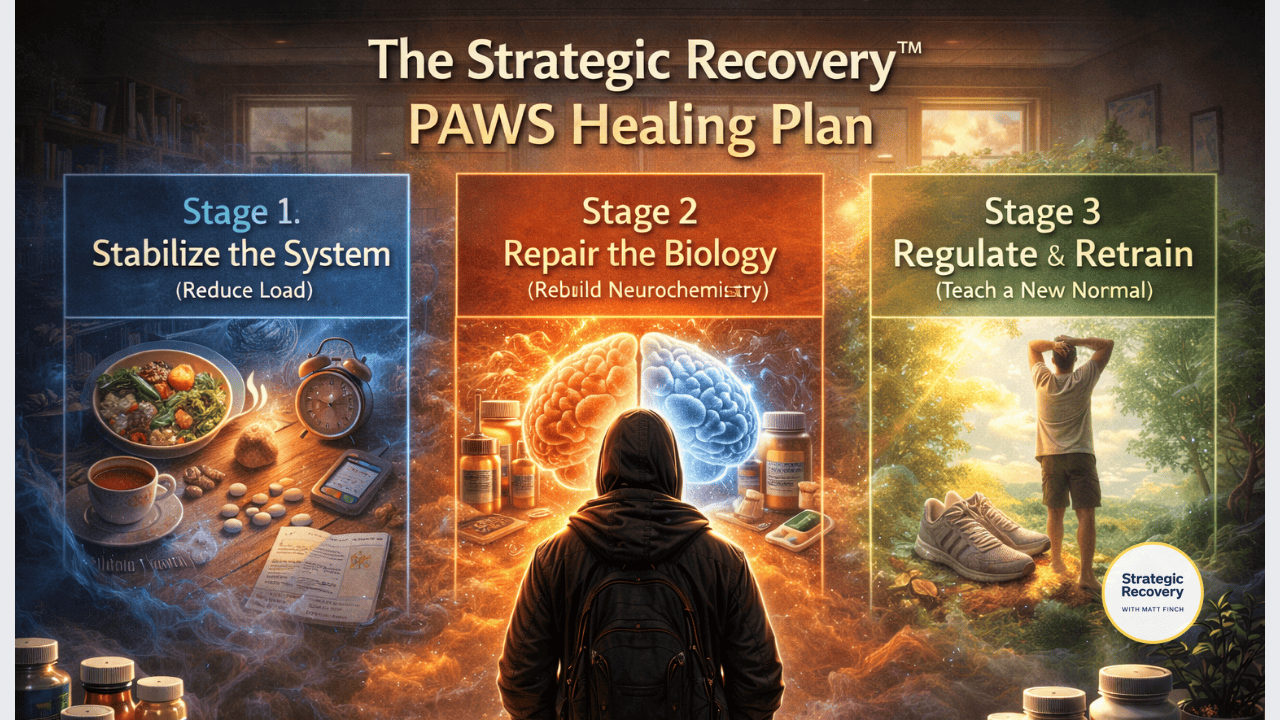
The Strategic Recovery™ PAWS Healing Plan unfolds in three overlapping stages, aligned with Phase 3 (Repair) and early Phase 4 (Rewire).
Stage 1: Stabilize the System ⚓
Understanding Stage 1 (Stop making PAWS worse)
Before you try to optimize anything, the first goal is simple:
Reduce unnecessary stress on the system.
First: less load ✅
Primary goals of Stage 1
- Lower nervous system overwhelm
- Prevent blood sugar crashes
- Improve sleep predictability
- Reduce stimulation and urgency
What this looks like in practice
- Eating regularly (no fasting in early PAWS)
- Prioritizing sleep timing over perfect sleep
- Reducing caffeine and stimulant load
- Creating simple daily rhythms
- Temporarily lowering expectations
Many people never experience relief because they skip stabilization and jump straight into “self-improvement.”
Stage 2: Repair the Biology 🔬
Understanding Stage 2 (The engine of PAWS recovery)
Once the system is more stable, repair can accelerate.
This stage is the core of PAWS healing.
Raw materials first ⚙️
neurochemistry, receptors, stress systems, and nutrients were depleted by the addiction cycle.
PAWS exists because:
- Neurotransmitters were depleted
- Dopamine receptors were downregulated
- Stress hormones were overused
- Micronutrients were drained
Core repair targets
- Dopamine rebuilding
- Serotonin balance
- GABA support
- Endorphin restoration
- Mitochondrial energy production
Stage 3: Regulate & Retrain 🎯
Understanding Stage 3 (Teaching the system a new normal)
As repair progresses, the nervous system becomes more receptive to retraining.
This stage overlaps with late PAWS and early rewiring.
Not intensity — consistency ✅
Key objectives
- Gradually increase stress tolerance
- Restore confidence in internal regulation
- Replace artificial regulation with natural inputs
- Rebuild pleasure capacity safely
This is where:
- Gentle movement
- Sunlight exposure
- Breath and rhythm
- Carefully dosed hormetic stress
The goal is consistency, safety, and trust.
🏗️ Why This Plan Works When Others Don’t
Most recovery advice fails because it:
- Emphasizes mindset too early
- Ignores biological depletion
- Assumes motivation is available
- Confuses discipline with healing
Strategic Recovery™ respects a simple truth:
You can’t build resilience on a depleted nervous system.
Resilience is the result of repair—not the prerequisite.
⏱️ How Fast Should You Expect Results?
This is a fair—and important—question.
With the Strategic Recovery™ PAWS Healing Plan:
Hopeful, reality-based timelines — built on regulation + repair.
- Many people notice relief within days to weeks
- Most experience meaningful improvement within 1–3 months
- Deeper rewiring continues gradually over 6–12+ months
🚫 What This Plan Is Not
This plan is not:
- A detox protocol
- A supplement shopping list
- A rigid routine
- A test of discipline
- A “do more” strategy
It is a support-the-system strategy 🏗️.
And when the system is supported, healing often happens faster than people expect.
📣 The Most Important Instruction of All
If you remember only one thing from this section, let it be this:
When symptoms flare during PAWS,
don’t ask “What’s wrong with me?”
Ask:
“What does my system need right now?”
That single question turns recovery from self-judgment
into intelligent cooperation with healing.
⚙️ XII. Optimizing PAWS Symptoms Reduction & Timeline Shortening
(How to Heal Faster Without Forcing, Flooding, or Burning Out)
Once PAWS is understood correctly, the goal shifts.
Not to push through symptoms.
Not to power your way past discomfort.
The real goal becomes this:
Reduce symptom intensity.
Shorten the healing timeline.
Protect the nervous system while repair completes.
This section focuses on the highest-leverage inputs—the few variables that reliably move PAWS forward when applied at the right time, in the right order.
🔁 First, a Crucial Reframe
PAWS does not resolve through effort.
It resolves through alignment.
Alignment means:
- Giving the brain 🧠 what it needs to rebuild
- Giving the nervous system ⚡ what it needs to feel safe
- Giving the body 🧍 what it needs to restore energy
- Giving the psyche 🧩 what it needs to stay oriented
When alignment improves, symptoms often decrease without force.
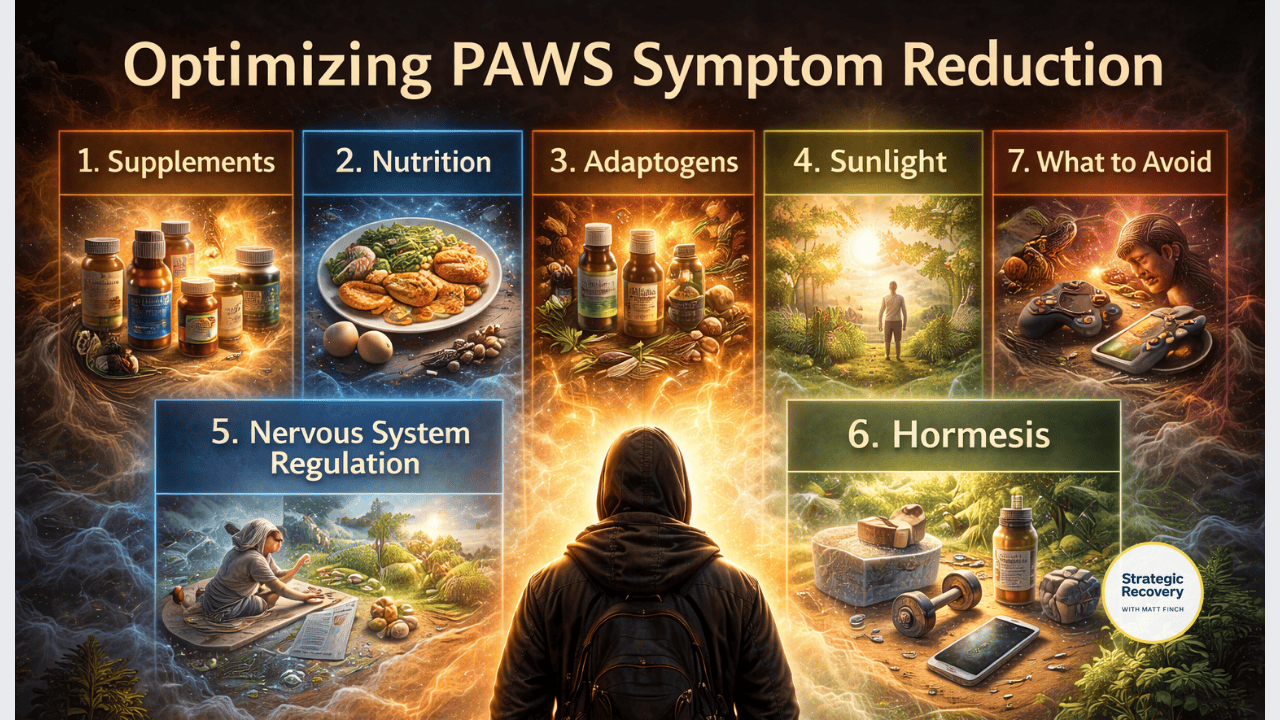
1. Supplements for PAWS 🧱
(Building Blocks, Not Band-Aids)
Supplements during PAWS are not about masking symptoms.
They are about restoring raw materials so healing can proceed.
Addiction and chronic stress reliably deplete:
- Vitamins and minerals
- Amino acids
- Fatty acids
- Antioxidant capacity
Without replenishment, repair slows—no matter how motivated you are.
Strategic Recovery™ Principle: Foundations before enhancers
Build the base first — then layer targeted support.
Sequence matters ✅
This usually means starting with:
- Core vitamins and minerals
- Electrolytes
- Omega-3 fatty acids
From there, targeted support can be layered based on symptoms:
- Amino acids → neurotransmitter rebuilding
- Antioxidants → oxidative stress reduction
- Mitochondrial support → energy restoration
Used strategically, supplements often:
- Reduce anxiety and depression
- Improve sleep quality
- Decrease cravings
- Increase emotional resilience
They enable it.

When the brain has what it needs, healing can finally proceed.
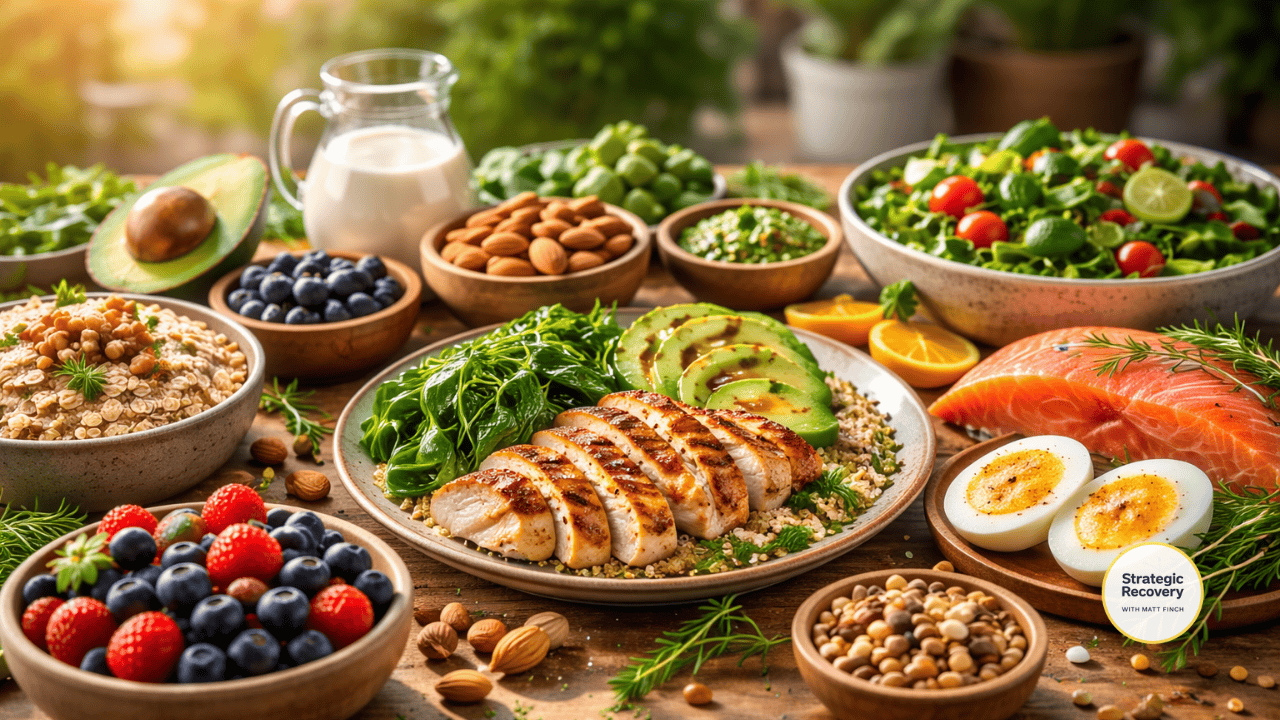
2. Nutrition for PAWS 🍳
(Stability Before Optimization)
During PAWS, nutrition is not about aesthetics or performance.
It’s about stability.
The brain requires:
- Steady glucose availability
- Adequate protein
- Micronutrients for neurotransmitter synthesis
Blood sugar crashes alone can:
- Trigger anxiety
- Intensify cravings
- Mimic panic
- Deepen fatigue
Core principles during PAWS
Simple, repeatable nutrition that lowers symptoms by restoring stability.
- Eat regularly (no fasting early on)
- Prioritize protein at each meal
- Include healthy fats for brain repair
- Avoid ultra-processed foods
- Minimize sugar spikes
It’s physiology.
When blood sugar steadies, the nervous system can finally heal.
3. Adaptogens for PAWS 🌿
(Smoothing the Stress Response)
Adaptogens are not stimulants.
Their role is normalization, not activation.
When used correctly, they can:
- Reduce cortisol extremes
- Improve fatigue resilience
- Stabilize mood
- Increase stress tolerance without overstimulation
They are especially helpful for:
- Anxiety-dominant PAWS
- Fatigue-dominant PAWS
- Stress-sensitive nervous systems
Best practices
How to use adaptogens in a way that supports regulation, not stimulation.
- Moderate doses
- Consistent use
- Individualized selection

they help it find balance again.
Used well, they make PAWS smoother and more navigable.
4. Sunlight: One of the Most Underrated PAWS Healers ☀️
Sunlight isn’t optional during PAWS.
It’s medicine.
Sunlight helps regulate:
- Circadian rhythm
- Dopamine production
- Serotonin balance
- Sleep quality
Just 10–20 minutes of morning sunlight can:
One of the highest-ROI regulation inputs you can add in early recovery.
Small effort → big return 📈
- Improve sleep that night
- Stabilize mood
- Increase daytime energy
- Reduce depression

Just minutes of morning light can reset rhythm, mood, and recovery.
5. Nervous System Regulation Inputs 🧘
(The Difference Between Healing and Just Surviving)
PAWS symptoms intensify when the nervous system stays in survival mode.
Regulation inputs lower that baseline load.
High-value regulators include:
Simple inputs that send the nervous system a steady signal: “You’re safe.”
A few inputs • done daily ✅
Inputs
- Consistent sleep and wake times
- Gentle, rhythmic movement
- Breathing that lengthens the exhale
- Predictable daily routines
- Reduced multitasking and stimulation
These inputs:
- Lower baseline anxiety
- Improve sleep depth
- Reduce craving intensity
- Allow repair processes to complete
You need a few, done consistently.

A few steady regulation inputs — done consistently — allow repair to complete.
6. Hormesis: Using Stress to Heal—Carefully ❄️
Hormesis means small, controlled stress followed by recovery.
During PAWS, dose matters.
Helpful forms (when timed correctly):
Hormesis is a medicine — but the dose must match the nervous system.
If it helps → you feel clearer after ✅
Examples
- Short walks
- Brief cold exposure
- Light strength training
- Bounded mental challenges
Hormesis should:
- Leave you clearer afterward
- Not wipe you out
- Be followed by rest

Small challenges, followed by rest, teach the nervous system how to recover again.
7. What to Avoid During PAWS ⛔️
(The Biggest Timeline Extenders)
Watch out for these delayers of healing.
Certain behaviors reliably prolong PAWS:
These are common “hidden relapses” of the nervous system — they feel productive, but they tax repair.
During PAWS: protect repair 🛡️
- Overtraining
- Undereating or fasting
- Excess caffeine
- Dopamine flooding (scrolling, porn, gambling)
- Sleep deprivation
- Forcing productivity
They delay repair.

Overstimulation, under-recovery, and forced productivity delay repair instead of accelerating it.
⏩ Why These Inputs Shorten the Timeline
PAWS heals in response to:
- Reduced stress load
- Improved biochemical availability
- Increased nervous system safety
- Consistent rhythms
When these conditions are present, healing accelerates.
When they’re absent, PAWS drags on.
🧭 The Strategic Recovery™ Takeaway
You don’t need to do everything.
You need to do the right few things,
consistently,
long enough for the system to respond.
PAWS doesn’t end because you endure it.
It ends because you create the conditions for repair.
And once those conditions are in place,
progress often comes faster—and more quietly—than expected.
🌱 XIII. Treating PAWS and Amplifying Phase 4 & 5
(Hormesis, Natural Highs, and Rewiring the Brain for Real Joy)
One of the most common misunderstandings about PAWS is this:
That healing ends when symptoms fade.
It doesn’t.
PAWS is not just something to endure.
It is a neuroplastic window 🪟—a rare period when the brain 🧠 is unusually open to change 🌱.
Handled passively, PAWS resolves.
Handled strategically, PAWS becomes the launchpad for a stronger, more joyful baseline than existed before addiction.
This section is about that difference.
🔧 PAWS Is a Repair Phase — and a Rewiring Opportunity
During addiction, the brain learned to:
- Outsource regulation
- Shortcut pleasure
- Avoid discomfort through external relief
During PAWS, those pathways weaken.
That weakening often feels frightening—
but it’s also what makes new wiring possible.
The real question becomes:
What do you wire in instead?
This is where hormesis and natural highs matter.
🌿 What Hormesis Actually Means (In Recovery Language)
Hormesis is not grinding.
It’s not suffering.
And it’s not “pushing through.”
Hormesis is small, intentional challenge followed by recovery—
enough stress to teach the nervous system:
“I can handle this — and I recover.”
Correctly applied, hormesis:
- Strengthens dopamine signaling
- Improves stress tolerance
- Builds confidence in self-regulation
- Accelerates healthy rewiring
Incorrectly applied, it backfires ⚠️.
🏛️ The Golden Rule of Hormesis During PAWS
If it leaves you clearer, calmer, or quietly energized, it’s helping.
If it leaves you depleted, anxious, or flattened, it’s too much—or too early.
Hormesis is about dose ⚖️, not toughness.
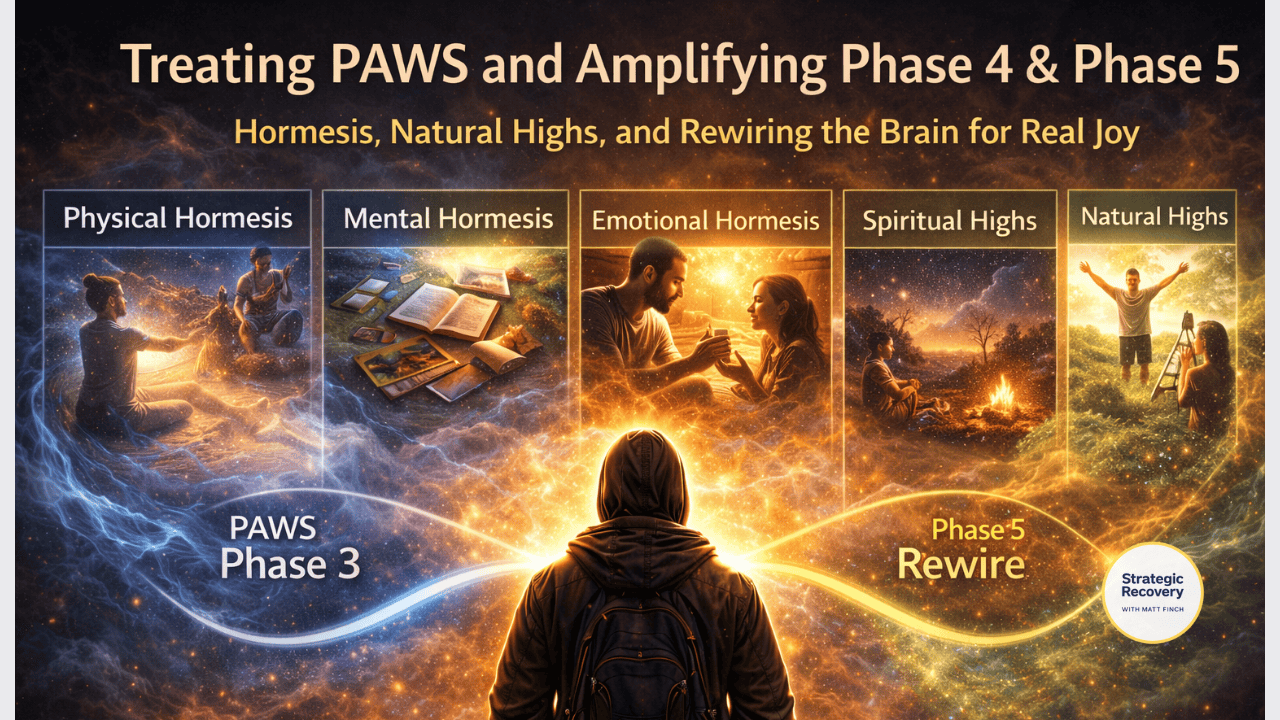
1. Physical Hormesis: Reclaiming the Body Safely 🏃♂️🧊
Understanding Physical Hormesis
Small, intentional challenges — followed by recovery — rebuild trust in the body.
Examples include
- Walking outdoors
- Gentle resistance training
- Brief cold exposure
- Yoga or mobility work
These experiences teach the nervous system
- Effort does not equal danger
- Recovery follows stress
- Energy can be generated internally

Gentle stress, followed by recovery, teaches the nervous system that effort is safe again.
2. Mental Hormesis: Rebuilding Focus and Agency 🧠📚
Understanding Mental Hormesis
Short, bounded engagement rebuilds confidence — without overstimulation.
Examples include
- Reading challenging but meaningful material
- Learning a new skill slowly
- Focused work in short, bounded sessions
This retrains
- Executive function
- Dopamine–reward loops
- Identity as a capable, engaged person

Small, meaningful cognitive challenges rebuild focus, agency, and trust in the mind again.
3. Emotional Hormesis: Feeling Without Flooding 💛🫧
Understanding Emotional Hormesis
Small, safe contact with emotion rebuilds tolerance — without overwhelm.
Examples include
- Allowing emotions without numbing
- Honest conversation
- Journaling difficult thoughts
- Therapy that respects nervous system limits
This builds
- Emotional tolerance
- Self-trust
- Resilience under stress
“I can feel this — and I’m still safe.”

When emotions are met with safety and support, resilience quietly returns.
4. Spiritual Hormesis: Meaning Without Bypass 🕊️🌿
Understanding Spiritual Hormesis
Not dogma — meaning-making that keeps you present with reality.
What this is
- This is not about belief systems or dogma.
- It’s about meaning-making.
Examples include
- Time in nature
- Service without overextension
- Reflection on suffering as temporary and instructive
- Clarifying values instead of chasing outcomes
When pain has meaning, it no longer demands escape.

When suffering is understood as temporary and instructive, it no longer demands escape.
🌅 Natural Highs: Re-Educating the Reward System
Addiction trained the brain to expect:
- Fast relief ⚡💊
- Intense spikes 📈🔥
- No recovery cost 🚫🧾
Natural highs retrain the brain to value:
- Gradual pleasure 🌅🙂
- Clean reward 🌿✨
- Sustainable energy 🔋🌊
Examples include:
- Movement + sunlight 🚶☀️
- Creative expression 🎨🧠
- Genuine connection 🤝❤️
- Flow states 🌊🎯
- Achievement earned slowly 🏔️⏳
At first, these may feel muted 🌫️.
That doesn’t mean they’re failing 🚫💥.
It means dopamine sensitivity is returning 🧠🔄.
Why Natural Joy Feels Weak Before It Feels Strong 🌱🔊
This is critical to understand.
Pleasure often returns quietly before it returns powerfully
Early pleasure can feel “small” — and that’s exactly why this moment is risky for relapse.
People relapse here because they think:
- “This isn’t enough.”
- “I should feel more by now.”
In reality:
- Sensitivity is increasing
- Receptors are recalibrating
- The volume is being turned up gradually
Allowing gradual pleasure compounds joy.
PAWS → Phase 4 → Phase 5: The Arc 🌈
When handled well, the arc looks like this:
- PAWS (Phase 3): Repair and regulation
- Early Phase 4: Gentle hormesis, natural highs, identity rebuilding
- Late Phase 4: Confidence, motivation, pleasure consistency
- Phase 5: Transcendence — not perfection, but resilience
This is how recovery stops being about not using 🚫🧪
and becomes about living well 🌿✨.
🔄 The Strategic Recovery™ Reframe
Here is the reframe that turns PAWS into an asset:
PAWS is not just what you survive.
It is what prepares your nervous system for a higher baseline than addiction ever allowed.
When you respect timing, honor regulation, and rewire deliberately⏳⚖️
PAWS becomes the bridge, not the barrier 🌉✨.
📊 XIV. Determining How Long & Severe PAWS Will Be
(Why Everyone’s Timeline Is Different — and How to Influence Yours)
One of the most common—and most anxiety-provoking—questions during PAWS is:
“How long is this going to last?”
The honest answer is: it depends.
But that answer doesn’t have to feel vague, dismissive, or frightening.
PAWS timelines are not random 🎲🚫.
They are responsive 🔄.
They respond to biology, history, environment, and—most importantly—inputs 🧬🌍⚙️.
Once you understand what actually influences PAWS severity and duration, fear gives way to strategy 🧠➡️🎯.
🪞 The First Truth: Comparison Distorts Reality
Before looking at specific factors, this needs to be said clearly:
Comparing your PAWS timeline to someone else’s will always mislead you.
No two people share the same recovery terrain
Different inputs create different timelines — even with the same level of commitment.
- Neurobiology
- Substance or behavior history
- Stress load
- Health baseline
- Nervous system sensitivity
- Environment
- Recovery supports
What matters is responsiveness.

No two nervous systems heal on the same timeline — responsiveness matters more than averages.
⚖️ The Core Principle That Governs PAWS Duration
Here is the rule that explains nearly every PAWS timeline:
PAWS lasts as long as depleted systems remain under-supported 🔋.
When support improves, timelines shorten ⏬.
PAWS does not run on a clock 🕰️🚫.
It responds to conditions ⚙️.
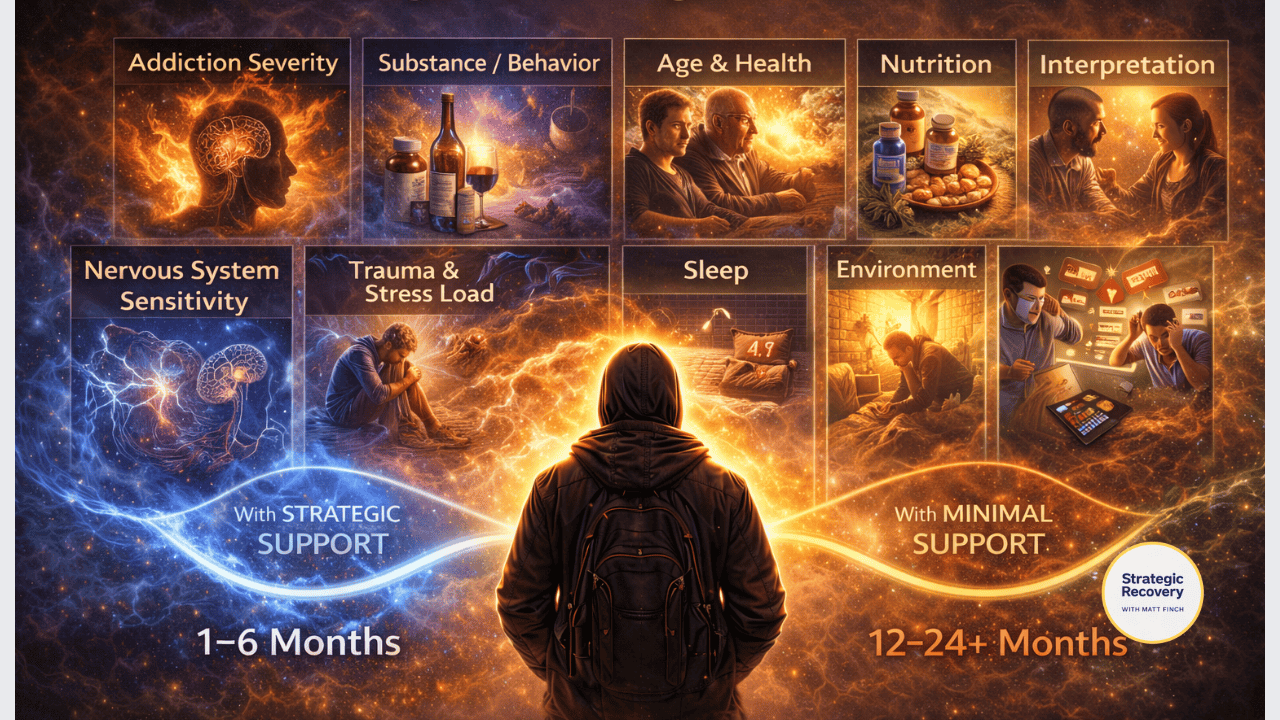
🧬 Key Factors That Influence PAWS Severity & Length
Key Factors That Influence PAWS Severity & Length
PAWS timelines vary for real biological reasons — these are the levers that change the curve.
1. Addiction Severity & Duration
Longer or more intense exposure typically leads to:
- Greater neurotransmitter depletion
- More dopamine receptor downregulation
- Deeper nervous system adaptation
2. Type of Substance or Behavior
Different substances and behaviors stress different systems:
- Alcohol: GABA, glutamate, sleep architecture
- Stimulants: Dopamine, stress hormones
- Opioids: Endorphins, motivation, pain regulation
- Behavioral addictions: Dopamine timing and anticipation
3. Age & General Health
Age and health influence:
- Cellular repair speed
- Hormonal resilience
- Sleep quality
- Mitochondrial efficiency
Baseline health often matters more than age alone.
4. Nutritional & Biochemical Status
This is one of the strongest timeline accelerators or brakes. Deficiencies in:
- B vitamins
- Magnesium
- Zinc
- Omega-3s
- Amino acids
When these are corrected, symptoms often ease faster than expected.
5. Nervous System Sensitivity
Highly sensitive nervous systems tend to:
- React more intensely
- Experience symptoms more vividly
- Take longer to settle without regulation
6. Trauma Load & Ongoing Stress
Unresolved trauma or chronic stress:
- Keeps the nervous system in survival mode
- Suppresses repair processes
- Intensifies emotional symptoms
7. Sleep Quality
Sleep is not optional during PAWS. Poor sleep alone can:
- Mimic depression
- Intensify anxiety
- Stall dopamine recovery
- Extend timelines significantly
8. Environment & Stimulation Load
Healing slows when the environment includes:
- Constant notifications
- High-pressure demands
- Social chaos
- Digital dopamine flooding
Environment is a biological signal — not a background detail.
9. Interpretation & Meaning
This factor is subtle — but powerful.
It’s how quickly you can improve the inputs — and how your system responds.
📆 Reality-Based PAWS Timelines
Reality-Based PAWS Timelines
Recovery speed is largely determined by the quality and consistency of support — not willpower.
With Moderate Support
- Noticeable improvement: 1–3 months
- Significant stabilization: 3–6 months
With Strategic Support
- Symptom relief: days to weeks
- Emotional stability: 1–3 months
- Pleasure returning steadily: 3–6 months
With Minimal or Inconsistent Support
- Lingering symptoms: 12–24+ months
They usually reflect missing inputs — not permanent damage.
🌤️ Why PAWS Often Ends Suddenly
Many people report that PAWS doesn’t fade gradually—it releases.
One day they notice:
- Anxiety is quieter
- Energy is steadier
- Pleasure is accessible
- Cravings are manageable
This happens because:
- Repair compounds invisibly
- Thresholds are crossed quietly
- The nervous system settles all at once
Progress is occurring long before it’s felt.
🎛️ How to Influence Your Timeline Intentionally
How to Influence Your Timeline Intentionally
You can’t force PAWS to end.
But you can remove the brakes.
-
Nutrition Consistent, stabilizing meals (especially protein + blood sugar rhythm)
-
Supplements Strategic support to restore raw materials for repair
-
Regulation Nervous system downshifts that reduce baseline load
-
Sleep Sleep rhythm and timing consistency (predictability beats perfection)
-
Light + Move Morning sunlight and gentle movement to re-anchor circadian signals
-
Reduce Stress Cut unnecessary overwhelm, urgency, and stimulation wherever possible
They change the trajectory.
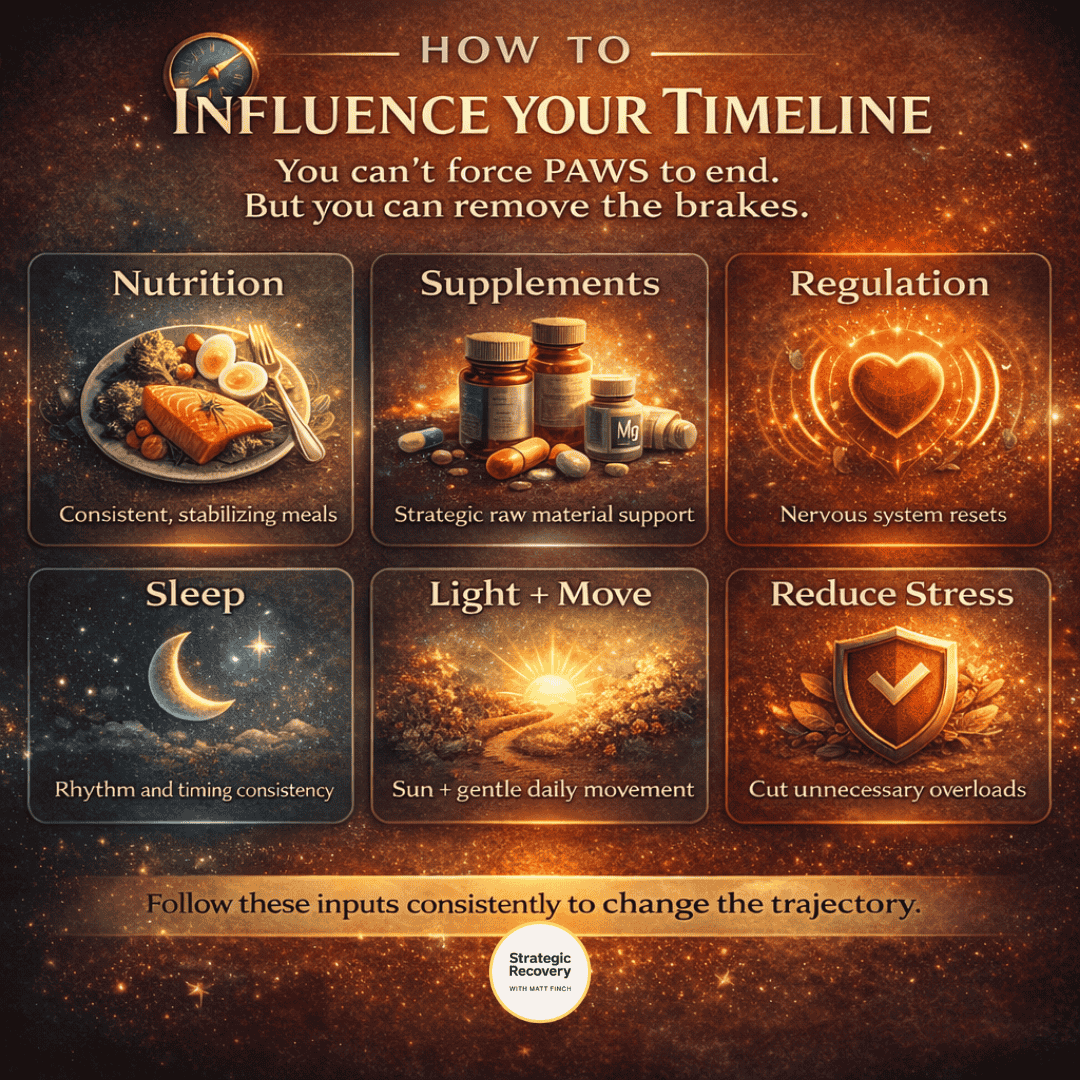
Consistent nutrition, strategic supplementation, nervous system regulation, sleep rhythm, sunlight, gentle movement, and reduced stress don’t just reduce symptoms.
They change the trajectory.
📌 The Most Important Reminder
If you’re in PAWS right now, hear this:
You are not late.
You are not damaged.
And you are not stuck.
You are in a responsive healing process.
And with the right inputs, that process almost always moves faster—and more quietly—than people expect.
🧪 XV. Getting Labs, Genetics, and Testing to Super-Optimize PAWS Healing
(When Data Helps—and When It Just Creates More Stress)
At some point during PAWS, many people start asking questions like:
When symptoms feel unpredictable, testing can seem like the next logical step.
- “Should I get labs done?”
- “What if something is seriously wrong?”
- “Would testing speed this up?”
The honest answer is sometimes—yes.
The more accurate answer is only when testing is used strategically.
Testing can be incredibly helpful during PAWS.
It can also become confusing, expensive, and anxiety-provoking if done indiscriminately.
This section will help you understand:
- When testing actually helps
- What’s worth testing
- How to use results without turning recovery into a diagnostic spiral
🧭 The Strategic Recovery™ Position on Testing
Here is the guiding principle:
Test to clarify direction — not to hunt for problems.
PAWS is already a known healing process.
Testing should refine your strategy, not convince you that something is “wrong” with you.
Used well, labs can help — used poorly, they can slow you down.
The difference is interpretation, pacing, and sequence.
Used well, labs can:
- Reduce guesswork
- Identify true bottlenecks
- Prevent unnecessary suffering
- Accelerate recovery
Used poorly, labs can:
- Increase health anxiety
- Create analysis paralysis
- Lead to overtreatment
- Distract from foundational healing inputs
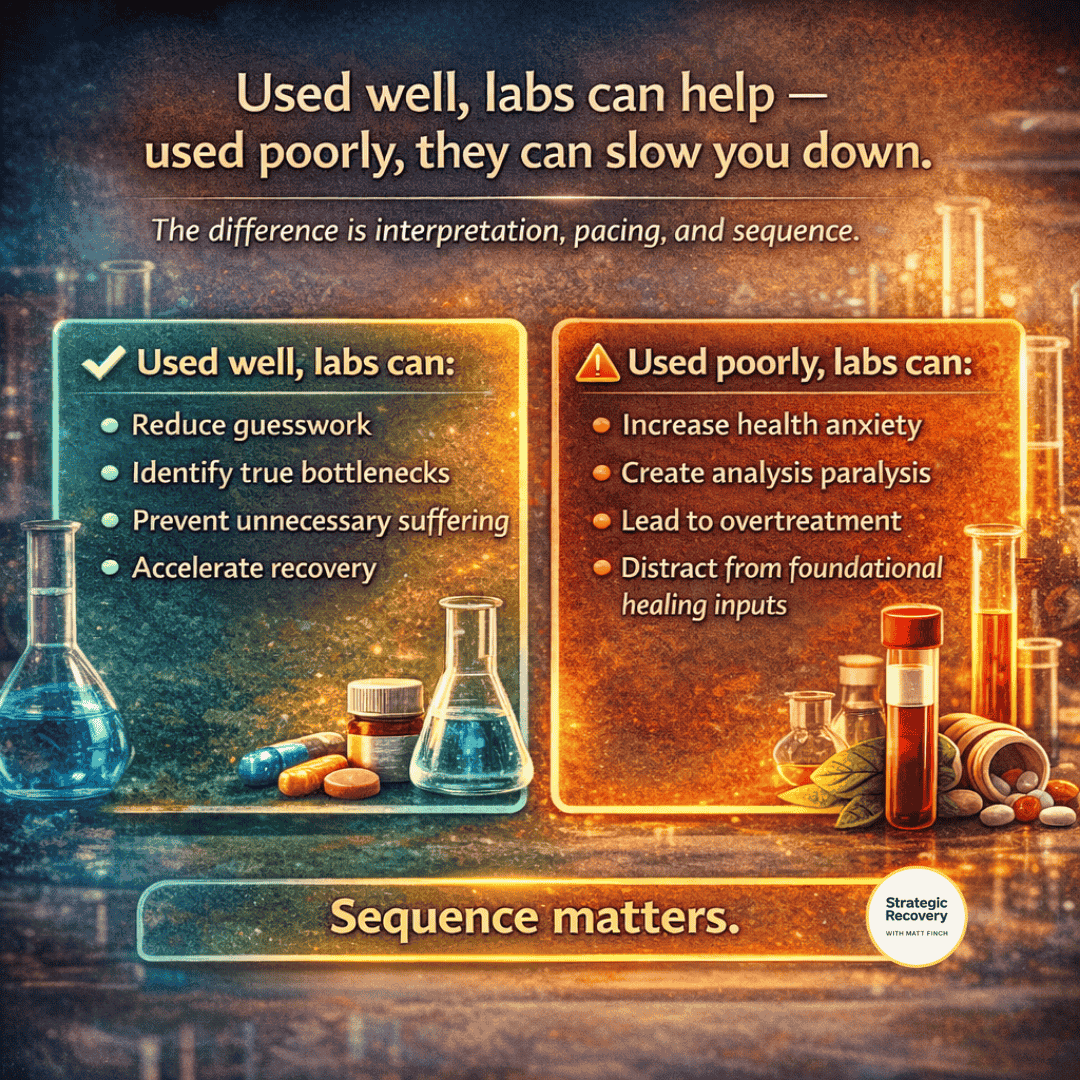
Used well, testing reduces guesswork, identifies true bottlenecks, and accelerates recovery.
Used poorly, it increases anxiety, creates paralysis, and distracts from foundational healing.
Sequence matters.
⏱️ When Testing Makes Sense During PAWS
Testing is most useful when:
- Symptoms are severe or lingering despite solid foundational support
- Energy, mood, or sleep fail to improve over time
- You suspect nutrient deficiencies or hormonal disruption
- You want to optimize recovery, not just endure it
Testing is usually not necessary when:
- You are in very early PAWS
- Sleep, nutrition, and nervous system regulation haven’t been stabilized
- Anxiety is high and reassurance—not data—is the priority
Often, the biggest improvements come before labs, simply by addressing the basics consistently 🧱.
📈 High-Value Tests That Can Accelerate PAWS Recovery
High-Value Tests That Can Accelerate PAWS Recovery
If you do pursue testing, focus on high-yield categories that directly influence brain function, energy, and regulation.
1. Nutrient & Micronutrient Status
High yieldAddiction and chronic stress commonly deplete:
- B vitamins (especially B6, B12, folate)
- Magnesium
- Zinc
- Iron status (including ferritin)
- Vitamin D
- Omega-3 index
- Can mimic depression and anxiety
- Can stall neurotransmitter rebuilding
- Can worsen fatigue and brain fog
Correcting even one major deficiency can sometimes produce dramatic symptom relief.
2. Thyroid Function
Often missedSubclinical thyroid issues are frequently missed. Low or borderline thyroid function can cause:
- Persistent fatigue
- Depression
- Brain fog
- Cold intolerance
- Low motivation
A full thyroid panel (not just TSH) provides a much clearer picture than screening alone.
3. Hormone & Stress-System Balance
RegulationHormonal disruption is common during PAWS due to prolonged stress exposure. Relevant systems include:
- Cortisol rhythm
- Testosterone or estrogen balance
- DHEA levels
- Can prevent sleep restoration
- Can intensify anxiety
- Can suppress dopamine recovery
Stabilizing these systems often unlocks progress that previously felt stuck.
4. Sleep & Circadian Rhythm Assessment
Big leverIf sleep remains poor despite good habits, testing may help identify:
- Sleep apnea
- Circadian misalignment
- Fragmented sleep architecture
Because sleep is such a powerful PAWS healer, correcting sleep disorders can shorten timelines dramatically.
5. Inflammation & Metabolic Markers
Load checkChronic inflammation can:
- Worsen depression
- Slow brain repair
- Increase pain sensitivity
Basic inflammatory and metabolic markers can help determine whether:
- Dietary changes are needed
- Gut support may help
- Stress load is still too high
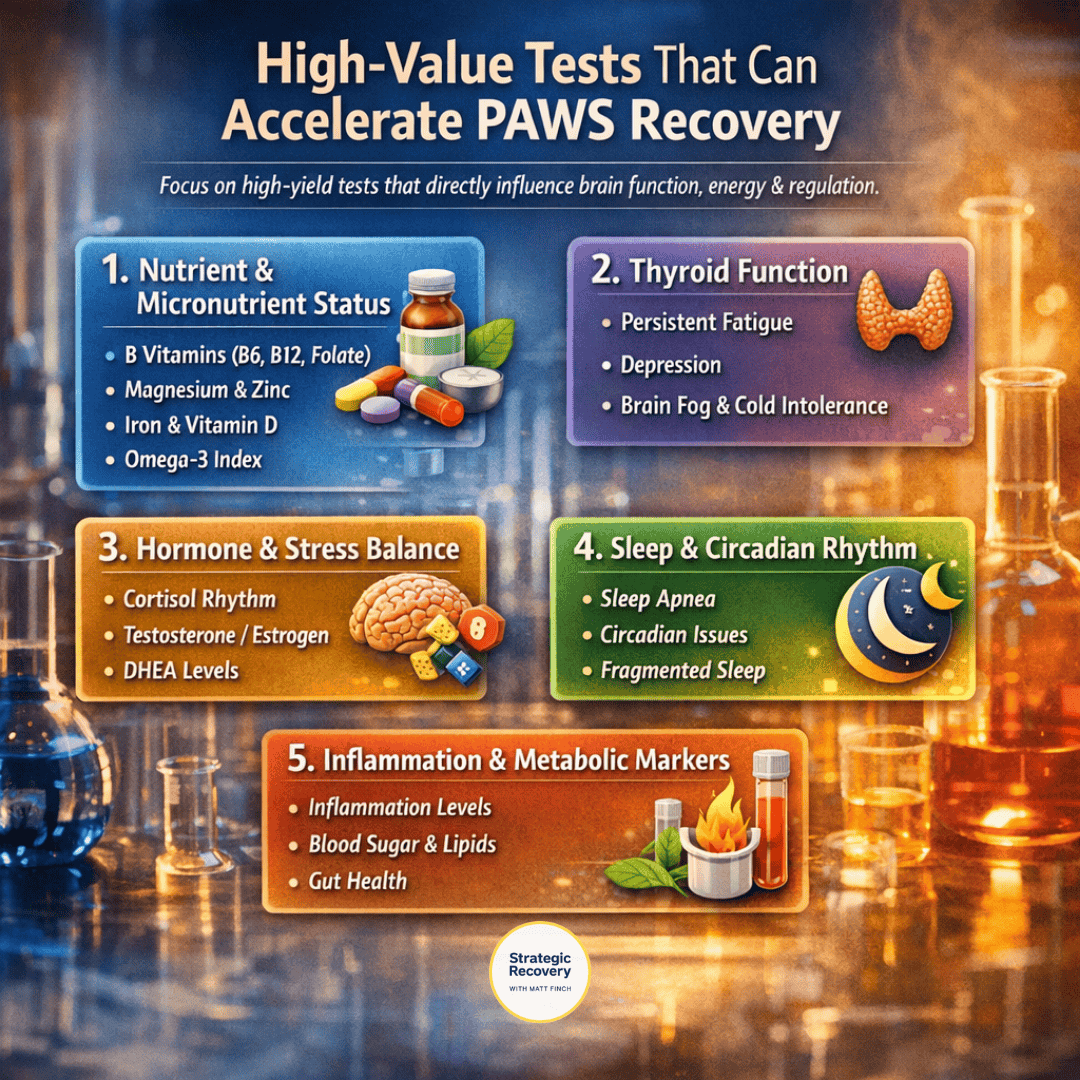
High-value labs focus on the systems that actually drive healing — brain chemistry, energy production, sleep, and nervous system regulation.
When used strategically, testing can remove bottlenecks and accelerate recovery instead of creating anxiety.
🧬 Genetic Testing: Useful — but Often Overused
Genetics can offer insight, but they must be interpreted carefully.
Genes do not predict destiny.
They reveal tendencies—not outcomes.
Genetic data may be helpful for:
- Understanding neurotransmitter metabolism
- Identifying detoxification bottlenecks
- Explaining heightened sensitivity to substances
But remember:
🧬 Genes load the gun.
🌍 Environment and behavior pull the trigger.
Most PAWS issues resolve through foundational repair 🧱 regardless of genetics.
🎯 Genetics should refine strategy — not replace it.
⚠️ The Most Common Testing Mistake
The biggest error is testing too much, too soon.
This often leads to:
- Overwhelm
- Fixation on minor abnormalities
- Chasing marginal findings
- Losing confidence in the healing process
📌 Remember:
PAWS is a healing phase 🛠️ — not a mystery disease.
⚖️ Testing should support healing, not undermine trust in it.
📏 A Simple Decision Rule
If you’re unsure whether testing makes sense, use this filter:
Testing should clarify direction — not amplify fear.
- Improving If symptoms are improving → keep supporting the basics
- Stagnant If symptoms are stagnant or worsening → testing may help
- Anxiety If anxiety is driving the urge to test → pause and regulate first
🖼️ How Testing Fits Into the Bigger Picture
Labs don’t heal PAWS 🧪🚫.
⚙️ Inputs heal PAWS.
Testing simply helps you:
- Aim inputs more precisely
- Avoid unnecessary trial and error
- Optimize recovery after stability is established
Think of testing as a fine-tuning tool 🎚️, not the foundation.
📌 The Strategic Recovery™ Takeaway
Here is the balanced truth:
You do not need perfect data to heal PAWS.
But the right data, at the right time, can accelerate healing dramatically.
Use testing wisely.
Stay grounded.
Keep the focus on restoring systems — not diagnosing yourself into fear.
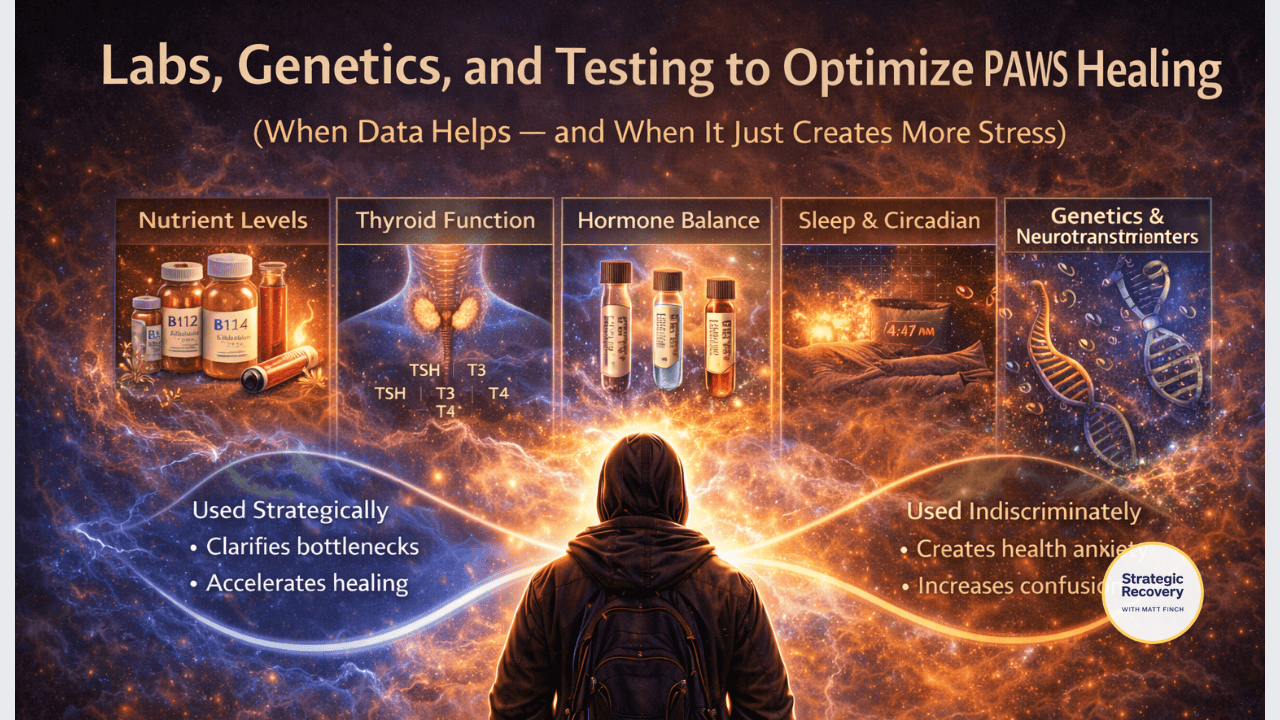
🔄 XVI. Reframing PAWS
(From Something to Survive into Something That Strengthens You)
Up to this point, we’ve focused on understanding PAWS, stabilizing it, repairing the systems underneath it, and accelerating healing intelligently.
🌿 Now comes a quieter—but equally important—shift.
It’s the shift from asking:
“How do I get through this?”
to asking:
“What is this phase building in me?”
This reframe doesn’t deny how hard PAWS can be.
It doesn’t romanticize suffering.
And it doesn’t bypass the need for real support.
What it does change is how the experience lands inside you—
and that changes everything.
🧠 Why Meaning Changes the Nervous System
The human nervous system doesn’t just respond to stimuli.
It responds to interpretation.
When discomfort is interpreted as:
- Proof of damage
- Evidence of failure
- A sign something is permanently wrong
…the nervous system tightens.
Resists.
Stays in survival mode.
🔄 But when discomfort is interpreted as:
- A temporary repair process 🛠️
- A sign of reorganization 🧩
- A meaningful transition 🌅
…the nervous system softens 🛡️.
This isn’t just philosophy 🧠.
It’s physiology ⚡.
🌿 Meaning reduces threat.
And when threat decreases, healing accelerates 🚀.
🌅 PAWS as a Transitional State, Not a Permanent Identity
One of the most damaging beliefs people form during PAWS is:
“This is who I am now.”
In reality, PAWS is not an identity.
It is a state.
A state in which:
This in-between state feels unstable because it is unstable.
But instability during transition is not failure.
It’s movement.
The Navy SEALs Reframe: “Embrace the Suck” 🪖
Elite performers in extreme environments understand something most recovery models ignore:
Some phases are not about feeling good.
They’re about staying oriented while conditions are temporarily hard.
“Embrace the suck” doesn’t mean enjoying suffering.
It means:
Applied to PAWS, it becomes:
That orientation alone reduces panic.

When discomfort is understood as part of healing, panic drops and resilience rises.
Brendon Burchard’s Reframe: “Honor the Struggle” 🏔️
🔄 A powerful reframe from high-performance psychology:
The struggle itself is evidence of growth.
During PAWS, you are:
And anything that takes energy feels hard
before it feels rewarding.
and start cooperating with it.

During PAWS, effort comes before reward — and honoring the struggle turns resistance into cooperation.
The Jeshua + Buddha Reframe: “Patient Endurance” 🕯️
Across spiritual traditions, there’s a shared truth that becomes intensely practical during PAWS:
Some transformations require patient endurance.
In the teachings of Jeshua (Jesus), endurance isn’t framed as grim suffering—
it’s framed as trustful perseverance through a refining season.
In the path of Siddhartha Gautama (the Buddha), endurance is not punishment—
it’s wise steadiness: continuing the practice without clinging, without panic, and without turning discomfort into a story of doom.
Here’s the game-changing version for PAWS:
I can endure this patiently—
hopefully—
even cheerfully—
because this is a temporary healing season, not my final state.

The Strategic Recovery™ Reframe 🧭
Strategic Recovery™ grounds all of this in a biologically accurate frame:
PAWS is a time to focus on healing your nervous system—
repairing restoring rebalancing replenishing resting rebuilding repatterning rehabilitating revitalizing
Not forcing. Not fighting. Not “fixing yourself.”

Healing happens through repair, regulation, and return to self, not struggle or self-fixing.
Why People Who Move Through PAWS Often Become Stronger Than Before 💪
This is one of the least talked-about truths in recovery:
What PAWS can build — when it’s navigated consciously
Over time, many people develop:
- Higher stress tolerance
- Deeper self-trust
- Greater emotional range
- More accurate self-awareness
- Stronger internal regulation
Why this happens
- False sources of regulation are removed
- Real regulatory capacity is built
- Patience and discernment are trained
- Respect for the body and nervous system deepens
📖 What PAWS Is Teaching You
Whether you like it or not, PAWS teaches:
- The difference between stimulation and nourishment
- The difference between discipline and regulation
- The difference between numbing and resting
- The difference between pleasure and relief
These lessons aren’t abstract.
They become embodied.
And once embodied, they don’t disappear.
🌿 A Quiet Shift to Practice
Instead of asking:
“When will this be over?”
Try asking:
“What capacity is being built right now?”
That single question changes how the experience is metabolized.
⚡ The Final Reframe
PAWS is not a punishment for addiction.
It is the cost of re-entering real regulation after artificial relief.
And when supported correctly, it often leaves you stronger than you were before.
This isn’t something you rush.
It’s something you move through with:
PAWS becomes a foundation—not a scar.

When supported with intelligence, compassion, and patience, it becomes a foundation — not a scar.
🕊️ XVII. Final Thoughts
(What Life Looks Like on the Other Side of PAWS)
When you’re inside PAWS, it’s hard to imagine life beyond it.
Not because you lack vision or hope—but because the systems that generate hope are still recalibrating.
So instead of offering empty reassurance, let’s speak honestly about what tends to emerge after PAWS resolves, when healing has had time to finish its work.
🌄 Life After PAWS Is Quieter — and That’s a Gift
One of the first things people notice is this: Life feels less dramatic.
What changes
- Fewer emotional spikes
- Fewer crashes
- Less urgency
- Less internal noise
At first, this can feel unfamiliar. Some people even wonder:
- “Is this it?”
- “Why doesn’t everything feel intense anymore?”
Your nervous system has returned to baseline regulation.
For the first time in a long time, you’re not living in constant reaction.

When the nervous system returns to baseline regulation, urgency fades, inner noise softens, and calm becomes the new normal.
🌊 Pleasure Returns — But in a Healthier Form
Pleasure after PAWS rarely arrives as fireworks.
It shows up as:
Quiet returns first — then it deepens.
- Subtle enjoyment
- Consistent motivation
- Moments of genuine contentment
- A quiet sense of “this is okay”
Relief-based pleasure (addiction)
- Urgent
- Fragile
Regulation-based pleasure (recovery)
- Stable
- Self-sustaining

It emerges quietly — through stability, presence, and a nervous system that no longer needs urgency to feel okay.
🤝 You Begin to Trust Yourself Again
PAWS often erodes self-trust.
After PAWS, something quieter—but far more powerful—returns:
Reliability 🔒.
You begin to trust that:
Not because life is easy — but because your system is learning it can recover.
- Your emotions are signals, not threats
- Your body recovers after stress
- Discomfort passes without escape
- You can meet life without numbing
This isn’t bravado.
It’s earned confidence 🏅.
And once it returns, it reshapes how you move through the world.
🛡️ Stress Still Exists — But It No Longer Owns You
Life on the other side of PAWS still includes:
- Stress
- Loss
- Frustration
- Uncertainty
What changes is capacity 📈.
You recover faster.
You don’t spiral as deeply.
You respond instead of react.
This is real resilience—not toughness, but elasticity.
🧱 Your Identity Is No Longer Organized Around Avoidance
One of the quiet gifts of PAWS is that it dismantles an old identity:
The identity built around escaping discomfort.
On the other side, many people discover:
- Clearer values
- Stronger boundaries
- More intentional living
- Less tolerance for chaos and self-betrayal
This isn’t moral superiority.
It’s nervous system wisdom.
🌍 Recovery Stops Being the Center of Your Life
This milestone often arrives unnoticed.
One day, people realize:
- They’re no longer tracking symptoms constantly
- They’re not analyzing every mood shift
- They’re not measuring progress daily
Recovery fades into the background.
Life moves into the foreground.
This isn’t complacency.
It’s completion ✅.

One day, you simply realize you’re living again — and recovery is no longer the center of the story.
💬 A Final Word for Those Still in PAWS
If you’re still in the thick of it, hear this clearly:
Nothing you’re experiencing means you’re failing.
Nothing you’re experiencing means this won’t end.
Nothing you’re experiencing disqualifies you from a full, meaningful life.
PAWS is not the verdict.
It’s the transition.
And transitions, by nature, are temporary.
🎯 What This Guide Was Meant to Do
This guide was never meant to:
- Rush you
- Fix you
- Turn recovery into a performance
It was meant to:
- Remove unnecessary fear
- Restore accurate understanding
- Help you cooperate with healing instead of fighting it
If it did even a small part of that, it’s already done something meaningful.
✨ The Closing Truth
Here it is, distilled one last time:
PAWS is not something you endure to earn a life.
It’s the final recalibration that allows you to live one—
fully, steadily, and awake.
And when it passes—as it almost always does with the right support—
you don’t go back to who you were.
You move forward:
more grounded,
more regulated,
and finally free.
You’re not behind.
You’re not defective.
You’re in the middle of becoming regulated again.
And that is a powerful place to be.

And when this recalibration completes, life doesn’t become louder or more intense.
It becomes steadier, calmer, and finally sustainable from the inside out 🌿.



Leave a Reply