
A Structured, Phase-Based Approach To Recovery — So You Know Exactly What To Do, When To Do It, And Why It Works.
If you’ve ever tried to quit…
cut back…
or “get your life together”…
and found yourself cycling back into the same patterns—
there’s a reason for that.
Not a vague reason.
Not a motivational one.
A structural one.
What most people are attempting in recovery—whether from alcohol, opioids, other drugs, or behavioral addictions—is not a single behavior change.
It is a multi-layered system recalibration involving:
- brain chemistry
- nervous system regulation
- stress response
- habit circuitry
- emotional processing
- and identity structure
That kind of transformation does not happen randomly.
And it does not respond well to fragmented advice.
Yet that’s exactly how most people approach it.
They’re given isolated strategies:
- stop using
- build discipline
- change your mindset
- go to meetings
- process your past
- find your purpose
Each of these can be useful.
But they are rarely organized into a sequence.
And without a sequence…
even good strategies fail.
Because in recovery, timing is not a minor detail.
👉 Timing determines whether a strategy works—or backfires.
Trying to build discipline while neurotransmitters are depleted…
Trying to process trauma during acute nervous system dysregulation…
Trying to create structure when sleep and energy are unstable…
Trying to install new habits before the underlying biology has stabilized…
These are not uncommon mistakes.
They are the default.
And when those approaches don’t work, the conclusion is usually personal:
“I’m not consistent enough.”
“I don’t want it badly enough.”
“Something isn’t clicking.”
But from a systems perspective, something much simpler is happening:
👉 The right tools are being applied at the wrong stage of recovery.
Recovery is not just what you do.
It is when you do it.
Without that distinction, the process feels unpredictable:
- progress followed by regression
- clarity followed by collapse
- motivation followed by burnout
With that distinction, the process becomes far more coherent.
Instead of asking:
“Why isn’t this working?”
You begin asking:
“What phase am I in—and what is this phase actually designed for?”
That shift—from effort to sequence—is where recovery starts to become:
👉 understandable
👉 predictable
👉 and most importantly… buildable
And that’s what the Strategic Recovery Map™ is designed to provide.
Table of Contents
Recovery becomes far more effective when it’s structured. Use this guide to move through each phase with clarity, sequence, and strategy.

The Truth That Changes Everything
Most relapse is not a failure of effort.
It is a failure of timing.
In other words:
👉 The issue is rarely what someone is doing.
It’s when they’re doing it.
When recovery is approached without a clear sequence…
people consistently apply effective tools in inappropriate physiological and psychological states.
For example:
- Attempting discipline during neurochemical depletion
- Attempting insight work during acute dysregulation
- Attempting behavior change without biological stability
Individually, these are valid strategies.
But applied out of phase…
they produce inconsistent—or even counterproductive—results.
From the outside, this looks like:
- “I started strong, then fell off”
- “I was doing everything right, and it still didn’t work”
- “I don’t understand why I keep going back”
From a systems perspective, the pattern is much clearer:
👉 The interventions were not aligned with the stage of recovery.
And when that misalignment repeats over time…
The outcome is predictable:
- frustration increases
- confusion compounds
- perceived self-efficacy decreases
- and eventually, disengagement occurs
Not because the person lacks capability—
but because the process lacks structure.
Once the sequence is understood…
that confusion begins to dissolve.
Because instead of asking:
“Why isn’t this working?”
the question becomes:
“Is this the right strategy for the phase I’m in?”
That single shift reorganizes the entire recovery process.
What once felt chaotic…
begins to feel ordered.
What felt unpredictable…
becomes patterned.
And what felt like repeated failure…
starts to look like misapplied timing—now correctable.

The Strategic Recovery Map™
Across years of working with individuals recovering from alcohol, opioids, kratom, benzodiazepines, and behavioral addictions…
a consistent pattern began to emerge.
Not just in what worked—
but in when it worked.
Certain interventions produced strong results in one stage…
and minimal—or even negative—results in another.
At first glance, recovery can appear unpredictable:
- periods of progress followed by regression
- motivation that comes and goes
- strategies that seem effective… until they suddenly aren’t
But when examined through a systems lens, the process is far less chaotic than it appears.
Recovery follows a progression.
A sequence of phases that the brain, body, and identity move through as they recalibrate.
Each phase is characterized by:
- a distinct neurochemical environment
- a specific nervous system state
- a limited (but evolving) capacity for change
- and a corresponding set of effective interventions
When these phases are not recognized…
the process feels inconsistent.
When they are recognized…
the process becomes structured.
This shift—from randomness to sequence—is where clarity begins.
Because instead of navigating recovery through trial and error…
It becomes possible to:
- identify your current phase
- understand what that phase is designed to accomplish
- and apply strategies that are aligned with your system’s actual capacity
That’s when people stop feeling lost.
Not because recovery becomes easy—
but because it becomes legible.
And once something is legible…
it becomes actionable.
That is the foundation this framework is built on.
The Strategic Recovery Map™ is a structured model that organizes recovery into five distinct, sequential phases—
each with a clear purpose, predictable challenges, and phase-specific strategies.

The 5 Phases of Strategic Recovery™
(Prepare → Detox → Repair → Rewire → Transcend)
This framework is not conceptual.
It is not ideological.
👉 It is a functional model of what occurs during the recovery process.
When viewed through a biological and systems-based lens…
recovery unfolds in a structured progression.
Not perfectly linear—but consistently sequential.
Each phase represents a distinct stage of system recalibration, defined by:
- a specific nervous system state
- a measurable biochemical environment
- a corresponding emotional and cognitive range
- and a clearly defined primary objective
As the system moves from one phase to the next…
capacity changes.
Tolerance for stress changes.
Ability to implement strategies changes.
Which leads to the most important principle in this entire model:
👉 The effectiveness of any intervention is phase-dependent.
What is highly effective in one phase…
may be ineffective—or destabilizing—in another.
This is why recovery often feels inconsistent when approached without structure.
And why it becomes significantly more predictable when organized correctly.
Each phase, therefore, is not just a stage to move through—
but a context that determines what will actually work.
And with that context in place…
strategy becomes precise.

A Systems View — Two Individuals, One Process
To make this framework concrete, it helps to move beyond abstraction.
Because recovery is not experienced as a model.
It is experienced as a lived, moment-to-moment process—shaped by physiology, environment, and personal history.
So rather than describing these phases in isolation…
we’ll follow two individuals as they move through them.
Not as idealized examples—
but as realistic representations of how this process unfolds.
Daniel (Alcohol)
Daniel is 48.
Professionally stable. High-functioning. Reliable.
From an external perspective, there are no obvious signs of collapse.
Internally, the picture is different.
His days are cognitively demanding and chronically overstimulating.
By evening:
- his nervous system is elevated
- his baseline stress remains high
- cognitive activity persists well past the point of fatigue
Alcohol serves a specific function.
Not recreation.
Not celebration.
👉 Downregulation.
It allows his system to transition out of a sustained sympathetic (fight-or-flight) state.
Without it:
- his mind continues cycling
- his body remains tense
- sleep onset is delayed or fragmented
Over time, this creates a reinforcing loop:
The more dysregulated the system becomes…
the more necessary alcohol feels.

Maya (Opioids)
Maya is 54.
Her entry point was medical—prescription opioids following an injury.
Initially, the effects were appropriate and contained.
But over time, the role of the substance shifted.
From symptom management…
to system regulation.
Maya’s baseline is characterized by:
- high emotional sensitivity
- low stress tolerance
- difficulty maintaining internal stability under pressure
Opioids provide something her system struggles to generate on its own:
👉 a sense of internal safety and coherence.
Without them:
- emotional intensity increases
- physiological discomfort rises
- the system becomes harder to regulate
As dependence develops, discontinuation is not experienced as a simple behavioral change—
but as a loss of stability.

Shared Structure
Different substances.
Different entry points.
Different external lives.
But at a systems level, the pattern converges:
👉 both individuals are using a substance to regulate an unstable internal state.
And over time…
their systems adapt to that external regulation.
That adaptation—biological, neurological, and behavioral—
is what this framework is designed to track.
Because recovery, at its core, is not just about removing a substance.
It is about guiding the system through the stages required to function without it.
And those stages follow a pattern.
A sequence.
One that we can now map clearly.
Phase 1 — Preparation (The Awakening)
Before any external change occurs—before detox, before withdrawal, before behavior shifts—there is a measurable internal transition.
It often goes unnoticed at first.
Not dramatic.
Not decisive.
But distinct.
A shift in perception begins.
Patterns that were previously tolerated… become harder to ignore.
Behaviors that once felt automatic… begin to feel misaligned.
This is the true starting point of recovery.
Not cessation.
👉 recognition.
What’s Happening in This Phase
From a neurobiological perspective, this phase reflects increased engagement of the prefrontal cortex (PFC).
The PFC region responsible for:
- self-awareness
- long-term evaluation
- pattern recognition
- decision-making
As this system becomes more active, several changes occur:
- behaviors are observed rather than simply enacted
- consequences are evaluated more accurately
- inconsistencies between values and actions become more apparent
At the same time, subcortical systems—particularly those associated with reward and habit—remain active.
This creates a predictable internal dynamic:
Two competing signals.
One oriented toward change.
One oriented toward immediate relief.
This is experienced subjectively as:
- hesitation
- ambivalence
- internal conflict
Importantly, this conflict is not a dysfunction.
👉 It is a required feature of the phase.
Without it, no transition would occur.
Daniel in Preparation
Daniel begins to register changes he previously normalized.
His baseline anxiety is higher.
Sleep feels less restorative.
Small stressors produce disproportionate reactions.
These observations are subtle—but cumulative.
One evening, his routine is interrupted—not externally, but cognitively.
Instead of moving directly into his usual drinking pattern…
he pauses.
Not for long.
But long enough to introduce a new variable:
“Is this still working?”
Later, he searches:
“Why can’t I stop drinking?”
This is not yet a commitment.
But it is a reorientation.
The behavior is no longer invisible.
Maya in Preparation
Maya notices that her current dosage no longer produces the same effect.
This introduces uncertainty.
Not just about the medication—
but about trajectory.
She begins researching.
Quietly.
Without external disclosure.
Her behavior does not change immediately.
But her interpretation of it does.
A question begins to repeat:
“What happens if this continues?”
That question marks a threshold.
Because once a pattern is evaluated in terms of its future trajectory…
it becomes significantly harder to ignore.

The Function of This Phase
Preparation is often misunderstood as inaction.
In reality, it is a cognitive and strategic setup phase.
Its purpose is not to produce immediate change.
It is to:
- establish accurate understanding
- reduce uncertainty
- identify viable next steps
- and increase the probability of a successful transition
In systems terms, this phase is about:
👉 reducing friction before initiating change.
What Actually Matters Here
If you are in this phase, the objective is not intensity.
It is precision.
That includes:
- understanding the nature of your dependency
- learning what detox will realistically involve
- evaluating whether tapering, abrupt cessation, or medical support is appropriate
- identifying constraints (time, environment, support, health)
- and preparing accordingly
This is also where environmental variables begin to shift:
- access is reduced
- triggers are identified
- support structures are considered
Not perfectly.
But intentionally.
Common Failure Points
There are two predictable errors in this phase.
1. Premature Execution
Initiating detox without sufficient preparation.
This often leads to:
- overwhelm
- destabilization
- early relapse
Not due to lack of effort—but due to insufficient system readiness.
2. Indefinite Preparation
Remaining in analysis without transition.
This can appear as:
- continuous research
- repeated planning
- delayed decision-making
At a certain point, additional information no longer reduces uncertainty. It becomes a form of avoidance.
Structural Reality
Preparation is not passive.
It is preparatory.
It is the phase where variables are organized…
so that when change begins…
it is not random.
In biological terms, it is the difference between:
Key Principle
Preparation is not delay.
It is what determines whether the next phase succeeds.
Because once this phase completes—
the process shifts from consideration…
to action.
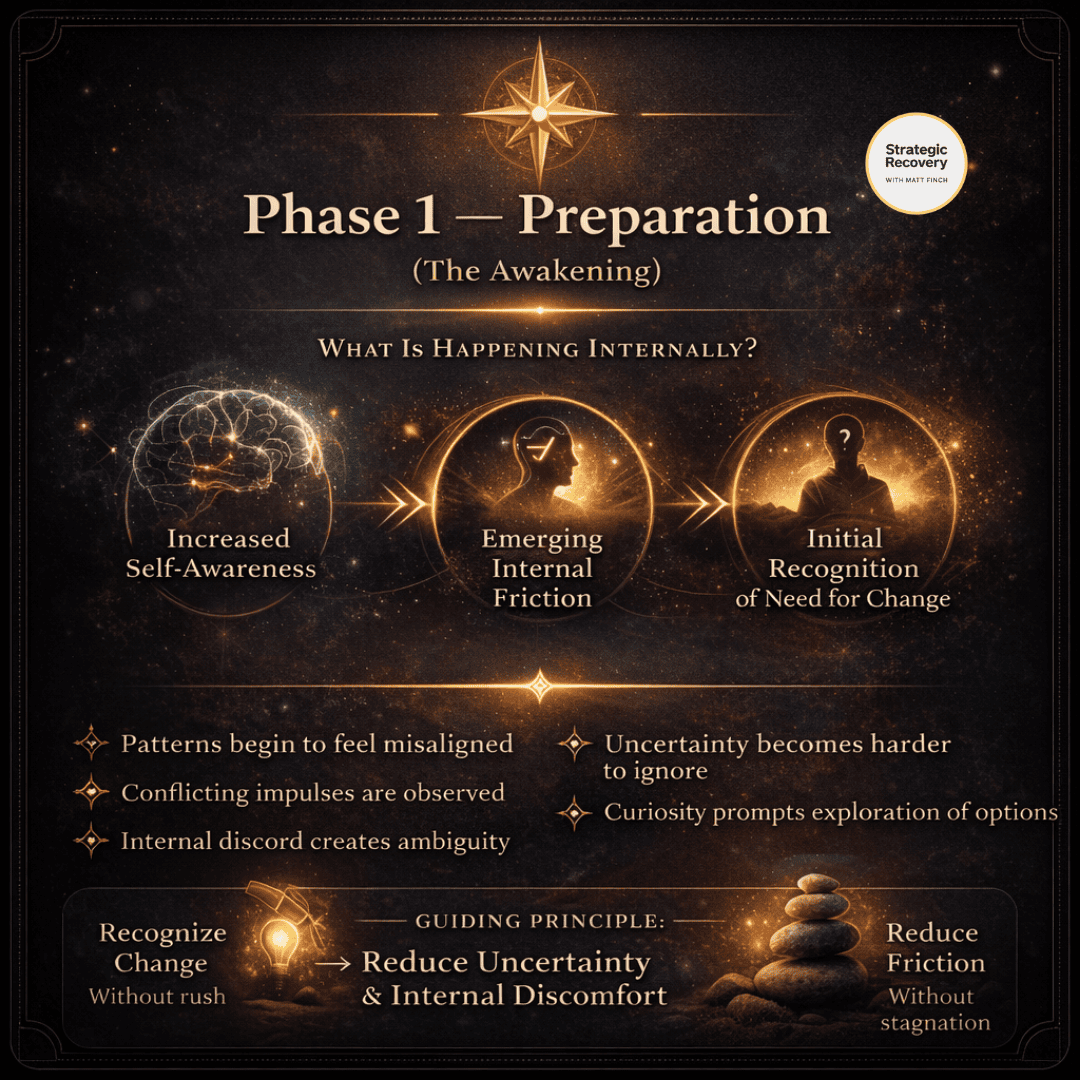
Phase 2 — Detoxification (The Release + Reset)
This is the phase where separation begins.
Where the substance or behavior is reduced… or removed.
And for many people, this is the most anticipated—and most feared—stage of the entire process.
That fear is not irrational.
Because this phase involves real physiological change.
Real discomfort.
Real instability.
But much of the fear surrounding detox comes from a limited definition.
Detox Is Not Just Withdrawal
In mainstream conversations, detox is often reduced to a single idea:
👉 “going through withdrawal.”
And while withdrawal can be part of detox…
it is not the full picture.
Detoxification is more accurately understood as:
👉 the process of removing an external regulatory input—and supporting the system as it recalibrates without it.
Two things are happening simultaneously:
- The substance or behavior is reduced or eliminated
- The biological system begins adjusting to its absence
Both matter.
Two Interdependent Processes
1. Separation from the Substance or Behavior
This is the most visible component.
The external input—the substance or behavior that has been regulating the system—is reduced or removed.
This can occur through two primary pathways:
Abrupt Cessation (Acute Withdrawal)
The substance or behavior is stopped completely.
Depending on the substance or behavior and level of dependence, this can involve:
- autonomic nervous system activation
- fluctuations in neurotransmitters
- sleep disruption
- emotional instability
- physical discomfort
From a systems perspective, this reflects a sudden loss of external regulation.
The brain and body must respond rapidly to maintain equilibrium.
Gradual Reduction (Tapering)
The substance or behavior is reduced incrementally over time.
This approach can:
- moderate withdrawal intensity
- reduce system shock
- allow for a more controlled transition
However, tapering is not universally viable. It requires:
- consistency in dosing
- behavioral control
- environmental stability
- and often, external support
In many real-world cases, these conditions are not fully present.
Which means:
👉 The appropriate strategy is not determined by preference—but by feasibility within the current system constraints.
Detox Settings (Context Matters)
Because detox is a physiological process—not just a behavioral one—the environment in which it occurs can significantly influence outcomes.
Common settings include:
- independent (at-home) detox
- outpatient programs
- medically supervised inpatient detox
- alternative medical approaches (e.g., ibogaine, NAD+, ketamine-assisted protocols)
Each option carries different levels of:
- medical oversight
- symptom management
- environmental control
- and risk mitigation
There is no universally “correct” setting.
Only the one that aligns with:
👉 the individual’s biological state, risk profile, and available resources.

2. System-Level Recalibration (Biological Reset)
This is the dimension of detox that is most frequently overlooked.
Because addiction does not only alter behavior.
It produces measurable changes across multiple biological systems:
- neurotransmitter production and receptor sensitivity
- stress hormone regulation (HPA axis)
- inflammatory signaling
- gut microbiome composition
- liver and cellular detoxification pathways
When the substance or behavior is removed…
these systems do not immediately normalize.
They enter a transitional state.
And without support, that state can feel:
- unstable
- uncomfortable
- and difficult to sustain
What Detox Actually Requires
Detox is not just the removal of an input.
It is:
👉 removal + stabilization.
That stabilization process involves supporting the body’s capacity to regulate itself again.
This typically includes:
- fluid balance and electrolyte support
- adequate protein and micronutrient intake
- liver support and antioxidant availability
- gut and digestion support
- reduction of additional physiological stressors
These are not optional enhancements.
They are foundational to reducing system strain during this phase.
Key Reframe
You are not just discontinuing a substance or behavior.
You are guiding a system through a period of reduced external regulation…
while it rebuilds its internal capacity to stabilize.
Daniel in Detox
Daniel elects to taper.
His alcohol intake is reduced gradually over a defined period.
The initial adjustment produces predictable effects:
- increased irritability
- restlessness in the evening
- disrupted sleep
Rather than interpreting these as failure…
they are understood as indicators of system transition.
He introduces basic structure:
- hydration earlier in the day
- protein intake to stabilize blood sugar
- magnesium to support nervous system regulation
The changes are not dramatic.
But they are directional.
Over time, variability decreases.
Stability begins to emerge.
Maya in Detox
Maya’s situation is different.
Due to the level of dependence, tapering is not viable.
She enters a medically supervised detox environment.
The early phase is intense:
- physical discomfort
- emotional fluctuation
- intermittent anxiety
But the environment provides containment.
Symptoms are managed.
Risk is reduced.
Most importantly:
👉 The process is completed.
Following detox, she transitions into the next phase with the substance removed—but the system still adapting.
Functional Reality of This Phase
Detox is often misunderstood as a phase of transformation.
It is not.
It is a phase of stabilization under constraint.
The system is operating with reduced support.
Capacity is limited.
Expecting high performance in this phase is a category error.
The objective is much narrower—and much more important:
👉 maintain stability while the system adjusts.
Key Principle
Detox is not where growth is built.
It is where destabilization is contained… and the reset begins.
And once that reset is underway…
the system becomes capable of entering the next phase:
👉 repair.
Phase 3 — Repair (The Rebuild)
This is the phase where expectations and reality often diverge.
Because the assumption is straightforward:
“Once I stop… I should start feeling better.”
But for many people, the experience is the opposite.
The substance is gone.
The behavior has stopped.
And yet:
- energy remains inconsistent
- mood fluctuates
- motivation is low
- sleep is still unstable
- and a general sense of “feeling off” persists
This discrepancy is what makes this phase so confusing.
From a behavioral perspective, progress has occurred.
But from a biological perspective…
👉 the system is still in transition.
What’s Actually Happening
During active addiction, the brain adapts to the presence of the substance or behavior.
This adaptation is not subtle.
It involves measurable changes in:
- neurotransmitter production
- receptor density and sensitivity
- stress response regulation
- baseline emotional tone
- and sleep architecture
For example:
- dopamine signaling becomes downregulated
- GABA and glutamate balance shifts
- endogenous opioid production decreases
- cortisol patterns become dysregulated
These changes allow the system to function with the substance.
But when the substance is removed…
those adaptations do not immediately reverse.
Instead, the system enters a temporary mismatch:
👉 the external input is gone—but internal regulation has not yet been restored.
This mismatch is experienced subjectively as:
- low motivation
- emotional variability
- fatigue
- irritability
- and reduced stress tolerance
The “Gap” Explained
A useful way to conceptualize this phase is as a regulatory gap.
Before:
After detox:
What remains is a gap between:
- what the system needs
- and what it can currently produce
And that gap is what you feel.
What Is Being Repaired
This phase involves coordinated recovery across multiple systems:
Neurotransmitters
- dopamine (motivation, reward)
- serotonin (mood stability)
- GABA (calm, inhibition)
- endorphins (natural pleasure and pain relief)
Endocrine Function
- cortisol regulation
- stress response normalization
- hormonal balance
Sleep Architecture
- REM/NREM balance
- sleep depth and continuity
- circadian rhythm stabilization
Nervous System Regulation
- reduced baseline hyperarousal
- improved parasympathetic activation
- increased tolerance for internal states
Collectively, this process is often referred to as:
👉 PAWS (Post-Acute Withdrawal Syndrome).

Critical Reframe
PAWS is frequently interpreted as regression.
From a systems perspective, it is the opposite.
👉 It is the active phase of repair.
The symptoms are not signs that something is wrong.
They are signs that something is recalibrating.
Daniel in Repair
Daniel has completed his taper.
Alcohol is no longer part of his daily routine.
But his internal experience is inconsistent.
Some days:
- he feels relatively clear
- more stable
- more present
Other days:
- energy drops unexpectedly
- irritability increases
- cravings reappear briefly
The variability is what stands out.
Instead of interpreting this as failure…
he shifts strategy.
He reduces unnecessary load.
Over time, the fluctuations begin to smooth.
Not instantly.
But reliably.
Maya in Repair
Maya’s experience is more emotionally pronounced.
Without opioids, her baseline sensitivity is fully exposed.
She experiences:
- waves of anxiety
- periods of fatigue
- moments of emotional intensity
Previously, these states were suppressed.
Now, they must be processed.
This requires a different skill set.
She begins learning regulation strategies:
- breathwork to reduce physiological arousal
- intentional rest instead of forced productivity
- structured support rather than isolation
At first, relief is intermittent.
But gradually, something new appears:
👉 self-generated stability.
Not constant.
But increasing.
The Objective of This Phase
This phase is often approached incorrectly.
People attempt to:
- optimize performance
- increase productivity
- accelerate progress
But those goals are misaligned with the system’s current capacity.
The primary objective here is not expansion.
It is:
👉 restoration.
Restoration of:
- baseline energy
- emotional stability
- physiological regulation
- and internal consistency
Common Misapplication
The most common error in this phase is applying pressure.
Attempting to “push through” low energy…
forcing productivity during instability…
expecting linear improvement…
These approaches increase system strain.
And often prolong the phase.
What Actually Works
Now that you know the most common error…
Here is what to focus on:
- reducing unnecessary demands
- maintaining consistent routines
- supporting biological recovery
- allowing variability without overreaction
This is not passive.
It is strategically conservative.
Key Principle
You do not rebuild a system by overloading it.
You rebuild it by:
👉 stabilizing, supporting, and allowing it to recalibrate over time.
Power Line
This phase does not require more discipline.
It requires more restoration.
And as restoration accumulates…
capacity begins to return.
Which makes the next phase possible:
👉 rewiring.

Phase 4 — Rewire (The Transformation)
At a certain point in the process, a qualitative shift begins to occur.
The system is no longer in constant instability.
Energy, while not perfect, is more consistent.
Emotional variability is still present—but more manageable.
Most importantly:
👉 there is now enough internal capacity to support change.
This is what defines the transition into the rewire phase.
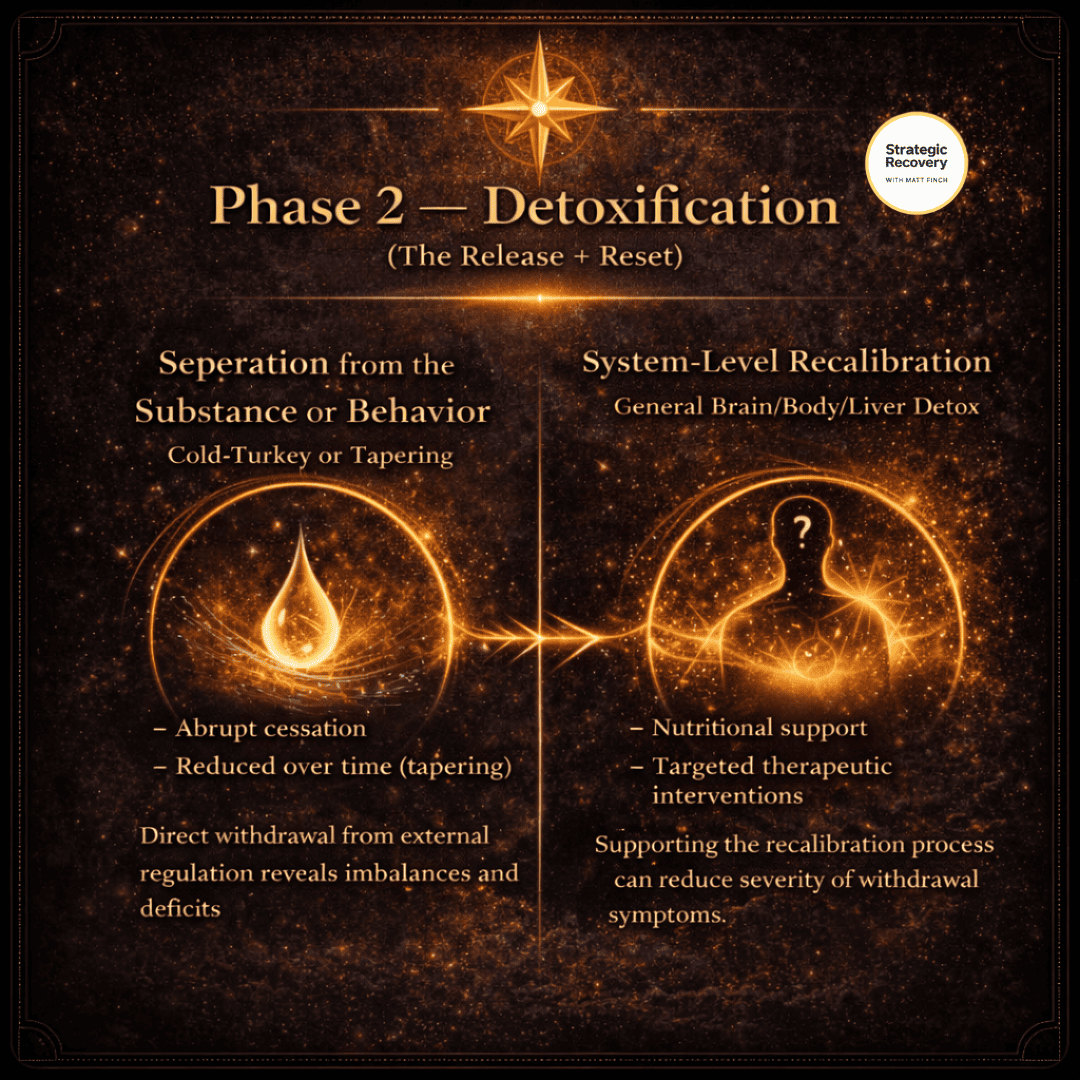
What’s Happening in This Phase
From a neurological standpoint, this phase is characterized by increased functional neuroplasticity.
Earlier in recovery, the brain is primarily focused on stabilization.
Now, it becomes capable of adaptation.
This means:
- new neural pathways can be formed
- previously dominant habit circuits can weaken
- alternative behaviors can be encoded and reinforced
At the same time, the reward system begins to recalibrate.
Activities that previously felt neutral—or effortful—start to produce:
- mild satisfaction
- incremental motivation
- increasing reinforcement
This shift is subtle at first.
But it is structurally significant.
Because it marks the point where recovery transitions from:
👉 effortful interruption
👉 constructive replacement.
From Suppression to Replacement
In earlier phases, the primary task is to stop or stabilize.
In this phase, the task changes.
It is no longer sufficient to remove the old pattern.
The system must be given new patterns to adopt.
Without this step, a vacuum remains.
And that vacuum increases relapse risk.
With this step, the process becomes self-reinforcing.
Daniel in Rewire
Daniel’s evenings were previously structured around alcohol.
That time window still exists.
But now, it is repurposed.
He introduces consistent alternatives:
- structured exercise
- low-stimulation wind-down routines
- reading or learning
Initially, these behaviors require conscious effort.
They do not produce the same immediate reward.
But through repetition…
something changes.
The behaviors become less effortful.
The resistance decreases.
The routine stabilizes.
Over time, the association shifts:

Maya in Rewire
Maya’s challenge is not just behavioral.
It is regulatory.
Opioids previously provided rapid emotional stabilization.
Now, she must develop internal alternatives.
She begins implementing:
- breathwork to downregulate arousal
- physical movement to shift state
- social connection to reduce isolation
At first, these interventions feel less effective.
Slower.
Less reliable.
But with repetition, two things happen:
This is the key dynamic of the phase:
👉 the system learns that regulation is possible without the substance.
Identity Begins to Shift
A secondary process begins to emerge here:
Identity reconstruction.
In earlier phases, the focus is on behavior.
Now, interpretation begins to change.
Instead of:
“I’m trying not to use”
The internal narrative becomes:
“I am someone who does not rely on that anymore”
This is not forced.
It is inferred from repeated behavior.
Common Misunderstanding
This phase is often approached as purely behavioral.
But behavior alone is insufficient.
The underlying requirement is:
👉 repetition under conditions of sufficient stability.
Without stability, repetition fails.
Without repetition, rewiring does not occur.
What Actually Drives Change
Not intensity.
Not motivation spikes.
But:
- consistency
- repetition
- environmental support
- and gradual reinforcement
Each repetition strengthens a pathway.
Each avoided pattern weakens another.
Over time, the balance shifts.
Key Principle
The brain does not change through insight alone.
It changes through repeated, reinforced experience.
Power Line
Repetition rewires what willpower never could.
And as these new patterns stabilize…
the system begins to enter a different state entirely:
👉 integration.
Phase 5 — Transcend (The New Normal)
This phase is often misunderstood.
Not because it is complex—
but because it is frequently described in extremes.
It is not perfection.
It is not constant clarity.
It is not the complete absence of difficulty.
What defines this phase is something more stable—and more sustainable:
👉 integration.
The major systems that were previously dysregulated…
have now reached a level of functional coherence.
Here is what coherence looks like:
- the nervous system is more consistently regulated
- baseline emotional variability is reduced
- stress can be processed without immediate destabilization
- and behavior is no longer dominated by a single pattern
This does not mean challenges disappear.
It means they can be absorbed without collapse.
What’s Happening in This Phase
By this stage, several long-term adaptations have occurred.
Here are the primary adaptations:
- neurotransmitter systems have stabilized at a new baseline
- reward circuitry has recalibrated to respond to natural inputs
- stress-response systems are less reactive and more flexible
- behavioral patterns have been replaced and reinforced
- identity has reorganized around new norms
The result is not constant elevation—
but increased capacity.
Capacity to:
- tolerate discomfort
- regulate internal states
- engage with life without requiring escape
What This Feels Like (Functionally)
The most noticeable change is not intensity.
It is absence of constant friction.
For example:
- thoughts about using are infrequent and non-compulsive
- decisions require less effort
- emotional states are more proportional to circumstances
- recovery behaviors are no longer “strategies”—they are default patterns
There is less internal negotiation.
Less resistance.
Less volatility.

Daniel in Transcendence
Daniel does not think about drinking in the same way he once did.
Not because he is actively resisting it—
but because it is no longer integrated into his operating pattern.
His evenings are structured differently.
His stress is managed differently.
His baseline state is different.
Alcohol is not something he is avoiding.
It is something that no longer fits within the system he has built.
Maya in Transcendence
Maya’s primary shift is internal.
Her system no longer requires external substances to create stability.
She can experience:
- emotional intensity
- stress
- discomfort
Without immediate dysregulation.
The need for escape has been replaced by the ability to regulate.
This does not eliminate difficulty.
But it changes her relationship to it.
What This Phase Represents
Here is a quick recap…
Earlier phases are defined by:
- stabilization
- restoration
- reconstruction
This phase is defined by:
👉 coherence.
Behavior, biology, and identity are no longer in conflict.
The system is not being managed moment-to-moment.
It is functioning as a whole.
Important Distinction
Transcendence does not mean immunity.
It means:
- higher resilience
- faster recovery from stress
- reduced reliance on external regulation
The difference is not that disruption never occurs—
but that it no longer leads to systemic collapse.
Key Principle
Recovery is complete when it is no longer something you are actively maintaining—
but something your system naturally sustains.
Power Line
You don’t fight addiction indefinitely.
You outgrow the conditions that made it necessary.
And from that point forward…
the focus is no longer on recovery itself—
but on what becomes possible because of it.

The Structural Reason Relapse Occurs
Relapse is often interpreted as a breakdown in discipline, motivation, or commitment.
From a systems perspective, a different pattern emerges.
In most cases, relapse is not caused by a lack of effort—
but by a misalignment between strategy and phase.
More specifically:
👉 interventions are applied outside of the system’s current capacity.
Common examples include:
- attempting behavior change during acute physiological instability
- introducing performance demands during ongoing biological repair
- expecting long-term identity shifts before foundational regulation is established
Each of these actions is valid in isolation.
But applied prematurely…
they increase system strain.
And when strain exceeds capacity…
the system defaults back to what it knows will restore stability quickly.
That default, in many cases, is the original addictive substance or behavior.
From this perspective, relapse is not random.
It is predictable under conditions of phase-strategy mismatch.
Core Principle
Recovery is not just determined by what you do.
It is determined by whether what you do is appropriate for the phase you are in.
When that alignment is absent, progress is inconsistent.
When that alignment is present, progress becomes far more reliable.
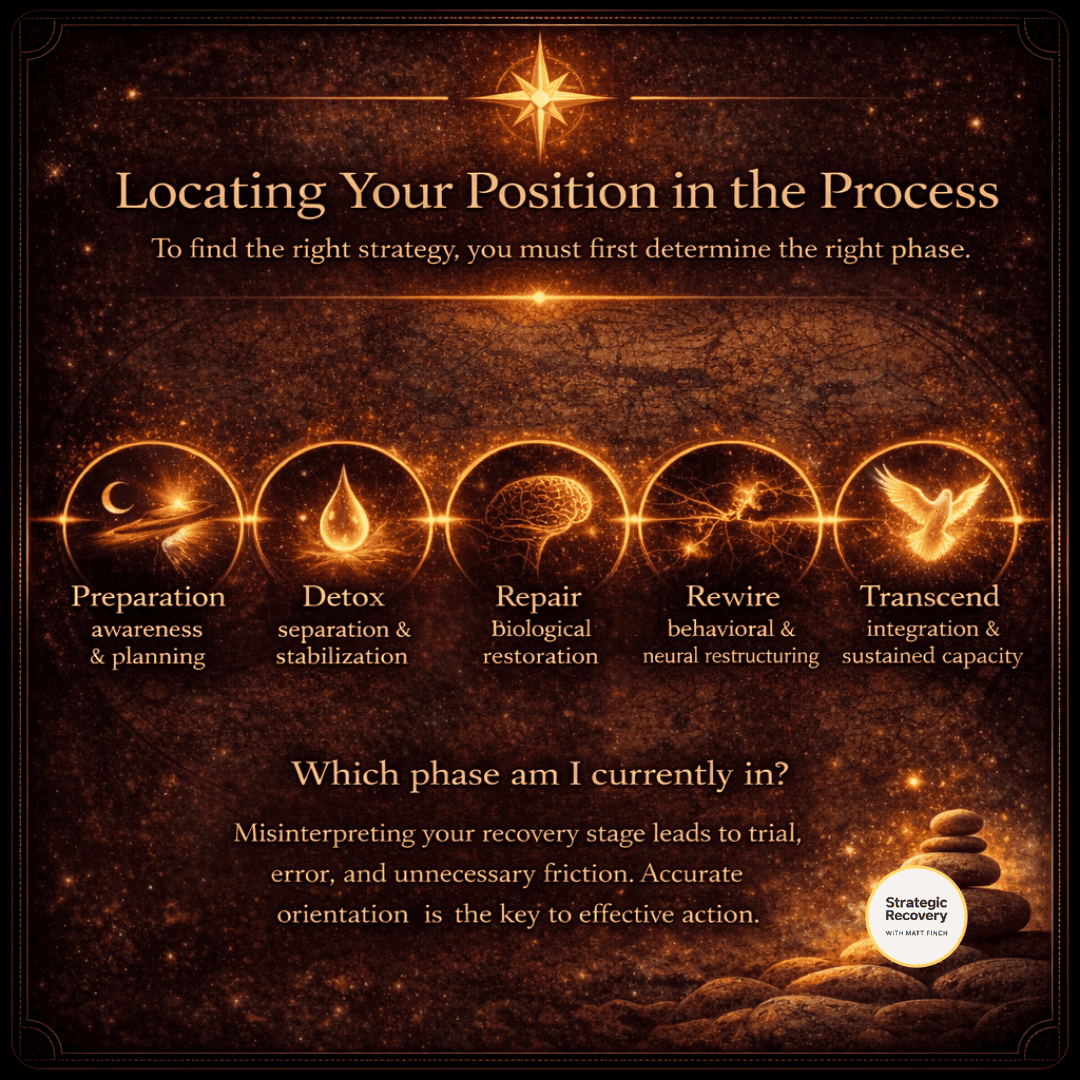
Locating Your Position in the Process
Once recovery is understood as a sequence…
the most useful question is no longer:
“What should I do next?”
It becomes:
“What phase am I currently in?”
Because the answer to that question determines:
- what your system is capable of
- what your primary objective should be
- and which strategies are most likely to produce results
A simplified orientation:
- Preparation → awareness and planning
- Detox → separation and stabilization
- Repair → biological restoration
- Rewire → behavioral and neural restructuring
- Transcend → integration and sustained capacity
Accurate placement within this sequence reduces unnecessary trial and error.
It also reduces misinterpretation.
What might previously have been labeled as “lack of progress”…
can often be understood as:
👉 a phase-appropriate experience.
Final Integration
When recovery is approached without structure…
it tends to feel inconsistent.
This looks like:
- periods of progress followed by regression
- clarity followed by instability
- effort followed by exhaustion
When recovery is organized as a sequence…
those patterns become more coherent.
Each phase has:
- a purpose
- a set of constraints
- and a set of appropriate actions
Understanding that structure does not eliminate difficulty.
But it changes how difficulty is interpreted—
and how it is responded to.
Instead of attempting to force outcomes…
the process becomes one of working with the system as it evolves.
Final Principle
Recovery is not a willpower problem.
It is a sequencing problem.
And when the sequence is understood…
everything that once felt chaotic
begins to organize.
🧭 Strategic Recovery™
A model built on:
- structure
- timing
- biological reality
- and phase-specific strategy
Not to replace effort—
but to make it effective.
👉 You don’t need more effort.
You need the right effort, applied at the right time.
Because when effort is aligned with the phase…
progress stops feeling random.
And starts becoming inevitable.
The 5 Phases of Strategic Recovery™ — Your Questions Answered
Think of this as your orientation guide to the map itself — what the phases mean, why timing matters, and how to stop applying the wrong strategy to the wrong stage of recovery.
-
1.What are the 5 phases of Strategic Recovery?
The five phases are Preparation, Detox, Repair, Rewire, and Transcend.
They describe recovery as a structured progression rather than a random struggle. Each phase has its own nervous-system reality, biochemical context, and strategic priority.
In simple terms: Preparation creates awareness, Detox creates separation, Repair rebuilds the biology, Rewire installs new patterns, and Transcend integrates a new normal.
-
2.Why does this framework matter so much for relapse prevention?
Because relapse often happens when people use a valid strategy at the wrong phase.
For example, trying to force behavior change during acute destabilization, or chasing identity-level transformation before the brain and body have finished repairing, creates unnecessary strain.
That is why the Strategic Recovery lens says relapse is often not a failure of character — but a failure of alignment between strategy and current system capacity.
-
3.How do I know which phase I’m currently in?
Start by asking what your system is actually struggling with right now.
Are you still in internal conflict and not fully committed? That points toward Preparation. Are you actively separating from the substance or behavior? That suggests Detox. Are you abstinent but still feeling off, flat, tired, irritable, or unstable? That often means Repair.
If you are building new patterns and your system can finally support repetition, that is usually Rewire. If recovery feels integrated and less effortful, you may be entering Transcend.
-
4.Is detox the same thing as withdrawal?
Not exactly. Withdrawal can be part of detox, but detox is broader than withdrawal.
Detox is the phase where external regulation is removed and the body begins adapting to its absence. That includes acute symptoms, but also nervous-system shock, sleep disruption, biochemical recalibration, and the need for environmental support.
That is why this article distinguishes between simple symptom language and a more complete systems-based detox model.
-
5.Why do so many people feel worse after they stop using?
Because stopping removes the external input, but the internal systems that adapted to it do not instantly return to normal.
That creates what this article calls a regulatory gap — the substance is gone, but the brain and body are still rebuilding their own ability to create stability.
This is the heart of Repair, and it is why symptoms like fatigue, emotional variability, low motivation, and sleep instability are often signs of ongoing biological repair, not proof that recovery is failing.
-
6.What is the real difference between Repair and Rewire?
Repair is about rebuilding the system. Rewire is about installing new patterns once the system can actually support them.
In Repair, the emphasis is on restoration: neurotransmitters, sleep, endocrine balance, nervous-system regulation, and internal stability.
In Rewire, the emphasis shifts toward neuroplasticity, repetition, replacement behaviors, and identity formation. That is when consistency begins to pay off in a deeper way.
-
7.What does “Transcend” actually mean? Is it just another word for perfection?
No. Transcend does not mean perfection, immunity, or constant bliss.
It means the major systems that were once dysregulated have reached a level of functional coherence. Stress can be absorbed without collapse. Recovery behaviors are no longer forced techniques — they feel more like defaults.
In other words, life is not frictionless. It is simply no longer organized around the same chronic instability.
-
8.Do people move through the phases in a perfectly linear way?
No — but the overall sequence still matters.
Recovery is often nonlinear in feel while still being sequential in structure. You may wobble, regress temporarily, or touch elements of multiple phases at once.
But that does not erase the fact that the system still tends to move from awareness → separation → restoration → rewiring → integration.
-
9.What if I’m doing a lot of things “right” but still not getting better?
Then the question may not be whether your efforts are good in isolation — but whether they are phase-appropriate.
The article’s core principle is that recovery is not determined only by what you do. It is determined by whether what you do matches the phase you are in.
That is why this map can reduce so much confusion: it helps explain why excellent tools can still fail when used at the wrong time.
-
10.How should I use this 5-phase guide in real life?
Use it as an orientation tool, not as a perfectionistic scorecard.
Its job is to help you identify where you are, reduce misinterpretation, and focus on the next most appropriate task.
If you want help applying this map to your own situation, Strategic Recovery coaching can help you identify your current phase, clarify your constraints, and build a more precise plan forward.
This FAQ is educational and not medical advice. Recovery is highly individual, and the right support depends on your biology, history, risk profile, environment, and current phase of healing.

Strategic Recovery Coaching with Matt Finch
Whether you are in Preparation, Detox, Repair, Rewire, or Transcend, Matt Finch helps you identify your current phase, clarify what your system is actually ready for, and build a recovery strategy that matches your real capacity — so progress becomes more structured, more intelligent, and far more reliable.




Leave a Reply