Now Playing: Episode #41 — Sunlight Is a Recovery Supplement
This page hosts the full Strategic Recovery Podcast audio episode [51min 🎙️] — a paradigm-shifting reframe: addiction doesn’t just alter chemistry… it alters timing. We break down circadian injury (late nights, junk light, unnatural dopamine spikes, fragmented sleep) and show how misalignment amplifies “low tanks” — making cravings, anxiety, and impulsivity worse than they need to be. Then we reveal the identity pivot: you are a solar-regulated organism — and light is upstream of half your recovery stack. You’ll learn why cravings often spike in the 4–8 PM window, why morning light helps set melatonin at night, and how to implement the Strategic Light Protocol: the Law of Morning Light, the Law of Midday Dose, and the Law of Night Protection. Finally, we close with a simple 7-day experiment to test the shift in your sleep, mood, energy, and urge intensity.
☀️ Rhythm beats willpower — restore the signal, and the nervous system remembers how to regulate.
Strategic Recovery Field Notes ☀️
Strategic Recovery with Matt Finch — Episode 41 Show Notes
This episode is a systems upgrade. Not motivation. Not hype. A practical reframe: circadian rhythm is recovery infrastructure.
Use these notes as a compass — not a checklist. Your job isn’t perfection. Your job is signal, timing, and consistency.
☀️ Quick Navigation
Reframe · Mechanism · Case Study · Protocol · Archetype · Identity · Challenge
- 🎬 Cold Open — Medicine With No Label
- 🕰️ Act I — The Real Problem Isn’t You. It’s Your Clock.
- 🌞 Act II — You Are a Solar-Regulated Organism
- 🗺️ Act III — Why San Diego vs New York Matters
- 🏗️ Act IV — The Strategic Light Protocol (3 Laws)
- 🌈 Act V — The Sun as Archetype (Symbol, Not Dogma)
- 🧬 Act VI — From Dimmed to Aligned
- 🔥 Closing — 7-Day Ritual Challenge
- 🔑 Key Concepts
🎬 Cold Open — “Medicine With No Label”
Imagine a “supplement” that stabilizes dopamine, improves sleep, lowers inflammation, strengthens motivation, and reduces cravings — with no prescription, no pharmacy, and no insurance approval.
Just… step outside.
- Addiction doesn’t just hijack dopamine. It hijacks daylight.
- Recovery isn’t only quitting substances — it’s rebuilding rhythm.
- This episode introduces circadian injury, the late-day craving spike, the 3 Laws of Light, and a 7-day experiment.
Promise: By the end, you’ll understand why rhythm — not willpower — may be the missing piece in addiction recovery.
🕰️ Act I — The Real Problem Isn’t You. It’s Your Clock.
Most recovery conversations focus on dopamine depletion, trauma, triggers, and environment. All important. But almost nobody talks about circadian damage.
The 5-part circadian assault
- Keeps you up late.
- Exposes you to artificial blue light at night.
- Spikes dopamine at unnatural hours.
- Blunts morning alertness.
- Fragments deep sleep.
That’s not random. That’s a timing injury.
What misalignment actually does
- Cortisol peaks too late
- Melatonin releases too late
- Sleep becomes shallow
- Afternoon crashes intensify
- Dopamine timing destabilizes
- Impulse control decreases
A dysregulated clock amplifies “low tanks” (Ep. 39): low catecholamines, low serotonin, low GABA, blood sugar instability, and low endorphin tone.
Reframe: Addiction can function like a circadian disorder layered on top of neurochemical depletion.
The Late-Day Relapse Window (4–8 PM)
This connects to Ep. 37 (The Urge Window). Cravings spike late afternoon because the body hits a predictable collision:
- Cortisol misalignment
- Blood sugar dip
- Dopamine dip
- Fatigue rising
- Prefrontal cortex weakening
When rhythm collapses, urges compress. That’s physiology — not character failure.
🌞 Act II — You Are a Solar-Regulated Organism
You are not just a brain in a skull. You are a light-sensitive biological system. Your body converts light into hormones, neurotransmitters, and behavior.
ipRGCs: the “timekeeper” cells
- Special retinal cells that detect brightness
- Signal your master clock (SCN)
- Clock sets hormone timing
Light → retina → clock → hormones → behavior.
The 3 timing levers
- Cortisol (morning fuel)
- Melatonin (night repair)
- Dopamine (daytime drive)
When timing improves, discipline stops feeling like war.
Cortisol: not just “stress”
- Morning light anchors the surge early
- More alert mornings
- Smoother afternoons
- Calmer evenings
Melatonin: the payoff
- Morning light determines nighttime sleep
- Miss morning light → melatonin delays
- Delayed melatonin → wired nights
- Wired nights → fragmented recovery
Dopamine: pursuit, not pleasure
Bright daylight supports alertness, learning, focus, and motivation — while artificial light at night can shift dopamine timing and increase impulsivity.
Key line: Sunlight is upstream of half your recovery stack.
Endorphins + Nitric Oxide + “Sun as medicine”
- UV exposure can stimulate endorphins (comfort chemistry)
- UVA can release nitric oxide (circulation support)
- Red/infrared may support recovery signaling
Strategic Recovery stance: avoid burns, avoid fear, avoid dogma. Practice dose, timing, and consistency.
🗺️ Act III — Why San Diego vs New York Matters
This act is a case study — not an overclaim. For years in sunny San Diego, opioids stayed recreational. In upstate New York, within two years, opioid addiction became severe.
Many variables changed: supply, stress, isolation, environment. And one variable almost nobody discusses: light exposure.
The hypothesis: when sunlight drops, circadian drift increases — and vulnerability can increase.
Vitamin D: the silent epidemic layer
- Indoor life → chronic underexposure
- Low D correlates with fatigue, mood issues, pain
- Seasonal vulnerability patterns matter
Say it with precision
I’m not claiming sunlight prevents addiction.
I’m saying deficiency may increase vulnerability — and restoring signal may reduce vulnerability.
A hypothesis worth considering
What if these four factors combine to intensify reward sensitivity?
- Low vitamin D
- Low endorphin tone
- Low mitochondrial energy
- Circadian misalignment
Not mystical. Biological. And consistent with lived experience.
🏗️ Act IV — The Strategic Light Protocol
Three laws. Simple. Repeatable. This isn’t tanning culture. This is timing repair.
🟡 Law #1 — Morning Light
- Within 30–60 minutes of waking
- 5–10 minutes outside (cloudy: double)
- No phone. No staring at the sun.
- No sunglasses if safe.
Call it: The Sovereign Start.
🟠 Law #2 — Midday Dose
- Non-burning exposure
- Skin-tone dependent dosing
- Build slowly. Never burn.
- Strategic exposure, not obsession
Goal: vitamin D + endorphin tone + recovery signaling.
🔵 Law #3 — Night Protection
- 90–120 minutes before bed: dim lights
- Reduce overhead LEDs
- Avoid bright screens
- Optional: 2 minutes outside at sunset
Morning light sets the clock. Night darkness protects the clock.
Optional Phase 2 stacks
Light + regulation inputs
- Sun + Walk
- Sun + Slow Exhale Breathing
- Sun + Grounding
- Sun + Cacao ritual
- Sun + Cold rinse
This bridges perfectly into breathwork and biohacking episodes — because once rhythm returns, everything else works better.
🌈 Act V — The Sun as Archetype
Across cultures, light has always symbolized clarity, order, and awareness — not because humans were naïve, but because they were observant.
In the Law of One, white light separates into a spectrum. You can take that spiritually or biologically — because the same principle exists in your body:
- White light → spectrum
- Morning light → cortisol / dopamine / activation
- Night darkness → melatonin / repair / integration
Light is an organizing principle. Addiction is disorganization. Recovery is reorganization.
🧬 Act VI — From Dimmed to Aligned
Sometimes addiction isn’t you getting worse. It’s your biology getting dimmer.
- Dimmer mornings
- Dimmer energy
- Dimmer motivation
- Dimmer hope
And in a dimmed system, artificial intensity feels like salvation. But when you restore the signal, discipline feels different — not because you became tougher, but because your system became aligned.
What alignment changes
- Energy stabilizes
- Cravings soften
- Mornings become clearer
- Evenings become calmer
- Motivation rises naturally
The identity pivot
You were not weak.
You were mis-timed. Overstimulated at night. Understimulated in the morning. Depleted. Fragmented. Dimmed.
When rhythm is broken, recovery feels like war. When rhythm is restored, recovery feels like structure. And structure builds identity. Identity builds freedom.
🔥 Closing — 7-Day Ritual Challenge
Run the experiment before you debate the philosophy. Seven days. Simple. Measurable.
Your ritual
- Morning: 7 minutes outside
- No phone
- No rushing
- Just light + presence
Track these signals
- Sleep depth
- Afternoon cravings
- Mood stability
- Energy
- Impulse control
The sun is ancient. Patient. Generous. Free.
Recovery is not just quitting poison.
It’s rebuilding rhythm.
Tomorrow morning: seven minutes. Outside. No phone. Just light.
Next episode: we regulate from the inside with breath.
🔑 Key Concepts
- ☀️ Sunlight as a supplement: a primary regulatory input — not a wellness accessory.
- 🕰️ Circadian injury: addiction alters timing (sleep, dopamine spikes, light exposure) — not just chemistry.
- 🧠 Timing = chemistry: misalignment destabilizes cortisol, melatonin, dopamine, and impulse control.
- 🌞 ipRGC timing cells: retina → master clock → hormones → behavior.
- 🌙 Morning light sets night sleep: consistent AM light supports melatonin timing.
- ⏳ Late-day relapse window: 4–8 PM spikes when fatigue + dips + misalignment collide.
- 🏗️ 3 Laws of Light: Morning Light · Midday Dose · Night Protection.
- 🧬 Dimmed → aligned: restore signal and discipline stops feeling like war.
- 🧪 7-day experiment: measure sleep, cravings, mood, energy, impulse control.
- 🗝️ Core anchor: rhythm beats willpower.
Bottom line: restore the signal — and your nervous system remembers how to regulate.
Morning light is not decoration.
It is instruction.
When rhythm returns, regulation follows. ☀️
Sunlight: The Game-Changing Addiction Recovery Secret No One’s Talking About
A practical deep-dive that pairs perfectly with Episode 41 — the circadian “why,” the biological “how,” and the simple steps that make rhythm feel possible again.
Episode 41 Resources
Curated links referenced in Episode 41 — designed to deepen the “rhythm first” reframe and connect your Phase 2 arc (Low Tanks → Urge Window → Circadian repair).
- Ep. 39 — The 5 Low Tanks of Recovery Neurochemical depletion • Low resilience • Why rhythm amplifies “low tanks”
- Ep. 37 — The Urge Window Impulsivity timing • 4–8 PM vulnerability • Widen the decision window
- The Vitamin D Deficiency Epidemic Chronic pain • Fatigue • Mood vulnerability • “Sunshine” physiology context
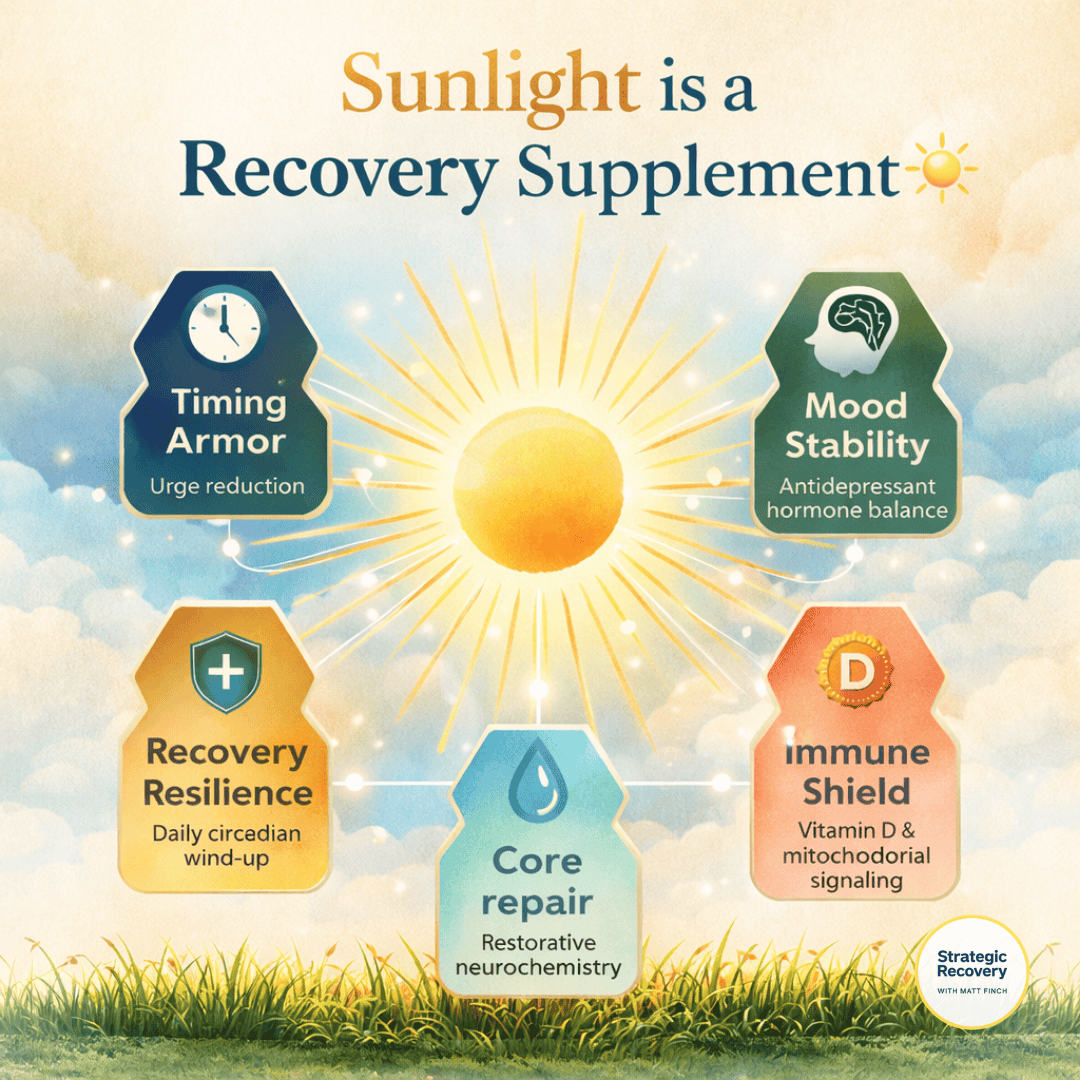
Sunlight is not lifestyle fluff.
It is circadian architecture.
When morning light calibrates your biology,
cravings soften, mood stabilizes,
and recovery gains structure. ☀️
Regulation begins with rhythm.
Frequently Asked Questions — ☀️ Rhythm, Light, & Recovery
Grounded answers to help you apply the episode without hype: circadian repair, morning light timing, late-day cravings, vitamin D, safety, and the 7-day experiment.
-
When you say “sunlight is a recovery supplement,” what do you mean?
Sunlight is upstream of regulation. It’s not “motivation.” It’s a timing signal.
Morning light tells the brain: “It’s daytime — activate.” That anchors your daily rhythm so hormones, energy, mood, and impulse control have a stable schedule to organize around.
Translation: you’re not adding fluff — you’re restoring circadian architecture.
-
Why do cravings often spike in the late afternoon or evening?
Because your system is running a predictable collision: fatigue + dopamine dip + blood sugar instability + reduced executive control.
When rhythm is off, the “urge window” compresses — decisions become faster, more emotional, more reactive.
Strategic move: strengthen the morning signal, stabilize midday fuel, and protect evening darkness. The relapse window shrinks.
-
How soon after waking should I get outside — and for how long?
Target within 30–60 minutes of waking.
Start with 5–10 minutes outside. Overcast? Double it. No staring at the sun. No pressure for perfection.
The win condition is consistency. You’re training timing, not chasing intensity.
-
Do I need direct sun, or does shade / cloudy weather still work?
For circadian timing, you mainly need bright outdoor light (even if it’s cloudy). Shade can still help.
For vitamin D, you typically need more direct exposure — but we’re not making tanning a religion.
Rule: get outside daily for the timing signal; treat “midday dose” as optional and skin-tone dependent.
-
What are the “3 Laws of Light” from the episode?
Law #1: Morning Light. Anchor your clock early.
Law #2: Midday Dose. Non-burning exposure (optional) for mood, vitamin D, and resilience.
Law #3: Night Protection. Dim the environment 90–120 minutes before bed so the clock can complete the cycle.
Morning light sets the clock. Night darkness protects the clock.
-
If I do morning light, will my sleep improve automatically?
Often it improves — but it’s not instant magic.
Morning light helps shift timing, but sleep depth also depends on stress load, blood sugar stability, caffeine/alcohol history, and nighttime light exposure.
Best stack: morning light + protein breakfast + evening dimming = faster momentum.
-
Is vitamin D the main reason sunlight helps recovery?
Vitamin D matters — but it’s not the only mechanism.
Sunlight also delivers a powerful timing signal that organizes cortisol, melatonin, alertness, and rhythm.
Think of it like this: vitamin D is one benefit. circadian alignment is the operating system upgrade.
-
What if I work nights or have a chaotic schedule?
Do the experiment relative to your wake time.
Get bright outdoor light after your “morning,” and protect darkness before your “night.”
Goal: create one stable anchor (wake time + first light exposure) so your body has something predictable to organize around.
-
Is this safe for everyone? What about medications and skin risk?
Use common sense and protect your skin. Never burn.
Some medications increase photosensitivity, and some health conditions require extra caution.
Best practice: keep the morning practice gentle (short exposure, no staring at sun), and consult your clinician if you have concerns.
-
What’s the 7-day “Ritual Challenge” and what should I track?
For 7 days, go outside for 7 minutes in the first hour after waking — no phone.
Track: sleep depth, afternoon cravings, mood stability, energy, and impulse control.
Run the experiment before you debate the philosophy. The body will tell the truth.
These FAQs are educational, not medical advice. Keep what increases stability and clear choice — and remember: regulation begins with rhythm.
🙏 Thank you for being part of the Strategic Recovery community.
👉 Click Here and Right Click to Save As to Download>>
🎧 Available on your favorite platform:




Leave a Reply