
You Don’t Just Have Cravings — Your Nervous System Is Dysregulated
(Here’s How to Fix It) | Episode 42
This page hosts the full Strategic Recovery Podcast audio episode [1hr 50min 🎙️]— a deep dive into why cravings, anxiety, and relapse
are often driven by nervous system dysregulation, not lack of discipline.
Inside, you’ll learn how shallow breathing, stress physiology, and internal state create the conditions for urges — and how to use
breathwork as a real-time regulation tool to interrupt patterns, calm your system, and regain control.
Featuring the Survival Breathing Pattern™, the Relapse Storm™, the 4 Breath Levers of Recovery™,
and the Urge Interruption Protocol™.
Change your breath. Change your state. Change your life.
Strategic Recovery Field Notes
Strategic Recovery with Matt Finch — Episode 42 Show Notes
This episode answers a deeper recovery question: What if cravings, anxiety, overthinking, and relapse risk are being amplified by the state of your body?
These notes are designed to help you see the pattern, understand the mechanism, and begin applying real-time nervous system regulation through breath. Use them as a reflection guide — not a perfection standard.
Quick Navigation
State · Breath · Cravings · Regulation · Integration
- Act I — The Paradigm Shift
- Act II — The Survival Breathing Pattern
- Act III — The Relapse Storm
- Act IV — Breathwork as the Fastest Lever
- Act V — My Story: The Turning Point
- Act VI — The Breathwork System
- Act VII — The Urge Interruption Protocol
- Act VIII — When Breathwork Isn’t Enough
- Close — Identity Shift & Final Integration
Act I — The Paradigm Shift
Most people in recovery think they have a craving problem, an anxiety problem, or a willpower problem.
But this episode introduces a deeper reframe: you’re not just addicted to the substance — you’re addicted to escaping the state your body keeps putting you in.
If the body is producing tension, urgency, restlessness, subtle panic, and low-grade internal discomfort, then the nervous system will naturally search for relief.
That means cravings are not always moral failures or random urges. Very often, they are signals of dysregulation.
Act II — The Survival Breathing Pattern
Many people live inside what this episode calls the Survival Breathing Pattern™: shallow chest breathing, unconscious breath holding, irregular rhythm, tight diaphragm, and subtle chronic activation.
The Pattern
- Shallow chest breathing
- Breath holding without realizing it
- Uneven or chaotic rhythm
- Subtle muscular bracing
- Low CO₂ tolerance
- Constant background activation
The Effect
- More overthinking
- More future anxiety
- More rumination
- More negativity bias
- More urgency
- More cravings
Core insight: your body feels unsafe, so your mind creates thoughts that match that feeling.
Act III — The Relapse Storm
This episode names a repeatable pattern many people misinterpret as weakness: The Relapse Storm™.
The Conditions
- Low blood sugar from under-eating or skipped meals
- Low amino acids and neurotransmitter depletion
- Shallow breathing or breath holding
- Stress chemistry rising in the background
The Result
- Adrenaline and noradrenaline increase
- Thoughts begin to race
- Everything feels more urgent and intense
- Cravings hit as a loud demand for relief
In this frame, relapse is not simply “I had a bad thought and acted on it.” The deeper sequence is: State → Thought → Behavior.
Signature reframe: a dysregulated body creates distorted thoughts, and then you try to solve them with willpower.
Act IV — Breathwork as the Fastest Lever
Supplements take time. Food takes time. Sleep takes time. But breath can shift your state right now.
The 4 Breath Levers of Recovery
- Chemistry — oxygen, CO₂ balance, brain function
- State — sympathetic vs parasympathetic tone
- Thoughts — clarity vs chaos
- Urges — intensity, duration, control
The Core Principle
Your breath is the fastest way to change how you feel — and how you feel determines what you do next.
Change your breath. Change your state. Change your choices.
Act V — My Story: The Turning Point
This episode also grounds the teaching in lived experience: years of shallow breathing, unconscious breath holding, anxiety, social anxiety, and discomfort in the body — even while doing “the work.”
The turning point came through a simple realization: shallow breathing and breath holding were creating a state of overthinking, anxiety, and mental noise.
Returning to diaphragmatic breathing and consistent breath practice began shifting the baseline: thoughts slowed down, anxiety dropped, and the sense of internal control increased.
The deeper realization: breath is not just a tool — it is a gateway to stability, clarity, control, and something higher.
Act VI — The Breathwork System
Not all breathing practices serve the same purpose. The episode organizes them into a practical hierarchy: foundation first, regulation second, advanced exploration last.
Level 1 — Baseline Breathing
- Nasal breathing
- Diaphragmatic breathing
- Reducing unconscious breath holding
- Slowing and smoothing the rhythm
This is the foundation most adults have lost.
Level 2 — Real-Time Regulation
- Box breathing
- Physiological sigh
- Cadence breathing
- Alternate nostril breathing
These are the tools you use when it matters.
Important note: you do not need advanced breathwork to transform your recovery. Most of the benefit comes from simplicity, consistency, and daily repetition.
Act VII — The Urge Interruption Protocol
When cravings hit, most people go into the mind: they argue, resist, negotiate, distract, or shame themselves. But they do not regulate the state underneath the urge.
The Protocol
- Stop
- Shift attention to the breath
- Breathe for 1–3 minutes
- Slow the exhale
- Let the wave pass
- Then decide what to do
Core line: you don’t fight the urge — you regulate the state creating the urge.
Default daily protocol: 5–10 minutes of box breathing every day, plus 1 minute anytime you feel stressed, anxious, or triggered.
This one habit can begin changing your baseline steadily, reliably, and cumulatively.
Act VIII — When Breathwork Isn’t Enough
This episode stays grounded: for some people — especially those with deeper trauma, severe anxiety, or chronic dysregulation — breathwork alone may not be enough.
When More Support Helps
- Neurofeedback
- Guided nervous system work
- Therapeutic support
- Structured routines and stronger external scaffolding
The Implementation Ladder
- Awareness
- Micro-practice
- Daily practice
- Integration into life
- Expansion when ready
Bottom line: start small, stay consistent, and let it compound.
Close — Identity Shift & Final Integration
The goal is not merely to become someone who can “fight cravings harder.” The deeper goal is to become someone who can regulate their own state.
When you can regulate your state, you do not need to fight as hard, panic as quickly, or get pulled as strongly by impulses.
You become calmer. Clearer. More stable. More grounded. More in control.
Final line: recovery isn’t just about resisting urges — it’s about becoming someone who knows how to regulate their own state.

Key Concepts
The core ideas that shift recovery from willpower-based struggle to real-time nervous system regulation.
- Cravings are state-driven — your body often creates the urge before your mind explains it.
- The Survival Breathing Pattern™ keeps the nervous system in chronic low-grade activation.
- State → Thought → Behavior — physiology shifts first, thinking follows, then action.
- The Relapse Storm™ is a collision of low fuel, stress chemistry, and dysregulated breathing.
- Breath is the fastest lever for shifting your internal state in real time.
- Slow exhales reduce activation and widen the gap between urge and action.
- Consistency beats intensity — daily practice rewires baseline state.
- Recovery becomes identity when you become someone who can regulate their own state.
Episode 42 Resources
Key Strategic Recovery articles and external guides referenced in this episode — focused on nervous system dysregulation, cravings, blood sugar, neurotransmitters, and foundational breathwork.
- Nervous System Dysregulation & Addiction (Ep. 14) How dysregulation increases relapse vulnerability, emotional intensity, and internal instability
- Low Blood Sugar & Addiction Why blood sugar crashes can amplify cravings, urgency, and emotional instability
- Low Neurotransmitters & Addiction (Ep. 16) How depleted mood tanks affect cravings, mood, anxiety, and relapse risk
- The Urge Window & Impulsivity (Ep. 37) How to widen the gap between feeling an urge and acting on it
- Getting Started with Box Breathing (WebMD) A simple starting guide to one of the most practical breathwork tools for regulation
- Alternate Nostril Breathing (Healthline) A foundational breath practice for balancing the nervous system and calming the mind
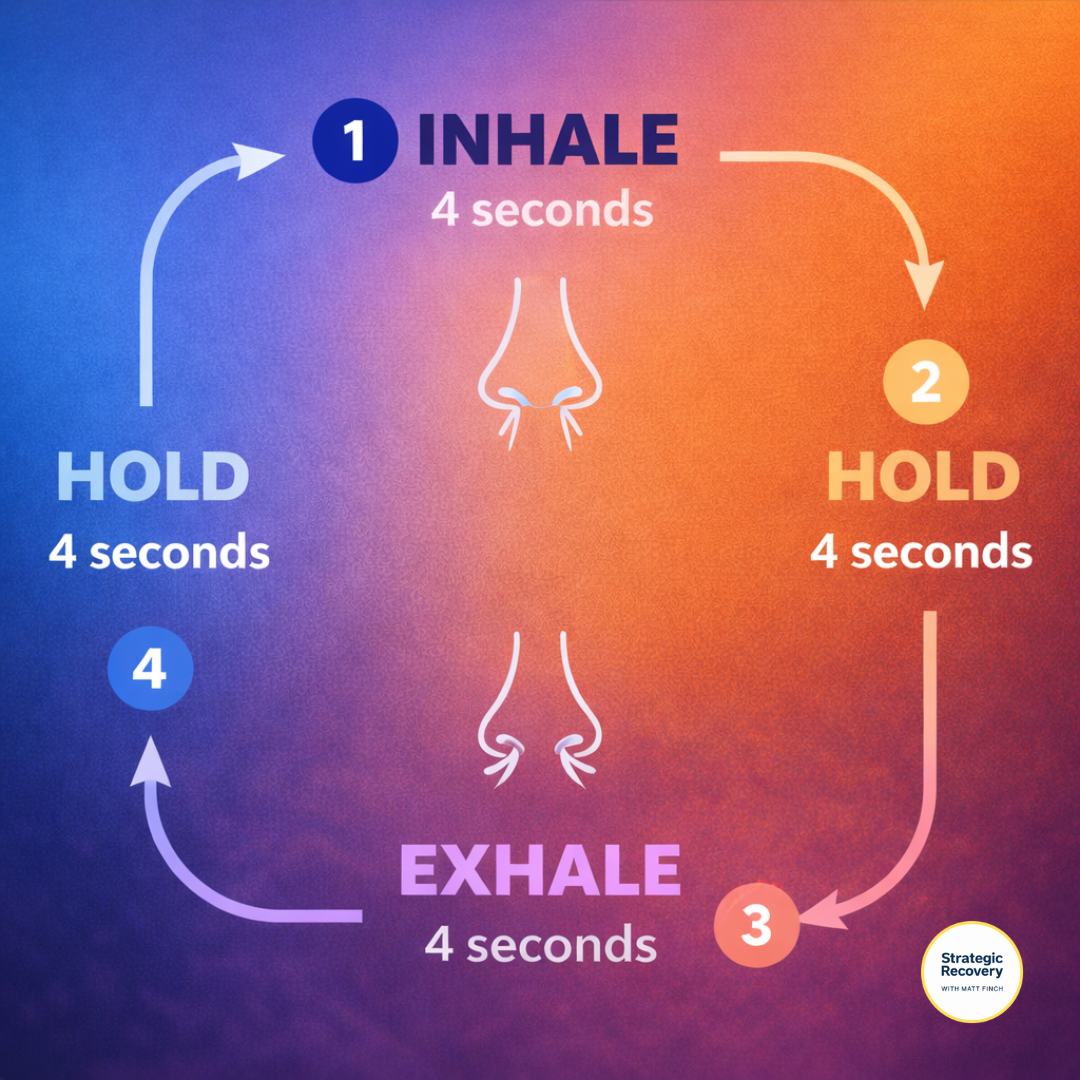
Box Breathing
One of the simplest ways to calm your nervous system in real time. Inhale through the nose for 4 seconds, hold for 4 seconds, exhale through the nose for 4 seconds, then hold again for 4 seconds.
Frequently Asked Questions — Nervous System Regulation and Breathwork
Clear, grounded answers to help you apply the episode fast: dysregulation, cravings, breathwork, urge interruption, and how to build a calmer baseline in recovery.
-
What does it mean to say “your nervous system is dysregulated”?
It means your body is spending too much time in a state of subtle or obvious threat activation.
That can look like tension, overthinking, urgency, shallow breathing, irritability, sleep disruption, or feeling “off” even when life is relatively calm.
Translation: your system is not broken — it is over-activated and under-regulated.
-
How does this connect to cravings and relapse?
Cravings often intensify when your internal state becomes difficult to tolerate.
If your body is creating tension, urgency, agitation, or mental noise, your brain will naturally search for relief. That is why cravings are often less about “wanting the substance” and more about wanting relief from the state.
State drives urge intensity.
-
What is the Survival Breathing Pattern™?
It is the pattern of shallow chest breathing, subtle breath holding, irregular rhythm, and chronic low-grade activation that keeps the body signaling “stay alert.”
When that pattern becomes your baseline, your mind starts generating thoughts that match the signal: more overthinking, more future anxiety, more urgency, and eventually more cravings.
Core idea: your body feels unsafe, so your mind creates thoughts that match that feeling.
-
Why does shallow breathing increase overthinking and anxiety?
Because breathing patterns influence chemistry, nervous system tone, and your internal stress signal.
Shallow breathing and breath holding can make the system more reactive, reduce calm, and create the kind of body-state that fuels racing thoughts and mental noise.
You do not always need to fix the thought first — sometimes you need to change the state producing it.
-
How fast can breathwork actually change how I feel?
Faster than most other tools.
Food takes time. Supplements take time. Sleep takes time. But breath can begin shifting your state within seconds to minutes.
That is why breathwork is so powerful: it is immediate, portable, and directly connected to your nervous system.
-
What is the best breathwork practice to start with?
For most people, the best place to start is simple diaphragmatic breathing plus a structured tool like box breathing.
That gives you both a healthier baseline pattern and a repeatable regulation tool you can use during stress, cravings, transitions, and before sleep.
Start simple. Repeat daily. Let it compound.
-
How do I use breathwork when a craving hits?
Pause first. Then shift attention away from the story and toward the breath.
Slow the exhale. Breathe for 1–3 minutes. Let the wave move through before making any decision.
Core principle: you do not fight the urge — you regulate the state creating the urge.
-
Why does the exhale matter so much?
The exhale is one of the fastest ways to signal “downshift” to the nervous system.
When you slow and lengthen the exhale, you help reduce activation and create more space between feeling and reacting.
Your exhale is your brake pedal.
-
What if I already know about breathwork but I do not do it consistently?
That is incredibly common. Knowing a tool and living a tool are not the same thing.
The shift happens when breathwork becomes part of your baseline rhythm — not just something you remember when things are already on fire.
Consistency beats intensity. One daily practice is more powerful than occasional inspiration.
-
Do I need advanced breathwork methods to get major benefits?
No. Most people can transform their baseline with simple, repeatable practices.
Advanced methods can be powerful, but they are not required for calmer days, fewer urges, better self-control, and a more regulated nervous system.
Daily basics usually beat occasional extremes.
-
What if breathwork helps, but it is not enough?
That does not mean you are broken. It usually means your system needs more support.
For deeper trauma, severe anxiety, or chronic dysregulation, it may help to pair breathwork with neurofeedback, therapeutic support, guided regulation work, or stronger routines and external structure.
Breath remains foundational — but sometimes you need more leverage.
-
If I only take one action from this episode, what should it be?
Install one daily regulation anchor.
A simple starting point is 5–10 minutes of box breathing each day, plus one minute anytime you feel stressed, anxious, or triggered.
That one habit can begin shifting your baseline steadily, reliably, and cumulatively.
These FAQs are educational guidance, not medical advice. If you are tapering medications, managing panic symptoms, or working through trauma-related dysregulation, coordinate with a licensed clinician where appropriate.
🙏 Thank you for being part of the Strategic Recovery community.
👉 Click Here and Right Click to Save As to Download>>
🎧 Available on your favorite platform:



Leave a Reply