
The 3 High-Performance Habits That Prevent Relapse
Why Some People Transcend Addiction — While Others Slowly Drift Back | Episode 45
This page hosts the full Strategic Recovery Podcast audio episode — a deep dive into the hidden psychological and nervous system patterns that determine whether people slowly drift back into addiction… or transcend it permanently.
Inside, you’ll learn the 3 High-Performance Habits that strengthen long-term recovery: Clarity, Energy, and Necessity — and how these forces reshape identity, regulate the nervous system, increase emotional resilience, and make relapse progressively incompatible with who you are becoming.
Featuring the Relapse Drift Framework™, future-self identity conditioning, nervous system alignment, sustainable high performance, and the transition from merely fighting for freedom… to finally living from it.
The goal is not merely to quit the substance. The goal is to build a self the substance no longer fits.
Strategic Recovery Field Notes
Strategic Recovery with Matt Finch — Episode 45 Show Notes
This episode explores why some people transcend addiction while others slowly drift back into it. The answer is rarely just motivation. It often comes down to the strength of three stabilizing forces: clarity, energy, and necessity.
These notes are designed to help you recognize relapse drift, rebuild identity, generate sustainable energy, and create a life your nervous system no longer wants to escape from.
Quick Navigation
Identity · Energy · Alignment · Necessity · Freedom
- Act I — The Relapse Drift Framework™
- Act II — High Performance in Recovery
- Act III — Habit #1: Seek Clarity
- Act IV — Habit #2: Generate Energy
- Act V — Habit #3: Raise Necessity
- Act VI — The Integration Point
- Act VII — The Danger of Toxic High Performance
- Close — From Fighting for Freedom to Living From Freedom
Act I — The Relapse Drift Framework™
Most relapse does not happen suddenly. It happens gradually, quietly, and often long before the substance appears.
The drift begins when clarity fades, energy collapses, standards weaken, emotional exhaustion rises, and intentionality disappears.
People stop journaling. Then they stop walking. Then they stop getting sunlight. Then they isolate. Sleep worsens. Future vision fades. Stress rises. Eventually, escape becomes emotionally attractive again.
Core reframe: Most people do not relapse because they consciously choose destruction. They relapse because they slowly disconnect from the systems, identity, and energy that kept them aligned.
Act II — High Performance in Recovery
High performance in recovery is not hustle culture, toxic optimization, burnout, grinding, or productivity obsession.
True high performance means sustainable alignment between biology, behavior, energy, identity, mission, and nervous system coherence.
Strategic Recovery definition: high performance in recovery means regulated nervous system, stable biology, intentional behavior, meaningful direction, emotional resilience, sustainable energy, and deep congruence.
Act III — Habit #1: Seek Clarity
Confused people relapse faster. Without clarity, anxiety rises, impulsivity increases, emotional avoidance grows, and distractions multiply.
Self
Who are you becoming now?
- Emotionally regulated
- Disciplined
- Spiritually grounded
- Healthy
- Calm
- Sovereign
Social
How do you want to show up in relationships?
- Emotionally safe
- Compassionate
- Present
- Honest
- Reliable
- Boundaried
Skills
What capabilities does your future require?
- Communication
- Emotional regulation
- Fitness
- Financial health
- Leadership
- Spiritual development
Service
Who needs your healed self?
- Children
- Partners
- Clients
- Community
- Future generations
Future Identity Priming: write three words for your future self, relationships, emotional state, and purpose. Read them daily as nervous system identity conditioning.
Act IV — Habit #2: Generate Energy
Exhausted nervous systems crave escape. Many recovering people are depleted, inflamed, sleep deprived, dysregulated, emotionally overloaded, and dopamine depleted — and then they shame themselves.
Key reframe: what many people call laziness is often depleted biology and nervous system exhaustion.
Physical Energy
- Hydration
- Sunlight
- Movement
- Protein
- Minerals
- Sleep
Emotional Energy
- Boundaries
- Grief processing
- Reducing shame
- Healthy relationships
- Self-compassion
Mental Energy
- Reducing chaos
- Reducing digital overload
- Clarity
- Focused attention
Spiritual Energy
- Meaning
- Awe
- Nature
- Service
- Gratitude
- Coherence
Act V — Habit #3: Raise Necessity
Most people have preferences, wishes, and vague hopes. But transformation requires necessity.
Identity
Who do you refuse to be anymore?
Mastery
Redirect addictive intensity into healing, fitness, spirituality, creativity, learning, and service.
Duty
Who needs you healthy? Children, clients, partners, families, and future generations.
Urgency
Without urgency people drift. Without structure identity dissolves. Without deadlines dreams decay.
Core line: Addiction narrows consciousness. Mastery expands it.
Act VI — The Integration Point
Without clarity, people drift. Without energy, people collapse. Without necessity, people negotiate with relapse.
But with all three, people become resilient, intentional, focused, future-oriented, emotionally regulated, and mission-driven.
Deep reframe: the goal is not merely to quit the substance. The goal is to build a self the substance no longer fits.
Act VII — The Danger of Toxic High Performance
Healing must remain human. High performance is not self-destruction disguised as excellence.
This episode differentiates aligned growth from trauma compensation. Rest matters. Softness matters. Nervous system safety matters. Self-worth cannot depend on productivity.
Key line: true high performance is sustainable. If it requires self-destruction, it is not excellence. It is survival adaptation wearing a fancy suit.
Close — From Fighting for Freedom to Living From Freedom
One day the obsession is quieter. The nervous system feels calmer. The body feels safer. The future feels more real than the past.
You make coffee. Walk outside. Feel sunlight on your skin. And realize you are no longer fighting for freedom. You are living from it.
The opposite of addiction is not merely sobriety. It is aliveness.
Final line: you no longer feel like you are escaping yourself. You feel like you are becoming yourself.

Key Concepts
The core ideas that shift recovery from white-knuckling relapse prevention to identity-based alignment, nervous system stability, and embodied freedom.
- Relapse often begins as drift — clarity fades, energy collapses, standards weaken, and escape slowly becomes attractive again.
- High performance is not hustle culture — it is sustainable alignment between biology, behavior, energy, identity, mission, and nervous system coherence.
- Seek clarity — reconnect with your future self, your relationships, your skills, and the people your healed self is here to serve.
- Generate energy — rebuild physical, emotional, mental, and spiritual energy so your nervous system no longer craves escape.
- Raise necessity — make recovery emotionally real through identity, mastery, duty, and intentional urgency.
- Reject toxic high performance — rest, softness, nervous system safety, and compassion must coexist with high standards.
- Build a self the substance no longer fits — the deeper goal is not just sobriety, but congruence, purpose, and aliveness.
- Freedom becomes embodied — eventually, you are no longer fighting for freedom; you are living from it.
The 3 High-Performance Habits That Prevent Relapse
A premium visual guide to help you build recovery around clarity, energy, and necessity — three high-performance habits that strengthen identity, reduce relapse risk, and make follow-through more natural.
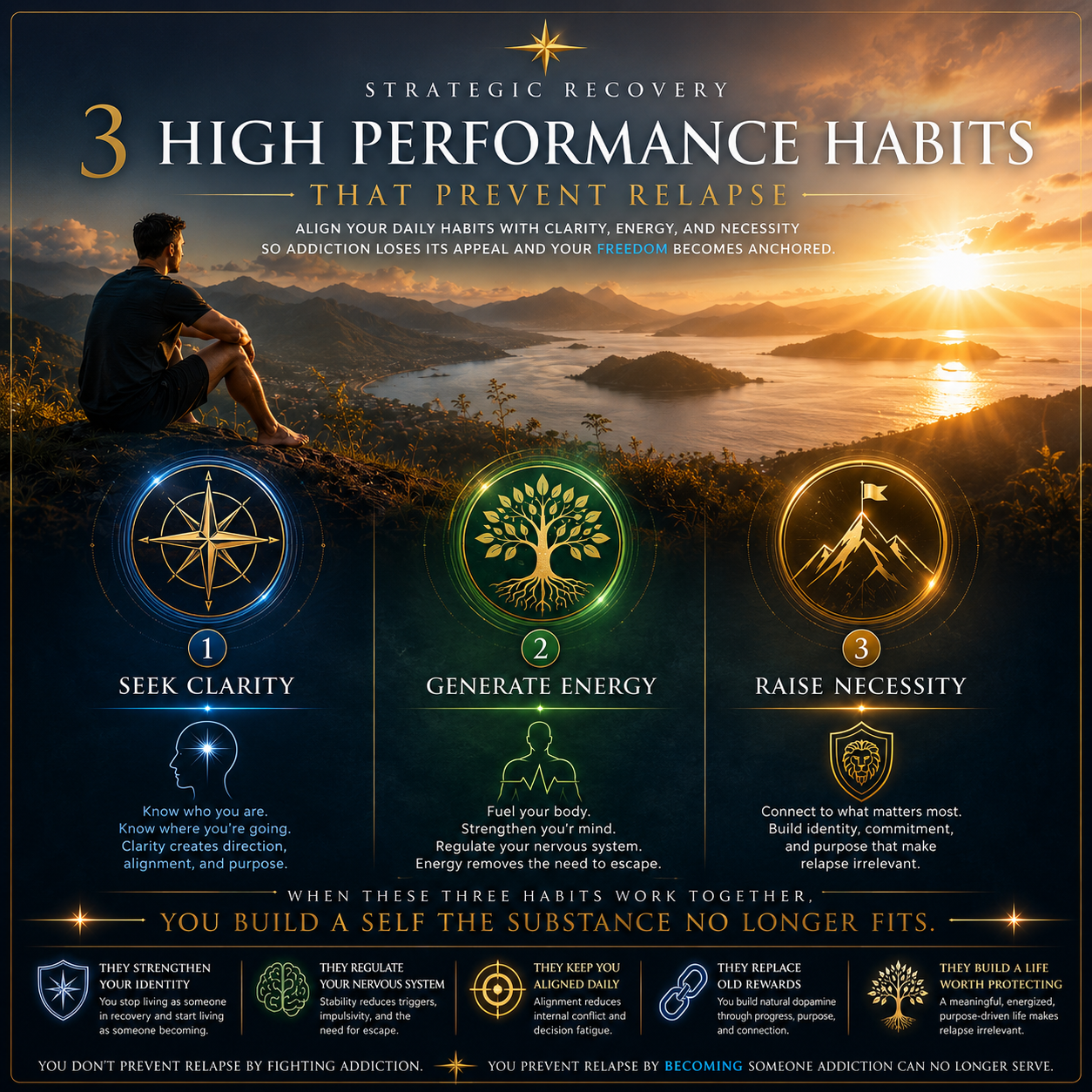
Want the print-ready PDF version?
Download the optimized PDF so you can print it, place it near your recovery journal, pin it to a refrigerator, or keep it visible as a daily reminder to build high-performance recovery habits before motivation fades.
Tip: print one copy for your recovery space and one for your planner, journal, or binder so clarity, energy, and necessity stay visible when the old pattern tries to return.
Episode 45 Resources
Books, tools, planners, and Strategic Recovery™ episodes referenced throughout this conversation on clarity, energy, identity, nervous system regulation, and the three high-performance habits that help prevent relapse.
- High Performance Habits (Brendon Burchard) The foundational book that inspired much of the framework explored in this episode around clarity, energy, necessity, identity, and sustainable high performance
- High Performance Planner A structured daily and weekly planning system designed to strengthen intentionality, focus, future orientation, and aligned execution
- High Performance Habits Tools Additional worksheets, frameworks, assessments, and implementation tools related to the High Performance Habits methodology
- Why You Relapse (Ep. 2) A foundational Strategic Recovery™ episode exploring the deeper mechanisms behind relapse, emotional drift, and recurring self-sabotage patterns
- Nervous System Dysregulation & Addiction (Ep. 14) A deeper exploration into how nervous system dysregulation drives cravings, emotional overwhelm, stress sensitivity, and relapse vulnerability
- Low-Hanging Fruit Protocol (Ep. 40) Practical foundational recovery strategies for stabilizing mood, energy, cravings, sleep, hydration, blood sugar, and nervous system resilience
- Consciousness As Regulation (Ep. 34) A Strategic Recovery™ exploration into awareness, coherence, inner regulation, and how consciousness itself can become a healing technology
Frequently Asked Questions — High Performance Habits and Relapse Prevention
Clear, grounded answers to help you apply the episode fast: how clarity, energy, and necessity prevent relapse drift, strengthen identity, regulate the nervous system, and help you build a life the substance no longer fits.
-
What are the 3 high-performance habits that prevent relapse?
The three habits are Seek Clarity, Generate Energy, and Raise Necessity.
In recovery terms, clarity gives direction, energy gives capacity, and necessity gives commitment.
Translation: these habits help you stop drifting, stop collapsing, and stop negotiating with relapse.
-
What is Relapse Drift?
Relapse Drift is the gradual disconnection that often happens before relapse.
It may begin when someone stops journaling, walking, getting sunlight, sleeping well, connecting with others, or remembering their future vision.
The relapse is often the final event. The drift began earlier.
-
Why does clarity matter so much in addiction recovery?
Without clarity, anxiety rises, impulsivity increases, distractions multiply, and the future becomes emotionally blurry.
Clarity reconnects you with who you are becoming, how you want to show up, what skills you need, and who your healed self is here to serve.
Core idea: a compelling future makes temporary escape less seductive.
-
What does “generate energy” mean in recovery?
It means rebuilding physical, emotional, mental, and spiritual energy so your nervous system is not constantly craving escape.
Physical energy includes sleep, sunlight, movement, hydration, protein, and minerals. Emotional energy includes boundaries, grief processing, reducing shame, and healthier relationships.
Key reframe: what many people call laziness is often depleted biology and nervous system exhaustion.
-
What does “raise necessity” mean?
Raise Necessity means making recovery emotionally real and identity-based.
Instead of vague hopes like “I should change,” necessity asks: Who do I refuse to be anymore? Who needs me healthy? What future am I protecting?
Necessity turns recovery from a preference into a mission.
-
How do these habits actually prevent relapse?
Without clarity, people drift. Without energy, people collapse. Without necessity, people negotiate with relapse.
But with all three, people become more resilient, intentional, focused, future-oriented, emotionally regulated, and mission-driven.
The goal is not merely to quit the substance. The goal is to build a self the substance no longer fits.
-
Is high performance in recovery the same as hustle culture?
No. This episode explicitly separates regulated high performance from hustle culture, burnout, toxic optimization, and trauma-driven overachievement.
True high performance in recovery means sustainable alignment between biology, behavior, energy, identity, mission, and nervous system coherence.
If your success destroys your nervous system, it is not mastery. It is compensation.
-
What is the difference between aligned growth and trauma compensation?
Aligned growth comes from self-respect, purpose, sustainability, nervous system safety, and genuine care for your future.
Trauma compensation comes from shame, fear, inadequacy, proving, overworking, and trying to earn your worth through output.
Healing must remain human: rest, softness, compassion, and standards all belong together.
-
What is Future Identity Priming?
Future Identity Priming is a simple daily practice where you write and review words that describe your future self, relationships, emotional state, and purpose.
For example: calm, disciplined, honest, emotionally safe, spiritually grounded, and mission-driven.
Repeated focus becomes identity conditioning.
-
What if I feel grief over lost years or wasted potential?
That grief is real, and it deserves compassion.
Many people in recovery grieve lost years, damaged relationships, unrealized potential, and who they could have become. But alignment changes the meaning of time.
You are not behind once you become aligned.
-
What daily questions can help me apply this episode?
In the morning, ask: Who needs me at my best today? What matters most today? What kind of energy will I embody today?
At night, ask: Did I live aligned today? What nourished me? What drained me? Did I honor my future self?
Small daily alignment creates long-term identity transformation.
-
What is the biggest takeaway from Episode 45?
The biggest takeaway is that relapse prevention is not only about resisting urges.
It is about building clarity, generating energy, raising necessity, strengthening identity, and creating a life your nervous system no longer wants to escape from.
The opposite of addiction is not merely sobriety. It is aliveness.
These FAQs are educational guidance, not medical advice. If you are in acute withdrawal, tapering substances, taking medication, or managing a medical or psychiatric condition, coordinate decisions with a licensed clinician where appropriate.
🙏 Thank you for being part of the Strategic Recovery community.
👉 Click Here and Right Click to Save As to Download>>
🎧 Available on your favorite platform:






Leave a Reply