
You Don’t Need More Supplements — You Need the Right Ones
(Match the Tool to the Tank) | Episode 43
This page hosts the full Strategic Recovery Podcast audio episode [1hr 14min 🎙️] — a deep dive into why most supplements fail
and how to find your personal “miracle supplements” through precision, not guessing.
Inside, you’ll learn how to identify your lowest neurotransmitter “tanks” and match targeted inputs to your brain’s
actual deficiencies — so you can reduce cravings, stabilize your mood, regulate your nervous system, and finally feel like yourself again.
Featuring the 5 Low Tanks of Recovery™, the Miracle Supplement Method™, and a strategic step-by-step
system for building a supplement stack that actually works.
Precision beats randomness. Match the tool to the tank.
Strategic Recovery Field Notes
Strategic Recovery with Matt Finch — Episode 43 Show Notes
This episode answers a deeper recovery question: What if the reason you still feel off is not because nothing helps — but because you haven’t yet matched the right support to the right deficiency?
These notes are designed to help you identify your lowest tanks, understand the logic behind “miracle supplements,” and begin applying precision-based support to your brain chemistry. Use them as a reflection guide — not a perfection standard.
Quick Navigation
Pattern · Deficiency · Precision · Tools · Stability
- Act I — Why Supplements “Don’t Work”
- Act II — What a Miracle Supplement Really Is
- Act III — My Story: When Everything Changed
- Act IV — The Miracle Supplement Method™
- Act V — The 5 Low Tanks Diagnostic Lens
- Act VI — Match the Tool to the Tank
- Act VII — How to Build Your Stack
- Act VIII — Common Mistakes That Quietly Sabotage Results
- Close — From Guessing to Precision
Act I — Why Supplements “Don’t Work”
Most people in recovery think they have a supplement problem, a motivation problem, or a willpower problem.
But this episode introduces a deeper reframe: you do not need more inputs — you need the right inputs matched to the system that is actually depleted.
If your dopamine is low, your GABA is low, your serotonin is low, your endorphins are low, or your blood sugar is unstable, then taking random supplements will often create random results.
Signature reframe: this is not a motivation problem — it is a precision problem.
Act II — What a Miracle Supplement Really Is
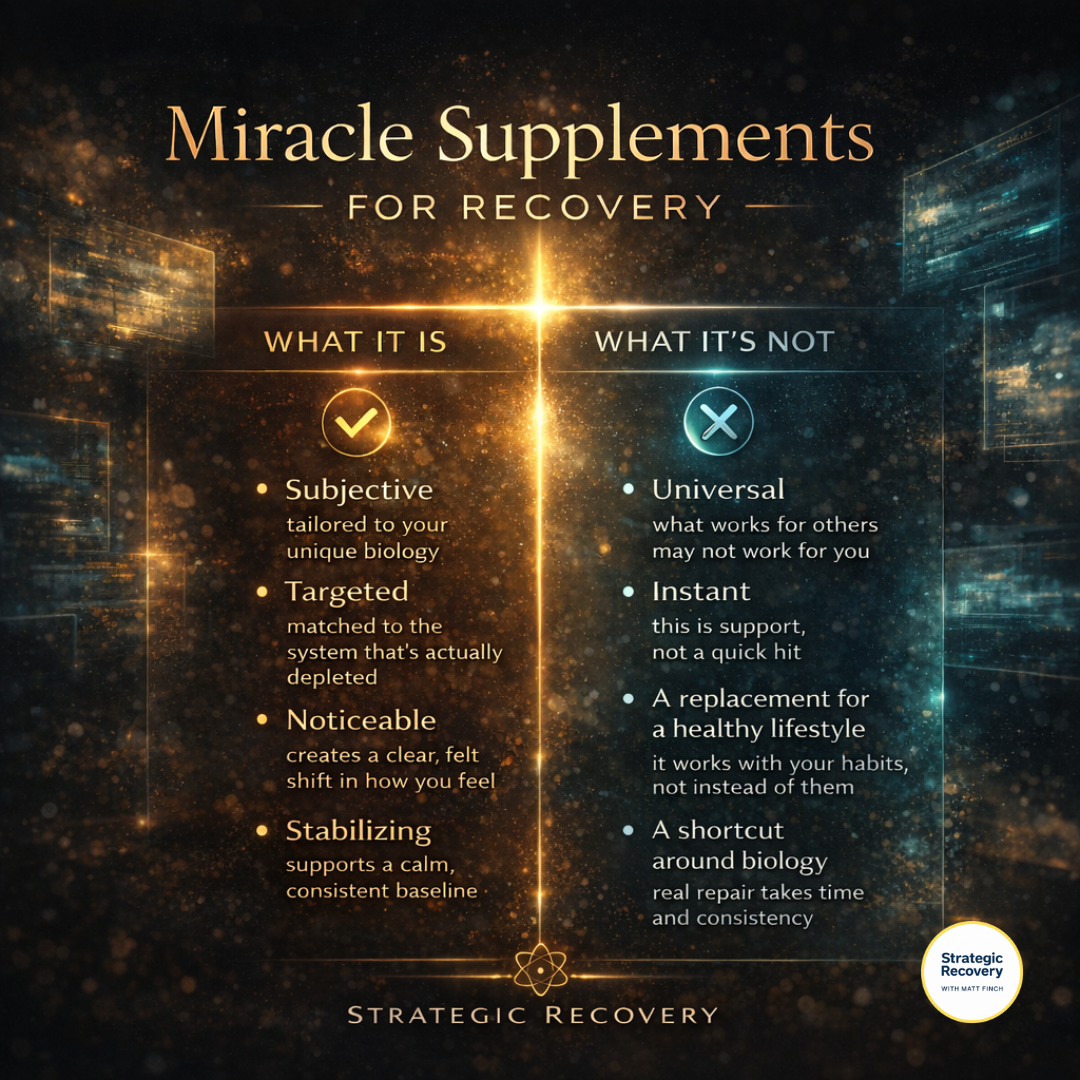
A “Miracle Supplement” is not magic. It is not hype. And it is not universal. It is the thing that works for you because it fills the right gap.
What It Is
- Subjective
- Targeted
- Noticeable
- Stabilizing
What It Is Not
- Universal
- Instant
- A replacement for lifestyle
- A shortcut around biology
A real “miracle supplement” does not spike you, numb you, or give you a fake high. It brings you closer to baseline — calmer, clearer, steadier, and more able to function.
Core line: it feels like a miracle because you finally filled the right gap.
Act III — My Story: When Everything Changed
This episode grounds the teaching in lived experience: detoxing off opioids, alcohol, and benzodiazepines — and then discovering that sobriety alone did not automatically create stability.
The turning point came through two supplements: Dopatone and Gabatone. Not as a high. Not as stimulation. But as a glimpse of what normal might actually feel like.
That moment led to the work of Dr. Charles Gant and the realization that addiction often involves self-medicating a depleted system.
Instead of seeing addiction only as weak discipline, bad choices, or lack of character, this episode reframes it through the lens of depletion, dysregulation, and targeted restoration.
The deeper realization: I wasn’t broken — I was depleted.
Act IV — The Miracle Supplement Method™
This episode organizes the supplement process into a practical hierarchy: awareness first, precision second, stacking last.
The 5-Step Method
- Identify your lowest tank
- Match targeted inputs
- Test and observe
- Stack slowly
- Stay consistent
The Core Principle
Precision beats randomness.
Do not start with everything. Start with what is most likely to matter.
This method moves you from “let me try this supplement” to “let me support this system.”
Act V — The 5 Low Tanks Diagnostic Lens
The episode revisits the 5 Low Tanks of Recovery from Episode 39 and applies them as a supplement-matching lens. Before you choose a tool, you need to understand the pattern.
Dopamine / Catecholamines
- Low drive
- Flat reward system
- Procrastination loop
- “I know what to do, but I can’t start”
Serotonin
- Anxiety without a clear cause
- Mental looping
- Unease
- “I can’t relax even when nothing is wrong”
GABA
- Wired but tired
- Tension
- Difficulty downshifting
- Sleep feels hard without help
Endorphins
- Emotional pain
- Numbness or rawness
- No natural sense of relief
- Life feels heavier than it should
Crucial add-on: blood sugar is the hidden foundation — if it is unstable, everything else becomes harder.
In practice, this means the question is not “what supplement is best?” It is “which tank is actually low?”
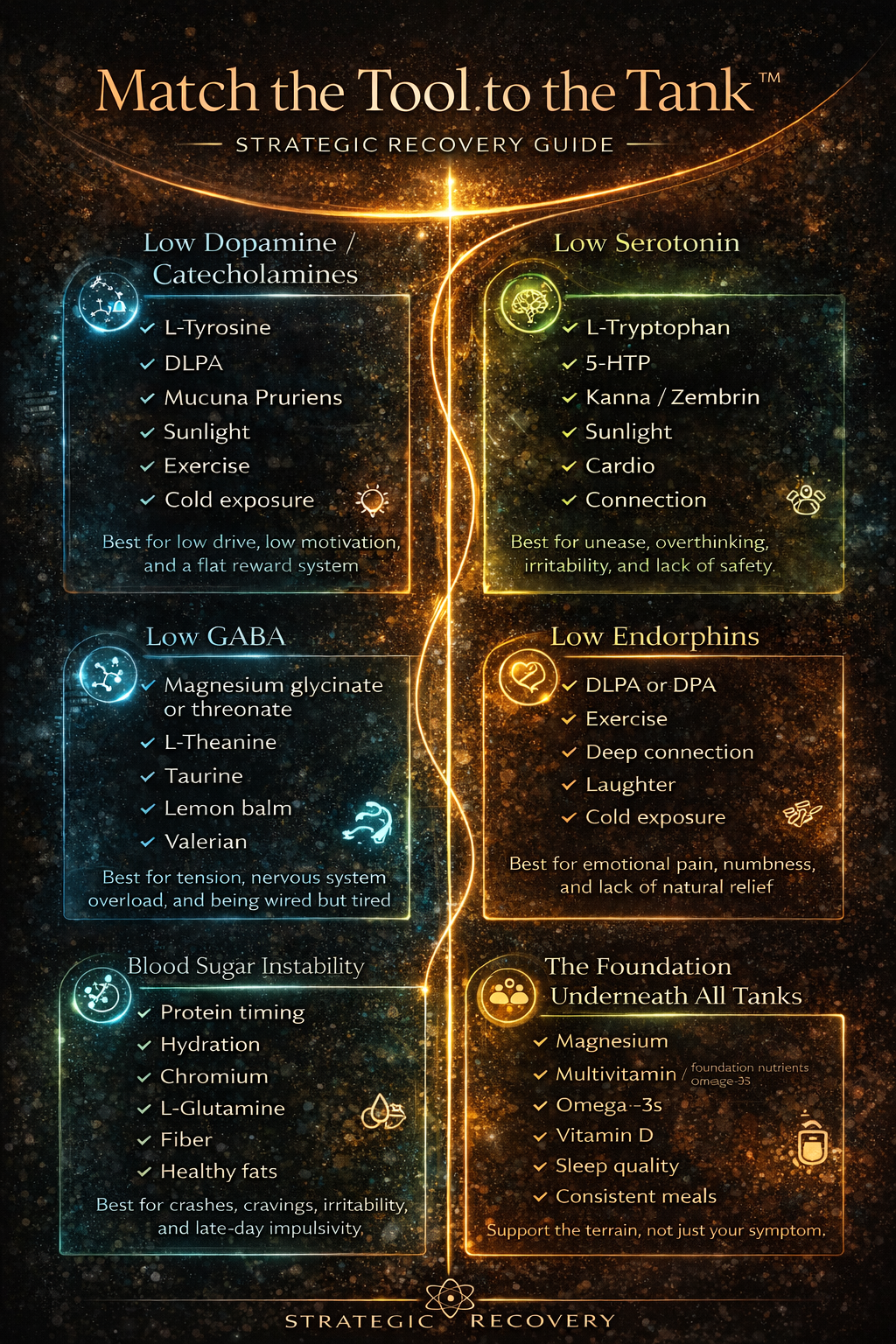
Act VI — Match the Tool to the Tank
This is the practical heart of the episode: do not match the supplement to the trend — match the tool to the tank.
Low Dopamine / Catecholamines
- L-Tyrosine
- DLPA
- Mucuna Pruriens
- Sunlight
- Exercise
- Cold exposure
Best for low drive, low motivation, and a flat reward system.
Low Serotonin
- L-Tryptophan
- 5-HTP
- Kanna / Zembrin
- Sunlight
- Cardio
- Connection
Best for unease, overthinking, irritability, and lack of safety.
Low GABA
- Magnesium glycinate or threonate
- L-Theanine
- Taurine
- Lemon balm
- Valerian
- Passionflower
Best for tension, nervous system overload, and being wired but tired.
Low Endorphins
- DLPA or DPA
- Exercise
- Deep connection
- Laughter
- Cold exposure
- Cacao
Best for emotional pain, numbness, and lack of natural relief.
Blood Sugar Instability
- Protein timing
- Hydration
- Chromium
- L-Glutamine
- Fiber
- Healthy fats
Best for crashes, cravings, irritability, and late-day impulsivity.
The Foundation Underneath All Tanks
- Magnesium
- Multivitamin or foundation nutrients
- Omega-3s
- Vitamin D
- Sleep quality
- Consistent meals
Support the terrain, not just the symptom.
Act VII — How to Build Your Stack
This episode stays practical: the goal is not a giant supplement pile, but a targeted system you can actually follow.
The Process
- Start with 1–2 targeted supports
- Track your response
- Adjust if needed
- Build gradually
The Optimization Layer
- Make supplements visible
- Use simple systems
- Journal the process
- Reduce complexity
The episode also emphasizes that a real stack is not just about products. It includes behavioral tools, lifestyle inputs, and daily consistency.
Bottom line: complexity is the enemy of execution.
Act VIII — Common Mistakes That Quietly Sabotage Results
The episode also names the most common mistakes that quietly sabotage results.
The Mistakes
- Taking too many supplements at once
- Chasing trends
- Inconsistency
- Ignoring sleep, food, and stress
- Using low-quality products
The Core Error
Trying to shortcut biology.
Your brain needs time to rebuild. Your body needs time to stabilize. The goal is support — not force.
The deeper lesson: more is not better — clear is better.
Close — From Guessing to Precision
The goal is not merely to become someone who can “take the right supplements.” The deeper goal is to become someone who can understand and support their own system.
When you understand your pattern, match the right input, and stay consistent, you move from “I’m trying to quit” to “I know how to support my brain.”
You become calmer. Clearer. More stable. More strategic. More self-trusting.
Final line: recovery isn’t just about removing substances — it’s about learning how to support the system that no longer needs them.

Key Concepts
The core ideas that shift recovery from random supplement guessing to precision-based biochemical support.
- You don’t need more supplements — you need the right inputs matched to the system that is actually depleted.
- A “Miracle Supplement” is subjective — it feels powerful because it fills the right gap in your chemistry.
- Match the tool to the tank — dopamine, serotonin, GABA, endorphins, and blood sugar each require different supports.
- Random inputs create random results — precision creates signal, clarity, and stability.
- Blood sugar is the hidden foundation — if it is unstable, every other tank becomes harder to stabilize.
- Start with one or two targeted supports — then observe, adjust, and build your stack slowly.
- Consistency beats complexity — a simple stack followed daily outperforms a perfect plan you can’t sustain.
- The deeper identity shift — recovery becomes more stable when you stop guessing and learn how to support your own system.
Miracle Supplements for Recovery
A simple visual for understanding what “miracle supplements” actually are — and what they are not. This is not about chasing hype. It is about finding targeted, noticeable, stabilizing support that matches your real biochemical needs.
Episode 43 Resources
Key Strategic Recovery articles, supplement tools, and foundational references featured in this episode — focused on matching the right tool to the right tank, rebuilding brain chemistry, and finding your personal “miracle supplements.”
- Dopatone™ Active A targeted formula referenced in Matt’s story for supporting dopamine, drive, and catecholamine-related depletion
- Gabatone™ Active A targeted formula referenced in Matt’s story for supporting GABA, calm, and a more regulated baseline
- End Your Addiction Now (Charles Gant, MD) The foundational book that helped popularize neurotransmitter deficiency as a lens for understanding cravings, mood, and recovery
- Recovery Supplements Guide A broader Strategic Recovery guide to supplement principles, foundational nutrients, amino acids, and practical stack-building
- The 5 Low Tanks of Recovery (Ep. 39) The core diagnostic lens behind this episode: dopamine, serotonin, GABA, endorphins, and blood sugar
- DLPA for Recovery A deeper guide to DLPA as a support for dopamine, endorphins, mood, pain relief, and cravings
- Mucuna for Recovery A guide to Mucuna Pruriens as a natural dopamine-supportive tool for motivation, drive, and depleted reward circuitry
- Sunlight for Recovery Why sunlight is one of the most underrated tools for dopamine timing, serotonin support, mood, and baseline stability
- L-Theanine & Recovery Guide A strategic guide to L-Theanine for calm focus, anxiety relief, nervous system regulation, and GABA-related support
Match the Tool to the Tank™
A premium visual guide to help you connect common recovery symptoms with the systems that may actually need support — dopamine, serotonin, GABA, endorphins, blood sugar, and the foundational terrain underneath all of them.
Want the print-ready PDF version?
Download the optimized PDF so you can print it, place it in your planner, pin it to a refrigerator with a magnet, or keep it visible as a daily decision-making guide.
Tip: print one copy for your recovery space and one for your planner, journal, or binder so the framework stays visible when you actually need it.
Frequently Asked Questions — Miracle Supplements and Precision-Based Recovery
Clear, grounded answers to help you apply the episode fast: how to identify your lowest tank, match the right tool to the right system, and build a simple stack that actually works.
-
What is a “Miracle Supplement” in Strategic Recovery terms?
A Miracle Supplement is not something magical, rare, or universal.
It is the supplement, nutrient, herb, or input that works especially well for your specific biology because it fills the gap that matters most in your system.
Translation: it feels powerful because it is subjective, targeted, noticeable, and stabilizing.
-
Why do supplements seem to work for some people but not for others?
Because different people have different patterns of depletion.
One person may need dopamine support. Another may need GABA support. Another may have unstable blood sugar making everything else harder.
What works for someone else may not match your tank.
-
What does “match the tool to the tank” actually mean?
It means you stop taking random supplements and start supporting the system that is actually low.
If you have low drive and a flat reward system, that points toward dopamine and catecholamine support. If you feel wired, tense, and unable to relax, that points more toward GABA support. If you crash late in the day and get irritable or impulsive, blood sugar may be the real issue.
Core idea: do not ask, “What supplement is best?” Ask, “Which tank is low?”
-
What are the five main tanks from this episode?
The five tanks are dopamine / catecholamines, serotonin, GABA, endorphins, and blood sugar stability.
These five systems influence drive, safety, calm, relief, and baseline energy. When one or more are low, you feel “off” in a very specific way.
The pattern gives you the clue.
-
How do I know if dopamine or catecholamines are my issue?
Common signs include low drive, procrastination, fatigue, a flat reward system, and that feeling of “I know what to do, but I can’t start.”
Useful supports may include L-Tyrosine, DLPA, Mucuna, sunlight, exercise, and cold exposure.
Translation: this is often a drive problem, not a discipline problem.
-
How do I know if GABA or nervous system braking is the issue?
Common signs include feeling wired but tired, body tension, trouble falling asleep, and difficulty downshifting even when nothing is actively wrong.
Useful supports may include magnesium, L-Theanine, taurine, lemon balm, valerian, and other calming nervous system inputs.
This is often a brake system problem.
-
Why is blood sugar included with neurotransmitters?
Because if blood sugar is unstable, everything else becomes harder to regulate.
Crashes can increase irritability, impulsivity, desperation, and cravings — especially later in the day. In many people, what feels like an emotional or psychological problem is partially a fuel problem.
Core idea: blood sugar instability is a stability problem that masquerades as a willpower problem.
-
What is the best way to start building a supplement stack?
Start with one or two targeted supports, not ten.
Then observe: mood, anxiety, cravings, energy, sleep, and baseline steadiness. If something helps, keep it. If not, adjust the timing, dose, or tool.
You are trying to create signal, not noise.
-
Why does taking too many supplements at once backfire?
Because you lose clarity.
If you start five or ten things at once, you do not know what is working, what is not, what is causing side effects, or what should be adjusted.
Bottom line: more is not better — clear is better.
-
Can supplements replace sleep, food, sunlight, and healthy routines?
No. Supplements support the system. They do not become the system.
If your sleep is poor, meals are erratic, stress is constant, and movement is low, supplements may still help — but they will not carry everything on their own.
They work with a healthy lifestyle, not instead of it.
-
How long should I test something before deciding whether it helps?
That depends on the tool, the dose, the quality, and your consistency.
Some people notice a shift quickly. Others need more time. The key is to give the tool a fair signal: use it consistently, in a sensible dose, and long enough to observe a pattern.
Consistency is what turns support into change.
-
What is the biggest mistake people make with “miracle supplements”?
Trying to shortcut biology.
People want a fast answer, a perfect stack, or a dramatic result right away. But real recovery support is about rebuilding what has been depleted and stabilizing what has been dysregulated.
Support the system. Do not try to override it.
-
If I only take one action from this episode, what should it be?
Go back to Episode 39, identify your lowest tank, and choose one targeted support to test first.
Do not overcomplicate it. Start with the system that feels most obviously depleted, then build from there slowly and strategically.
That one shift can move you from guessing to precision.
These FAQs are educational guidance, not medical advice. If you are taking medication, tapering substances, pregnant, or managing a medical or psychiatric condition, coordinate supplement decisions with a licensed clinician where appropriate.
🙏 Thank you for being part of the Strategic Recovery community.
👉 Click Here and Right Click to Save As to Download>>
🎧 Available on your favorite platform:






Leave a Reply