
The hidden power of intermittent reinforcement—and how to stop organizing your nervous system around the next message, commission, reconciliation, or win.
There was a period of my life when two completely different kinds of emails could alter my emotional state within seconds.
One might contain a commission notification. Someone had visited my addiction recovery website, clicked one of my affiliate links, purchased a supplement I recommended, and earned me $20, $33.75, or eventually a much larger payment.
The other might contain a message from the woman I loved. Maybe she missed me. Maybe she was still angry. Maybe she wanted to apologize. Maybe she wanted me back. Maybe we were going to reconnect, make love, and somehow return to the extraordinary closeness we had experienced during the first three months of our relationship.
Or maybe there would be nothing:
- No commission
- No affectionate message
- No evidence that my business was succeeding
- No reassurance that my relationship was going to survive
So I would check again.
And again.
And again.
Somewhere else, a gambler might be sitting in front of a slot machine, placing another wager and pressing the same button one more time.
The next outcome could be another loss. It could be a small win. It could be a near miss that made the jackpot feel impossibly close. Or it could be the moment that seemed capable of changing everything.
Three entirely different environments.
Three completely different rewards.
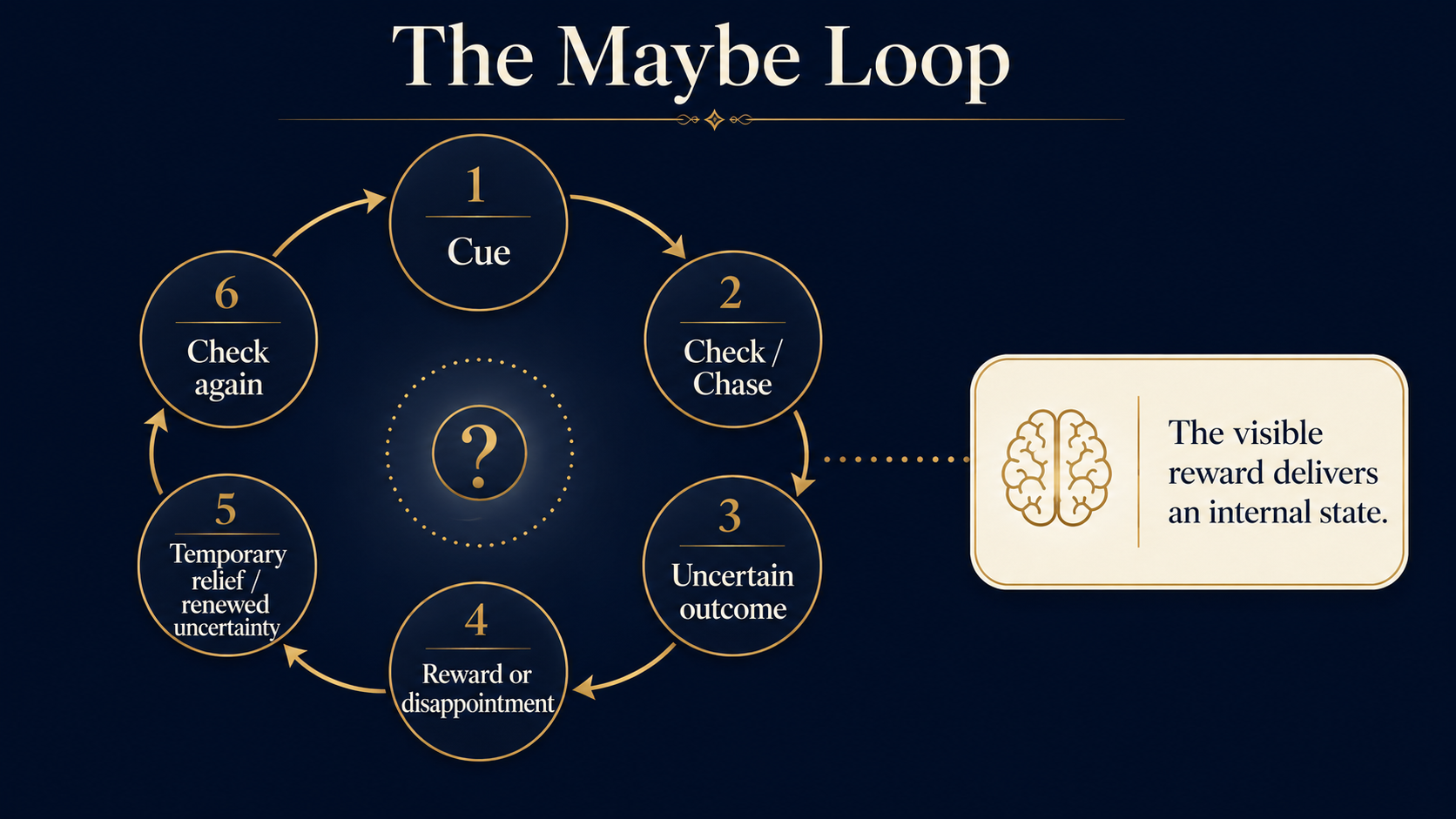
One question being written into the nervous system:
Maybe this time.
I did not understand it yet, but my business, my relationship, my phone, my emotions, and my attention were becoming organized around an unpredictable possibility.
I was not merely seeking money. I was not merely seeking love. I was not merely seeking another message.
I was seeking the internal states I believed those rewards would deliver:
- Relief
- Validation
- Safety
- Certainty
- Significance
- Belonging
- Freedom
- Hope
The reward was what arrived.
The internal state was what I was actually chasing.
And because I never knew when the reward would appear, it became extraordinarily difficult to stop looking for it.
When Addiction Stopped Looking Like Addiction
Until approximately the age of thirty-three, I believed I understood what addiction looked like because I had spent most of my life experiencing it firsthand.
I became addicted to cannabis during my teenage years and used it heavily from approximately ages fifteen to twenty-two. After that, alcohol gradually became my primary substance, and I remained addicted to it through much of my twenties and into my early thirties. Then opioids entered the picture.
What began with prescription painkillers eventually progressed into a much darker and more destructive chapter, and from approximately ages thirty to thirty-two, opioids became woven together with the alcohol, anxiety, emotional pain, compulsive relief-seeking, and increasingly unmanageable life I was trying to escape.
By my early thirties, I knew what it felt like to wake up already needing something. I knew what it felt like to promise myself I would not use and then watch that promise dissolve as soon as craving, anxiety, depression, exhaustion, opportunity, or emotional discomfort became strong enough.
I understood obsession, tolerance, withdrawal, temporary relief, and the consequences that accumulate while a person keeps returning to the same behavior even after it has clearly begun destroying far more than it provides.
I became sober from alcohol and other drugs in late November of 2011. By the Fall of 2012, approximately one year into sobriety, I believed I had escaped the primary addictive chapter of my life.
I thought addiction required a substance—something swallowed, smoked, snorted, or otherwise consumed; something capable of directly altering consciousness and chemistry.
I had never been addicted to gambling. I had never considered myself addicted to shopping, pornography, sex, romantic relationships, or codependence. So I believed that if I remained free from alcohol and other drugs, the phenomenon of addiction had largely been solved.
I was totally wrong.
Not because every intense habit I developed afterward qualified as a clinical addiction. And not because recovery means every passion, craving, relationship, ambition, or period of overwork should suddenly be pathologized.
I was wrong because I had understood the object of addiction far better than I understood the process beneath it.
I knew what it felt like to crave a chemical.
I did not yet understand what it felt like to crave a possibility.
Removing alcohol and opioids saved my life. But removing the substances did not instantly teach my nervous system to feel safe, regulated, valuable, connected, purposeful, productive, and at peace without compulsively reaching for something outside itself.
At first, much of that reaching moved into work.
I became intensely productive, ambitious, perfectionistic, and increasingly unable to rest without feeling that I should be learning, improving, earning, creating, helping, fixing, or accomplishing something.
From the outside, this looked far better than addiction. I was sober. I was working. I was studying. I was raising my daughter. I was helping people recover. I was rebuilding my identity and trying to create a meaningful life.
But internally, I was often operating with the accelerator pressed to the floor. I developed a chronically upregulated nervous system, persistent hypervigilance, anxiety, muscular tension, and chronic pain.
The substance was gone. The urgency remained.
Later, another part of the pattern migrated into an intimate relationship. For approximately three and a half years on and off, I became deeply codependent with a woman I loved. I eventually moved to Hawaii and became engaged, and although that chapter helped me recover from some of the chronic overwork and physical pain, it also revealed how easily my emotional stability could become fused with another person’s attention, approval, mood, availability, affection, and choices.
During one six-month period, the pattern also moved into food. I experienced powerful cravings for ultra-processed foods and repeatedly consumed enormous quantities of pizza, burritos, ice cream, refined sugar, processed carbohydrates, and calorie-dense combinations of fat and starch. At the time, I did not know that my testosterone was extremely low or understand how endocrine health, sleep, stress, blood sugar, emotional pain, and reward-seeking could interact.
I only knew that eating those foods temporarily changed how I felt. And once the relief, pleasure, stimulation, or fullness wore off, I wanted to change how I felt again.
Work. Achievement. Perfection. Food. Romantic reassurance. Sex. Messages. Approval.
None of these things is inherently pathological. Work can express purpose. Food can provide nourishment and pleasure. Romantic love can become one of the most meaningful experiences of a human life. Sex can create intimacy. Ambition can build something extraordinary. A message from someone we love can genuinely brighten an entire day.
The problem begins when our freedom, functioning, identity, emotional stability, and ability to remain present become increasingly dependent on receiving those rewards.
I had stopped using alcohol and opioids to change my internal state. But I had not stopped searching for ways to change it.
The delivery systems were becoming more socially acceptable. The underlying urgency was becoming harder to recognize.
Addiction had not necessarily returned in the same form. But the deeper pattern of reaching outside myself for relief, stimulation, validation, certainty, and regulation had learned how to change its clothing.

Then I enrolled in one evening psychology course at Mesa College.
The class was called Learning and Behavior.
I entered that classroom believing I was learning how psychologists understood pigeons, children, habits, rewards, consequences, and behavioral change.
I had no idea that I was being given a map of my own future.
The Class That Gave Me the Language
In the Fall of 2012, approximately one year after getting sober, I enrolled at Mesa College for the third and final time.
I was raising a toddler as a single father while working forty hours per week as a certified alcohol and other drug counselor at a treatment clinic about fifteen minutes from home. I was earning sixteen dollars an hour.
During the day, I performed intake assessments and provided individual counseling to patients receiving methadone treatment. One evening each week, I facilitated an outpatient counseling group for clients who were primarily taking Suboxone, although some were receiving Vivitrol, methadone, or no medication-assisted treatment.
I loved helping people. I loved learning about addiction. And although I had only been sober for approximately one year, I already knew that I wanted to spend my life helping people understand and recover from the conditions that had nearly destroyed mine.
My original plan was ambitious: Mesa College, then San Diego State University for a bachelor’s degree in psychology, then a master’s degree, then a PhD, and finally a career as a doctoral-level addiction therapist.
But when I calculated what that path would realistically require while working full time and raising a young daughter, I realized it might take another ten years. Possibly fifteen. Maybe longer.
After seeing how much time and concentration even one serious evening course required, I made a difficult but practical decision. I withdrew from college for the third and final time.
Technically, that left me as a three-time community college dropout with nothing beyond a high school diploma. No associate degree. No transfer. No graduate degree. No letters after my name.
But that final semester gave me something I would eventually value more than the credential I had been pursuing.
It gave me an idea.
The course was Learning and Behavior, taught by a PhD clinical behavioral psychologist who worked full time in private practice. One of his primary specialties involved helping parents improve their children’s behavior through practical behavioral principles—especially positive reinforcement.
He taught parents to identify the behaviors they wanted to see more often, notice those behaviors when they occurred, and reinforce them with attention, praise, encouragement, privileges, or other meaningful consequences. He also explained how parents can inadvertently strengthen the very behaviors they want to eliminate by giving them enormous emotional energy and attention.
For certain minor attention-maintained behaviors, his approach emphasized reducing attention to the unwanted behavior while deliberately strengthening more adaptive alternatives. He recommended an excellent parenting book based largely on these principles, and I was fascinated by how something as ordinary as parental attention could influence which behaviors grew stronger and which gradually weakened.
He was not a typical instructor reading slides from a textbook. He was a practicing psychologist who spent his professional life applying the material. Teaching that one evening course seemed to be something he did because he loved the subject and enjoyed teaching it.
I became completely captivated.
I completed every reading assignment. I listened carefully. I raised my hand. I asked questions. I answered questions. I participated in discussions and helped the students seated around me when they were confused.
I attended every class. I was never late. In fact, I was consistently early, seated, prepared, and ready to learn.
At the end of the semester, I had earned 242 points out of a possible 250—the highest grade in the class by a substantial margin.
I was not obsessed with impressing the professor. I was obsessed with understanding the material.
I wanted to know what makes a living being repeat a behavior.
The basic answer was reinforcement: a consequence that increases the likelihood of the preceding behavior occurring again.
Positive reinforcement means something is added after a behavior, making the behavior more likely. Negative reinforcement means something uncomfortable is removed after a behavior, making the behavior more likely.
That second category is extremely important in addiction. A person may drink not only because alcohol creates pleasure, but because it temporarily removes anxiety, withdrawal, loneliness, inhibition, or emotional pain. The relief reinforces the behavior.
We also learned about punishment, extinction, shaping, and different reinforcement schedules.
Continuous reinforcement means the reward follows every qualifying response. A fixed-ratio schedule rewards after a predictable number of responses. A variable-ratio schedule rewards after an unpredictable number of responses. A fixed-interval schedule makes reinforcement available after a predictable period. A variable-interval schedule makes reinforcement available after an unpredictable period.
The variable schedules fascinated me most.
When the reward appears only sometimes—and the timing or number of required responses remains uncertain—the organism may continue because the next attempt could be the one.
Maybe the next peck. The next lever press. The next wager. The next inbox refresh. The next apology. The next loving message. The next reconciliation.
Behavior learned through partial or intermittent reinforcement can become unusually resistant to extinction, although the effect depends on context, alternatives, sequencing, and learning history rather than operating as a universal law. [1]
The central principle remained powerful:
When a reward has always been unpredictable, its temporary disappearance may not teach us to stop. It may teach us to keep trying.
That semester, I came to understand intermittent reinforcement as an intellectually fascinating principle. I could explain it on an exam.
What I did not yet understand was how it felt from the inside.
Less than two years later, I began living inside it.

Two Inboxes. One Nervous System.
In July of 2014, less than two years after taking Learning and Behavior, I launched OpiateAddictionSupport.com.
At the time, it was not much of a business. It was an idea, a growing collection of articles, and a belief that everything I had survived and learned about opioids, withdrawal, supplements, nutrition, behavior, and recovery could become useful to people far beyond the walls of the treatment clinic.
I did not offer coaching yet. I had not created an online course. I did not have a large audience, a recognizable brand, or proof that anyone would ever find what I was publishing.
But I had joined the affiliate programs of two supplement companies whose products I believed could support people recovering from opioid dependence. If someone visited my website, clicked one of my custom links, and purchased a supplement, I could earn a commission.
So I began blogging. I studied search engine optimization. I learned how people searched online when they were frightened, withdrawing, desperate, or trying to help someone they loved. I researched, wrote, edited, and published consistently, trusting that if I became useful enough, someone would eventually find me.
Then, in September of 2014, someone did.
An email appeared in my inbox informing me that I had earned my first affiliate commission.
Twenty dollars.
Financially, it changed almost nothing.
Psychologically, it changed everything.
That twenty dollars meant someone had found my website. Something I wrote had helped a stranger make a decision. All the studying, writing, publishing, and learning might actually be leading somewhere.
I loved helping people recover, but I did not want to spend my entire career earning sixteen to twenty dollars an hour inside a clinic while raising my daughter and squeezing my larger purpose into whatever energy remained after work.
I wanted freedom. I wanted to write, teach, create, and build recovery resources that could reach people throughout the world.
That first commission was not merely twenty dollars.
It was proof that another future might be possible.
After that first commission, every inbox check contained a possibility.
Maybe someone had purchased something. Maybe another commission had arrived. Maybe the website had generated income while I was doing something else. Maybe all the work was beginning to compound.
Most of the time, there was nothing.
Then, eventually, another commission would appear.
The effect was immediate: excitement, relief, validation, confidence, and hope.
The empty inbox did not teach me to stop checking. It taught me that perhaps I had checked too early.
So I checked again. And again. Dozens and dozens of times each day.
At the time, I thought I was being an attentive entrepreneur. That was partially true. But beneath the practical explanation, my inbox was becoming a place I went to check whether my future was safe.
In December of 2014, I flew to Boca Raton, Florida, to attend Tony Robbins’ six-day Date With Destiny event. Before arriving, I had joined a Facebook group for attendees and connected with a man named Trevor, who became my hotel roommate.
One evening, Trevor and I were eating sushi at the hotel restaurant. During dinner, I checked my phone.
Another commission notification had arrived.
It was the third commission of the day.
I remember thinking:
Wow. My commissions and income are now growing exponentially. All of the SEO blogging and hard work is starting to pay off. I’m going to become a professional recovery blogger for life.
The sushi, the hotel, the emotionally intense event, my new friendship with Trevor, the excitement of travel, and the third commission of the day all fused into one moment.
It felt like momentum. It felt like destiny. It felt as though life were showing me that I had found my path.
And in many ways, I had.
OpiateAddictionSupport.com eventually grew far beyond those early twenty-dollar commissions. Traffic increased. I began offering recovery coaching. I created an online course. On strong days, the business generated $500 or $1,000. On exceptional days, it could generate ten thousand or even twenty thousand dollars. For several years, my annual income exceeded $100,000.
The dream became real.
But so did the conditioning.
One month after launching the website, in August of 2014, I began dating a woman I will call Amanda.
Amanda was approximately ten years younger than me. She was studying herbal medicine through my parents’ Self-Heal School while attending San Diego State University full time, earning excellent grades, and planning to become a marriage and family therapist.
She was intelligent, beautiful, health-conscious, academically driven, and deeply interested in psychology, nutrition, herbs, healing, and personal growth.
During the first three months, almost every experience we shared felt extraordinary.
One night, we walked beneath the moon and stars along the sand and water at Mission Bay. We held hands as we talked about our lives, dreams, interests, and everything we were learning. Every few minutes, we stopped, kissed passionately, held one another, and continued walking beneath the night sky.
Another day, we went to North Torrey Pines. The sky was warm, bright blue, and completely clear. We hiked down the cliffs toward the beach, surrounded by sunlight, ocean air, and an enormous open horizon.
I had brought organic ninety-percent dark chocolate, dried mango strips, and raw pink coconut water. We spread our towels across the sand, ate together, talked, kissed, hugged, cuddled, and rested in the sun. Then we entered the approximately seventy-one-degree ocean and swam together while the waves moved around us.
Our dates could last twelve hours. We went to restaurants, hiked, explored San Diego, talked for hours, held each other, and made love.
I was not drinking alcohol or taking opioids. But the combination of novelty, anticipation, attraction, sunlight, movement, touch, sex, admiration, and emotional connection made me feel naturally high.
For those first months, Amanda’s presence felt almost continuously rewarding.
Almost every emotional lever I pulled seemed to produce love.
Looking back, it would be easy to call those first three months a lie. But that would not be fair.
The beach was real. The moonlight was real. The chemistry, affection, attraction, and happiness were real.
But the versions of ourselves producing those experiences were incomplete.
Amanda initially presented herself as shy, soft, admiring, emotionally resilient, and naturally aligned with the romantic energy I found deeply attractive. I presented myself as more confident, durable, regulated, and continuously available than I actually was.
I acted more interested in some of her music, authors, and preferences than I authentically felt. I devoted enormous amounts of time to marathon dates, even though I was intensely driven to write, parent, serve people in recovery, and build an entirely new professional life.
We were doing something very human. We emphasized the qualities most likely to attract the other person, concealed traits we feared might lead to rejection, and allowed infatuation to fill the spaces where genuine knowledge had not yet developed.
The chemistry was real. The affection was real. But the versions of ourselves creating those experiences were incomplete.
Approximately three months into the relationship, Amanda and I were at the beach around eleven o’clock at night. I had finished working, and she had completed her schoolwork and studying.
That night, she seemed like a completely different person.
The shyness, softness, and highly feminine romantic energy I had become accustomed to were gone. Her speech, body language, mannerisms, confidence, and entire way of carrying herself felt dramatically different. She appeared more forceful, assertive, and masculine than I had experienced before.
I felt scared—not because confidence or assertiveness is wrong, but because the contrast was so dramatic that I felt as though I were suddenly meeting someone else.
That night forced an uncomfortable realization: perhaps the version of Amanda I had fallen in love with was not the version she could or wanted to embody every day. And perhaps the version of me she had fallen in love with was equally incomplete.
I was far more sensitive than I had portrayed. I carried more anxiety, trauma, hypervigilance, and nervous-system activation than I had revealed. I was far more consumed with building my business than I had appeared during months of twelve-hour dates.
The honeymoon was not ending because every genuine feeling disappeared. It was ending because reality was entering.
After the honeymoon, what had felt almost continuously loving became unpredictable.
Conflict grew more common. Criticism. Defensiveness. Arguments. Emotional volatility. Confusion and competing versions of reality. Withdrawal. Stonewalling. Breakups. Days or weeks apart.
Then loneliness. Missing each other. Another message. An apology. A reunion. Passionate affection. Extraordinary makeup sex. Renewed hope that we had finally understood what went wrong.
Then another collapse.
What felt retrospectively like an eighty-twenty pattern began to emerge. Perhaps eighty percent of the relationship felt dominated by tension, incompatibility, fighting, anxiety, criticism, or emotional pain. But the other twenty percent felt astonishing.
The reunions were powerful. The affectionate messages felt sacred. The sexual connection was intense. The relief after conflict or silence could feel like proof that our love had survived everything.
The positive experiences became less frequent. Yet because they had become scarce, uncertain, and preceded by deprivation, they carried even greater emotional weight.
I began working harder to recover them: another explanation, another apology, another long message, another promise to improve myself, another belief that if I could communicate more clearly, become more resilient, work less, love better, understand her wounds, or discover the perfect combination of words and behaviors, the woman from the first three months might return permanently.
The loving version did return.
But only sometimes.
That was enough to keep hope alive.
Meanwhile, as my business grew, so did my emotional dependence on its rewards.
When sales arrived, I felt successful, intelligent, secure, validated, and safe. When the inbox became quiet, the opposite happened.
If four or five days passed without a commission, coaching purchase, or course sale, my mind did not interpret it as an ordinary fluctuation. It treated it as a catastrophe:
This is it. I’m ruined. I am never going to make money online again. I’m finished. Now I need to find a real job.
I became anxious, miserable, fearful, physically tense, and unable to sleep well. My self-worth collapsed.
Then a commission would arrive.
Within seconds, the prediction of disaster could disappear.
The sale did not merely provide income. It removed fear. It restored hope. It reassured me that I was still capable, valuable, successful, and safe.
The cost was not limited to the minutes I spent checking.
The deeper cost was that part of my attention was rarely where my body was.
I could be working, but part of me was waiting to find out whether the work had generated any money. I could be with Amanda, but part of me was monitoring the business. I could be with my daughter Willow, but part of me was listening for evidence that my professional future was safe. And when Amanda and I were fighting or separated, part of me remained alert for the message that might restore the relationship.
The unpredictable inboxes affected my presence, productivity, peace, sleep, physical tension, mental health, mood, relationships with Amanda and Willow, and sense of self-worth.
I was not merely checking for information.
I was checking to discover how I was allowed to feel.
At the time, I believed I was dealing with two completely different parts of my life.
One was business. The other was love.
One inbox told me whether I had earned money. The other told me whether the woman I loved missed me, wanted me, desired me, forgave me, or believed our relationship could survive.
They seemed unrelated.
But beneath the surface, my nervous system was learning the same lesson from both.
Most checks produced nothing. Some produced disappointment or pain. But every once in a while, one of those digital doors opened and delivered exactly what I had been waiting for: a commission, a sale, a loving message, an apology, a reunion, evidence that the business was still alive, or evidence that the relationship was still alive.
And because I never knew which check would contain the reward, I kept checking.
Do not stop checking.
The next reward could change everything.
Why “Maybe” Becomes So Powerful
From the outside, remaining invested in a relationship that feels painful most of the time can appear irrational.
Why would someone tolerate days of conflict, silence, confusion, or emotional deprivation for a handful of extraordinary experiences? Why would a gambler continue after repeated losses? Why would an entrepreneur refresh an inbox dozens of times when almost every check reveals nothing?
The answer is not simply that the occasional reward feels good.
The reward can become disproportionately powerful because of everything surrounding it.
When affection follows silence, it does not arrive as ordinary affection. It arrives as the end of abandonment.
When reconciliation follows conflict, the reunion does not feel like an ordinary evening together. It feels like the removal of fear.
When a commission follows five dry days, the money does not merely increase a bank balance. It temporarily resolves the terrifying possibility that the business is dying and the future is unsafe.
Sometimes the reward creates pleasure. Sometimes its greater power comes from ending pain.
Relief can feel so intense that we mistake it for evidence that the entire pattern is healthy.
The nervous system begins comparing the reward not to an ordinary baseline but to the deprivation that immediately preceded it. That contrast magnifies the experience.
Scarcity magnifies it further.
When affection was abundant during the honeymoon, it felt wonderful. When affection became rare, it began feeling precious. Every loving message seemed more significant because I did not know when another would arrive.
Emotionally intense peaks can also receive disproportionate weight in how we remember an experience, although this “peak-end” tendency is context-dependent and should not be treated as a universal description of memory.[2]
We remember the moonlit walk. The perfect apology. The most passionate reunion. The enormous sales day.
Those moments can become the evidence we use to define the relationship or business, even when they are not representative of everyday reality.
Investment deepens attachment too. Relationship research has long shown that commitment is shaped not only by satisfaction, but by perceived alternatives and the size of one’s investments.[3]
We do not want the years, apologies, tears, sacrifices, relocations, promises, or personal transformations to have been “for nothing.” So we keep investing—not only because today is good, but because leaving would force us to grieve everything we believed the investment might eventually produce.
In my relationship with Amanda, I was attached to three relationships at once:
The relationship we experienced during the first three months.
The relationship that occasionally reappeared during our best reunions.
And the relationship I believed we could build if we finally healed everything standing between us.
We were trying to save our relationship.
We were trying to recover the relationship we remembered and reach the relationship we imagined.
An unresolved question can occupy an astonishing amount of mental space.
Are we together or not? Does she love me? Will they respond? Is the business failing? Will another sale arrive? Will the next wager recover the losses?
The person checks not only because they want a pleasurable answer. They check because almost any definitive answer may feel preferable to remaining suspended inside uncertainty.
This is where negative reinforcement becomes essential.
Negative reinforcement does not mean punishment. It means a behavior becomes more likely because it removes or reduces something unpleasant.
Alcohol can become reinforcing because it temporarily reduces anxiety. Checking can become reinforcing because it temporarily resolves uncertainty. Reconciliation can become reinforcing because it ends the distress of separation. A sale can become reinforcing because it removes fear about financial safety.
Sometimes the reward does not create the greatest high.
It ends the greatest discomfort.
Conflict followed by genuine repair is part of healthy intimacy. The distinction is whether repair creates increasing safety and stability—or merely resets the same cycle.
Popular explanations often call dopamine “the pleasure chemical.” That description is incomplete.
Foundational research indicates that dopamine neurons participate in reward learning and signal the discrepancy between expected and received rewards—reward prediction errors. As learning develops, neural responses can shift from the reward to the cue that predicts it.[4]
In another controlled experiment, dopamine neuron activity tracked reward probability, while a sustained signal during anticipation was greatest when reward was maximally uncertain—around 50% probability.[5]
These primate studies do not prove that every text, email refresh, reunion, or slot-machine spin produces an identical “dopamine hit.” They do help explain why unresolved possibility can command attention.
The strongest activation may not occur after the answer. It may occur while the answer remains unknown.
The nervous system can become more activated by the question than satisfied by the answer.
Once the answer arrives, its emotional effect may be surprisingly brief. The commission produces relief. The message produces reassurance. The reunion produces euphoria. Then uncertainty begins accumulating again.
Gambling offers one of the clearest demonstrations of a system organized around unresolved possibility.
The person places a wager. Before the outcome appears, the future remains open.
A near miss is objectively still a loss. Yet simulated-gambling research has found that near misses can recruit reward-related circuitry, increase desire to continue, and become more motivationally significant among people with greater gambling severity.[6][7]
That does not mean a near miss forces every person to continue or that the brain experiences it exactly like a win. It means an objective loss can feel psychologically unfinished.
The outcome seems to say: You failed—but you were close.
Gambling also compresses the cycle. A difficult relationship may unfold over days. A business may earn rewards over multiple weeks. A digital gambling product can deliver anticipation, outcome, reaction, and renewed opportunity repeatedly within minutes.
Losses, in turn, create another motivation: the desire to recover what has already been lost.
The next wager becomes emotionally connected to every previous loss. One win might make the earlier losses feel justified. One jackpot might repair the damage.
A human being is not a slot machine. A relationship contains attachment, empathy, history, sexuality, meaning, responsibility, vulnerability, and genuine love.
But the conditioning pattern can still contain a familiar message:
You have already invested so much. You have come so close. Do not stop now.
The gambler is not only purchasing the possibility of money.
The gambler is purchasing another moment in which the future has not yet been decided.
Perhaps the most dangerous confusion created by unpredictable love is the belief that emotional intensity proves relational depth.
The person cannot sleep. They check constantly. They feel euphoric when contact returns and devastated when it disappears. Surely, they think, feelings this powerful must mean the connection is extraordinary.
The love may be real. The connection may be meaningful. But the intensity of a nervous-system response does not tell us whether a relationship is healthy, compatible, honest, available, or sustainable.
Intensity can be created by uncertainty, scarcity, fear of loss, secrecy, conflict, withdrawal, reunion, sexual chemistry, and dramatic changes in emotional state.
Intimacy requires honesty, responsiveness, accountability, consistency, mutual availability, respect, repair, and enough safety for both people to remain fully themselves.
People who perceive their romantic partners as more understanding and responsive report greater partner-specific attachment security, and perceived responsiveness has also predicted aspects of long-term well-being.[8][9]
Research on relationship fluctuation found that greater instability in relationship quality predicted increased psychological distress, declining life satisfaction, and reduced confidence in the relationship’s future—even after accounting for its overall level and trajectory.[10]
The question is not whether a relationship ever changes. Healthy relationships breathe.
The question is whether its overall structure creates increasing trust—or increasing vigilance.
Intensity asks: How strongly do I feel?
Intimacy asks: How safely, honestly, and consistently can we live?
The opposite of addictive love is not boring love.
It is dependable love.
The Maybe Machine Is Everywhere
Intermittent reinforcement did not begin with smartphones. Human beings have always waited for uncertain outcomes: letters, news, approval, weather, opportunities, affection, acceptance, and signs that our efforts would produce something meaningful.
But modern technology has compressed thousands of unresolved possibilities into a device small enough to remain in our hand, pocket, bed, car, bathroom, office, restaurant, and every other environment we enter.
A text might contain affection. An email might contain money. A dating app might contain a match. A social notification might contain praise, conflict, criticism, or evidence that something we created is spreading. A sales dashboard might show a course purchase. A job portal might contain an interview request. A medical portal might contain test results. A read receipt might tell us that someone saw what we wrote.
Each check opens a small door into an unresolved future.
The modern phone is compelling not only because it contains pleasurable things.
It contains unresolved possibilities.
The signal alone can divide attention. In one experiment, cell phone notifications disrupted performance on an attention-demanding task, even when participants did not interact with the phone.[11]
We may resist opening the message, but part of us is already wondering what it says.
Who contacted me? Is it important? Did I make money? Am I wanted? Am I in trouble? Did something change?
The body remains in the room. Part of the attention has already left it.
The problem is not that we check technology. The problem begins when the information inside the device becomes responsible for regulating our emotional weather.
A sale means today is a good day. Silence means the business is failing. A loving message means we are secure. A delayed response means something is wrong. A surge in views means our work matters. A quiet dashboard means we are becoming irrelevant.
The technology delivers information.
We turn the information into identity.
The answer is not necessarily total disconnection. A more sustainable intervention may be to replace continuous unpredictable access with predictable access.
In a two-week experiment involving 124 adults, limiting email checking to three times daily reduced daily stress compared with unrestricted checking.[12]
In a randomized field experiment involving 237 smartphone users, batching notifications three times daily improved self-reported attentiveness, productivity, mood, perceived control, and stress compared with ordinary notification delivery. Eliminating notifications completely produced more anxiety and fear of missing out for some participants.[13]
The goal is not always total disconnection.
The goal is freedom from constant unpredictability.
Instead of letting the inbox interrupt us every hour, we decide when it opens. Instead of allowing every message to become an immediate command, we create communication windows. Instead of monitoring sales, views, comments, and analytics throughout the day, we review them at predetermined times.
The lever is no longer permanently sitting in our hand.
An important correction is necessary, however.
Not every delayed message is an instance of intermittent reinforcement. Not every inconsistent person is intentionally manipulating someone. Not every fluctuating business produces an addiction-like pattern.
Human beings are inconsistent for ordinary reasons. We work, sleep, parent, become distracted, get sick, need solitude, misunderstand one another, and become overwhelmed.
Intermittent reinforcement describes a learning pattern. It does not automatically explain the motive behind the person or system delivering the reward.
The pattern can become powerful even when no one intended to create it.
Several overlapping ideas are frequently collapsed online.
Intermittent reinforcement describes a process in which a behavior is rewarded only sometimes or under uncertain conditions. It does not diagnose the person participating in it.
Compulsive checking occurs when the compulsion to seek information repeatedly becomes difficult to control and begins to interfere with concentration, sleep, work, relationships, or emotional stability.
Anxious attachment involves heightened sensitivity to relational distance, rejection, responsiveness, and abandonment. A partner may genuinely be inconsistent, and the person may also bring heightened sensitivity into the situation. Both can be true.
Codependence is a broad, nonstandardized term. Here, I use it to describe a pattern in which a person’s attention, identity, emotional stability, and behavior become excessively organized around another person’s moods, needs, choices, problems, approval, or potential.
The phrase trauma bond should be used far more carefully than it commonly is online. Foundational research studied attachment in abusive relationships involving intermittent maltreatment and power imbalance. The term belongs primarily in discussions of abuse, coercion, and intimate partner violence—not as a fashionable synonym for every painful breakup or hot-and-cold romance.[14]
Gambling disorder is a recognized clinical condition involving persistent, recurrent gambling that creates significant distress or impairment. A person does not need to reach a diagnostic threshold before gambling deserves attention, but not every wager is a disorder.
We do not need to exaggerate the pattern to take it seriously.
The most useful question is not always: What label applies?
It may be:
What is this pattern doing to my life?
Is it expanding my ability to love, work, sleep, parent, create, serve, think clearly, and remain connected with myself?
Or is it gradually consuming those capacities?
Am I still choosing?
Or am I becoming less free?
How to Know Whether “Maybe” Is Running Your Life
Intermittent reinforcement is difficult to recognize because the behavior often contains something genuinely meaningful.
The relationship may contain real love. The work may contain real purpose. The business may generate real income. The platform may create authentic connection. The wager may occasionally produce real money.
The goal is not to deny the reward.
The goal is to see the entire pattern surrounding it.
The following questions are not a diagnostic instrument. They are an invitation to honesty.
THE INTERMITTENT REINFORCEMENT SELF-AUDIT
1. Do I repeatedly check messages, email, social media, sales, analytics, online status, or gambling results after deciding I would stop?
2. Does part of my attention remain on alert while I am working, resting, parenting, socializing, creating, praying, or trying to sleep?
3. Do I feel anticipation before checking, followed by disappointment when nothing has arrived?
4. After receiving the reward, how long does satisfaction last before I need fresh evidence?
5. Does my emotional state rise or collapse according to one person’s responsiveness?
6. Does silence feel intolerable rather than merely disappointing?
7. Does one affectionate message, apology, sexual reunion, or wonderful weekend cause me to minimize a much longer pattern of instability or pain?
8. Am I investing more attention, explanation, sacrifice, and emotional energy increasingly while consistently receiving less?
9. Am I attached primarily to who this person is most days—or to who they were, who they occasionally become, and who I believe they might someday become?
10. Have I begun confusing the relief that follows distance or conflict with evidence that the relationship is fundamentally secure?
11. Does a sale, commission, view count, testimonial, or booking determine whether I feel successful and safe that day?
12. Do ordinary fluctuations in business trigger catastrophic thoughts about permanent failure?
13. Am I checking performance data so frequently that checking reduces the quality of the work that might improve those results?
14. Can I create and serve according to long-term strategy—or am I reacting constantly to short-term feedback?
15. Am I continuing to gamble partly because I believe one future win could repair previous losses?
16. Do near wins, small returns, or occasional jackpots matter more emotionally than the total amount I have lost?
17. Have I begun risking money needed for necessities, hiding my behavior, borrowing, chasing losses, or repeatedly failing to follow limits I set?
18. Has the possibility of winning become more important than what gambling is actually costing me?
19. Has the pattern affected my sleep, concentration, physical tension, mood, mental health, parenting, relationships, finances, work, spirituality, or ability to care for myself?
20. Do I become less present with people physically beside me because I am waiting for something elsewhere?
21. Have I abandoned routines, values, responsibilities, friendships, or opportunities to remain available for the next reward?
22. Am I evaluating the pattern by its best moments—or by what it produces most of the time?
23. Would I advise someone I deeply loved to continue under the same conditions?
24. If nothing changed for another year, would I willingly choose this exact life?
And finally:
Am I becoming more free—or less free?
Answering yes does not prove addiction.
Human beings care. We hope. We become attached. We miss people. We become excited about work. We check for important news. We want reassurance during uncertainty.
The warning sign is not the existence of emotion.
It is the gradual surrender of agency.
Missing someone is human.
Losing your ability to function because their unpredictable attention regulates your nervous system is a warning.
Wanting a business to succeed is human.
Allowing every fluctuation to determine your worth and safety is a warning.
One of the most useful ways to evaluate the pattern is to stop asking only how extraordinary its best moments can become.
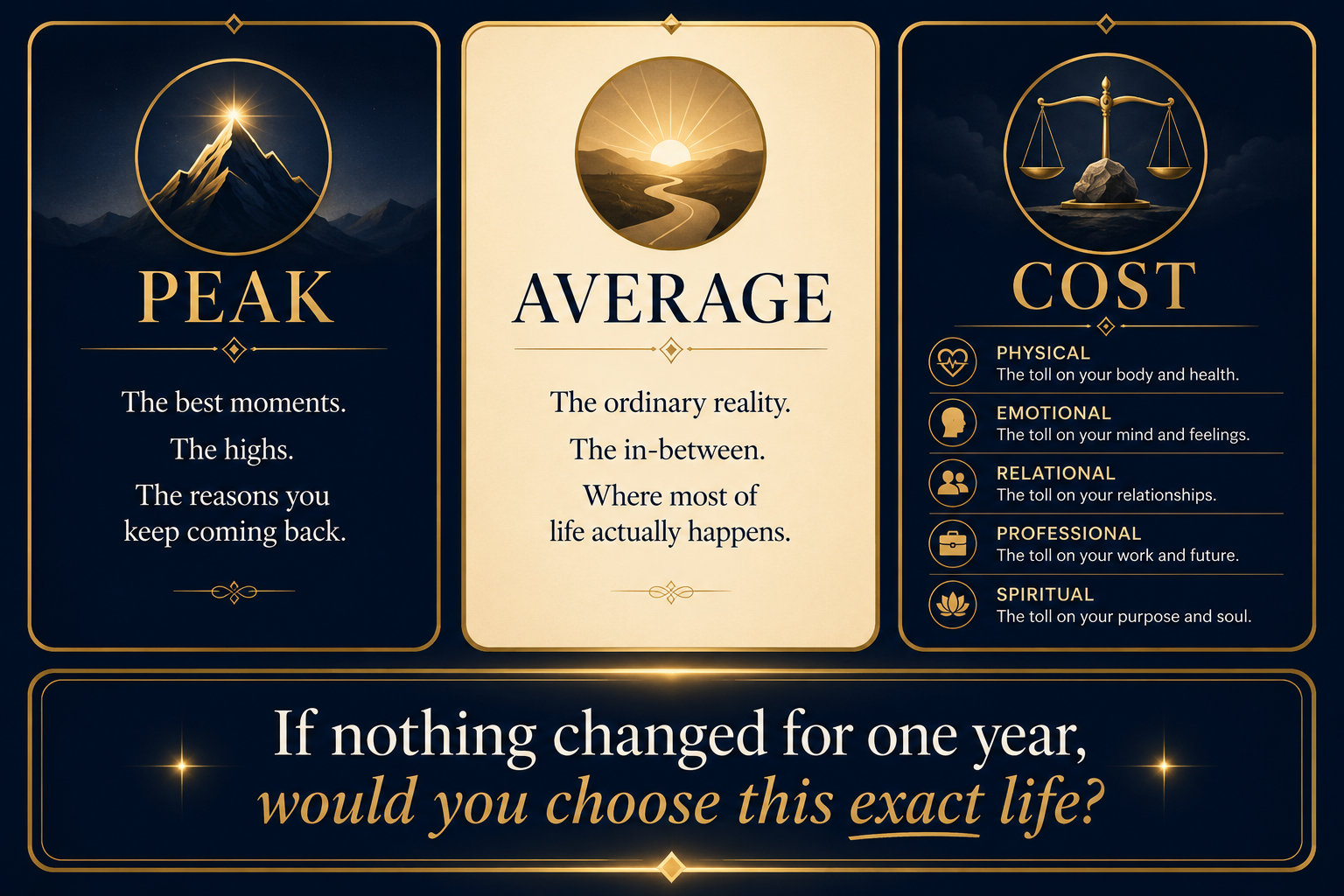
Examine three realities.
The Peak
What are the greatest moments? The most loving message. The most passionate reunion. The largest sale. The biggest win. The most viral post.
Write them down honestly. Do not diminish them merely because the larger pattern has become painful. The peaks may have been completely real.
The Average
What happens on an ordinary day, week, or month?
How often do I feel peaceful, present, secure, focused, respected, connected, and able to function?
How often am I waiting, checking, worrying, explaining, chasing, recovering, hiding, gambling, arguing, or trying to recreate a peak?
The average is not emotionally dramatic. That is why people overlook it.
But the average is where most of life is lived.
The cost
What has the pattern required from me emotionally, physically, psychologically, socially, environmentally, spiritually, professionally, and financially?
What has it cost my sleep? My body? My attention? My creativity? My parenting? My friendships? My honesty? My dignity? My purpose? My relationship with myself?
Then ask:
If the peaks disappeared, would the average still be acceptable?
If nothing changed for another year, would staying still feel like love, hope, ambition, or faith—or would it become self-abandonment?
The purpose is not to force an immediate decision.
It is to restore accurate perception.
The intermittent reward survives partly because the peak repeatedly erases our memory of the cost.
The audit places all three realities on the same page.
The peak. The average. The price.
The Strategic Recovery Intermittent Reinforcement Reset
Understanding the pattern is not the same as becoming free from it.
A person can understand intermittent reinforcement perfectly and still check their inbox thirty times before lunch. They can recognize that a relationship is destabilizing them and still experience an almost physical craving for contact. They can calculate exactly how much money they have lost gambling and still believe one more wager could repair the damage.
Insight matters. But conditioned behavior does not disappear simply because the conscious mind has developed an accurate explanation for it.
The pattern exists inside our expectations, routines, environments, physiology, relationships, emotional reflexes, and the meanings attached to the reward.
The Strategic Recovery approach is therefore not merely to remove the reward.
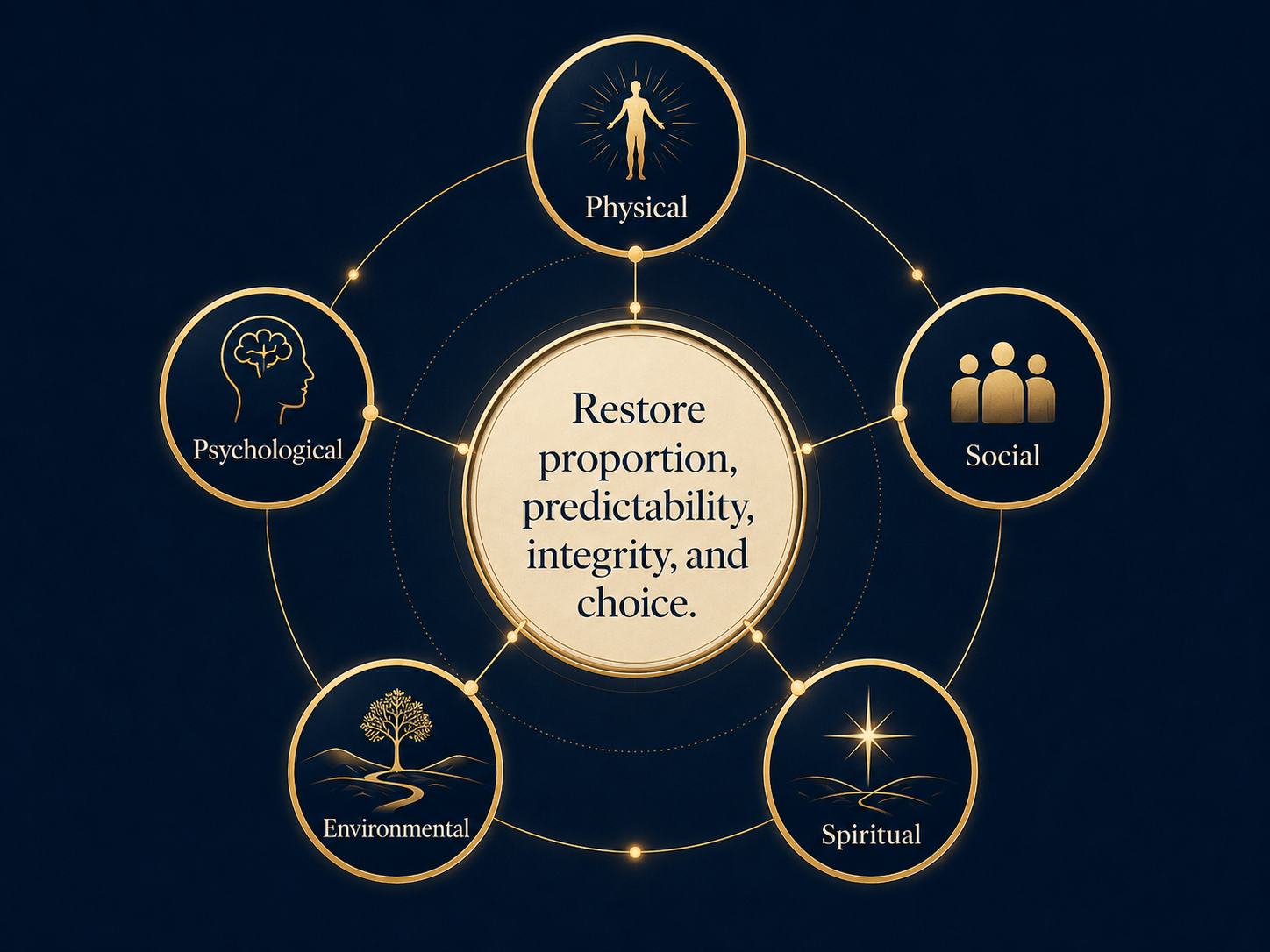
It is to build a body, mind, social system, environment, and spiritual foundation that no longer require one unpredictable reward to provide nearly all our safety, validation, excitement, connection, relief, or hope.
You do not merely stop pulling the lever.
You build a life in which the lever gradually loses its authority over you.
First: Identify What The Reward Is Really Providing
The visible reward may be a message. The internal reward may be reassurance.
The visible reward may be a commission. The internal reward may be safety.
The visible reward may be reconciliation. The internal reward may be relief from abandonment.
The visible reward may be sex. The internal reward may be worth, desirability, connection, or temporary freedom from loneliness.
The visible reward may be a gambling win. The internal reward may be excitement, escape, restored hope, or the belief that previous losses can still be redeemed.
If we believe we are only craving the visible reward, we may attempt to suppress the behavior without replacing the state it delivered.
The behavior is the delivery system.
The internal state is the product.
Once we identify the product, we can stop relying on a single unstable supplier.
Pillar One — Physical: Stabilize The Body Beneath The Urge
An urge never occurs in a disembodied mind. It appears inside a body that may be rested or exhausted, fed or hungry, hydrated or depleted, calm or overstimulated.
When the body is dysregulated, uncertainty can feel less like an unanswered question and more like an emergency.
A delayed response becomes abandonment. A slow sales day becomes financial ruin. A gambling urge becomes an urgent command rather than a passing state.
This is why the first interruption is sometimes almost embarrassingly physical.
Eat a real meal. Drink water. Walk outside. Breathe more slowly. Sleep before deciding. Move tension through the body. Reduce excessive caffeine. Step into sunlight. Stretch. Rest.
None of these actions solves the relationship, business, or financial problem.
They change the internal condition from which the problem is being interpreted.
A dysregulated body can interpret uncertainty as an emergency.
Before sending another message, placing another wager, or reopening the inbox, ask:
Am I hungry? Exhausted? Overstimulated? Lonely? Have I moved today? Have I slept? Am I trying to solve an emotional problem while my body is already in a threat state?
A stabilized body does not guarantee the correct decision.
It gives us a better chance of making one.
Pillar Two — Psychological: Decode the Loop
Slow the behavior down enough to see its architecture:
Cue → Behavior → Expected reward → Desired state → Immediate consequence → Long-term cost
Example:
Cue: Three hours have passed without a response.
Behavior: I check texts, email, social media, read receipts, and online status.
Expected reward: A loving message or evidence that the person is still available.
Desired state: Reassurance, relief, safety, and restored connection.
Immediate consequence: Either a short reduction in uncertainty or increased distress.
Long-term cost: Greater vigilance, dependence, distraction, and reduced ability to tolerate ordinary distance.
Instead of saying, “I need to check,” say:
I am experiencing an urge to resolve uncertainty.
Instead of, “I need them to answer,” say:
Part of me believes their response will regulate how I feel.
Instead of, “I need to know whether I made a sale,” say:
I am looking for immediate evidence that my future is safe.
The new language creates separation between the urge and the action.
The urge is real.
It is not necessarily an instruction.
When the urge appears, name the cue, identify the state being sought, delay the behavior, regulate the body, and choose deliberately.
When expected reinforcement stops, behavior may temporarily intensify, but this “extinction burst” is not universal. One applied review found bursts in about 24 percent of the examined cases, with lower rates when extinction was combined with alternative procedures rather than used alone.[15]
The urge becoming louder does not necessarily mean the boundary is wrong.
It may mean the system has not yet learned that the old action is no longer the only available path to relief.
Pillar Three — Social: Stop Making One Source Your Entire Emotional Ecosystem
Intermittent reinforcement becomes especially powerful when a single person, platform, business result, or activity is the primary source of nearly every meaningful state.
One person provides affection, sexuality, companionship, reassurance, excitement, validation, hope, and relief.
One business provides identity, income, mission, accomplishment, status, security, and proof of worth.
One gambling environment provides stimulation, escape, community, risk, fantasy, and the possibility of financial rescue.
When one source becomes responsible for everything, any interruption in access can feel like psychological suffocation.
No single person should become your nervous system’s only source of oxygen.
Call the friend you stopped calling. Spend time with the family member who is actually available. Return to the recovery meeting, spiritual community, professional network, or creative circle you neglected. Tell someone the truth about how much you are checking, waiting, gambling, hiding, or unraveling.
Isolation protects the loop.
Honest connection exposes it.
In gambling recovery, this may require financial transparency, specialized counseling, peer support, and allowing trusted people to see the behavior before another crisis forces disclosure. Randomized trials support cognitive-behavioral and motivational approaches for reducing gambling harm, though no single format works for everyone.[16][17]
Pillar Four — Environmental: Remove The Lever From Your Hand
When a powerful cue remains visible, audible, accessible, and available every second, willpower must win repeatedly.
The cue only has to win once.
That is an unfair contest.
Disable notification previews. Remove badges. Silence nonessential alerts. Move the phone out of the bedroom. Log out between planned visits. Stop monitoring read receipts and online-status indicators.
Separate business communication from revenue notifications. Check analytics at predetermined times. Review weekly or monthly trends rather than emotionally interpreting every hour.
Create communication windows.
For gambling: remove applications, block websites, restrict access to funds, use self-exclusion tools, and involve a trusted person in financial safeguards.
The purpose is not punishment.
It is to create enough friction for consciousness to reenter the sequence.
Willpower becomes less important when the lever is no longer permanently sitting in your hand.
Research on limited email checking and notification batching supports the broader principle of predictable, rather than constant, access.[12][13]
Decide when the door opens, rather than letting the possibility behind it interrupt you all day.
Environmental protection is one layer of a larger recovery structure. Blocking the casino does not automatically heal the desperation that entered it. Silencing the phone does not automatically heal attachment fear. Closing the dashboard does not automatically create financial safety.
But it creates time and space for deeper repair to begin.
Pillar Five — Spiritual: Restore Integrity, Meaning, And Direction
The Spiritual Pillar asks a different question.
Not: How do I get the next reward?
But who am I becoming as I continue to pursue it?
Is this pattern aligned with my values? Does it expand my life or contract it? Does it make me more honest, loving, present, and capable of serving?
Or does it require secrecy, obsession, self-neglect, rationalization, and the repeated abandonment of what I already know to be true?
A person can spend years asking whether the relationship will work.
A more revealing question may be:
What is participating in this relationship currently doing to my character and my life?
An entrepreneur can ask when the next sale will arrive.
A deeper question is:
Can I continue creating meaningful work without requiring every result to confirm my worth?
A gambler can ask whether the next wager might win.
The spiritual question is:
What am I sacrificing to preserve the possibility?
Prayer creates space between urgency and action. Meditation teaches us to observe longing without becoming identical to it. Journaling reveals the stories we keep repeating. Nature returns attention to a world larger than the screen. Service transforms the question from “What am I receiving?” to “What am I contributing?” Creative expression metabolizes emotions that might otherwise become messages, wagers, or compulsive checking.
Recovery is not merely resisting the next reward.
It is building a life that no longer revolves around waiting for it.
Replace The Unpredictable Supplier
Identify the state the reward was providing and construct several more dependable pathways to it.
If the reward provides connection, create scheduled contact with friends, family, peers, and community.
If it provides a sense of accomplishment, use daily process goals rather than waiting for sales, applause, or outcomes. Complete the article. Make the call. Serve the client. Publish the resource. Exercise. Keep the promise. Let completion—not notification—become evidence of progress.
If it provides financial safety, build a budget, maintain reserves, diversify income, and conduct planned revenue reviews.
If it provides excitement, introduce healthy novelty: music, movement, nature, travel, adventure, learning, and creative challenge.
If it provides relief, strengthen sleep, therapy, breathwork, movement, emotional processing, prayer, journaling, boundaries, and reliable social support.
If it provides worth, build self-respect from how you live—not from whether another person, customer, audience, or game rewards you today.
You do not break a powerful reward loop by building an empty life.
You break it by replacing one unpredictable emotional supplier with a diversified system of health, connection, meaning, accomplishment, integrity, and self-trust.
Peace May Feel Empty Before It Feels Peaceful
When the cycle quiets down, peace may not immediately feel peaceful.
It may feel empty, boring, flat, or suspicious.
A nervous system conditioned by anticipation, rupture, checking, urgency, and relief may interpret stability as the absence of something important.
There is no message to decode. No conflict to resolve. No dashboard to refresh. No dramatic reunion. No loss to recover. No crisis demanding immediate attention.
The person may say, “I feel nothing.”
But what they may be feeling is the absence of activation.
Gradually, quieter capacities return: concentration, creativity, rest, patience, presence, discernment, reliable affection, deeper work, self-respect, and the ability to enjoy something without immediately fearing its disappearance.
A nervous system conditioned by chaos may initially mistake peace for emptiness.
Do not rush to fill that space with another unpredictable reward.
Give peace enough time to reveal what it contains.
Recovery Is the Return of Choice
The goal is not to stop loving, building, caring, taking risks, or enjoying wonderful outcomes.
The goal is choice.
Can I participate without disappearing?
Can I love without abandoning myself?
Can I pursue success without making every result a verdict on my worth?
Can I tolerate uncertainty without treating it as an emergency?
Can I receive a reward without needing another one immediately?
Can I examine the average reality rather than be repeatedly conquered by the peak?
Can I stop when the cost exceeds the reward?
Recovery is not the elimination of desire.
Recovery is the restoration of proportion, perspective, integrity, and choice.
When Maybe Is No Longer Enough
In the Fall of 2012, I sat in an evening psychology class at Mesa College, approximately one year after getting sober.
I arrived early. I never missed a class. I studied every chapter, participated in every discussion, helped the students around me, and finished the semester with 242 points out of 250—the highest grade in the class by far.
At the time, I believed I was learning about B. F. Skinner, pigeons, levers, parents, children, rewards, consequences, and the principles that make behavior grow stronger or gradually disappear.
I could explain continuous reinforcement. I could distinguish fixed schedules from variable ones. I could explain why a behavior that was rewarded only sometimes might persist even after the reward began to disappear.
I understood the concept intellectually.
But I did not yet know what it felt like to live inside it.
I did not know that, less than two years later, one inbox would begin telling me whether my professional future was safe.
I did not know another inbox would begin telling me whether I was loved.
I did not know that a twenty-dollar commission could eventually become a ten-thousand-dollar day.
I did not know that an extraordinary honeymoon could become years of unpredictable conflict, distance, reunion, sexual intensity, hope, and pain.
I did not know how quickly checking could become vigilance. How easily relief could be mistaken for happiness. How scarcity could increase value. How an uncertain future could become more commanding than the life directly in front of me.
And I did not know that recovery would eventually require far more than abstaining from alcohol and opioids.
It would require noticing every place where my peace, presence, productivity, identity, self-worth, and safety had become dependent upon an unpredictable reward.
That lesson did not make the rewards unreal.
The money was real. The love was real. The pleasure was real. The hope was real.
But something can be real and still be unable to sustain the life we are asking it to support.
A peak can be breathtaking and still exist inside an average reality that is steadily harming us.
A possibility can be beautiful and still cost too much to keep pursuing.
The reward may be real.
The love may be real.
The hope may be real.
But when the average reality repeatedly requires us to sacrifice our health, peace, presence, purpose, relationships, integrity, or relationship with ourselves—
maybe is no longer enough.
Recovery begins when we stop allowing the next message, sale, reconciliation, notification, or win to decide how we are permitted to feel.
It begins when we stop pulling the lever long enough to hear our own life calling us back.
And it deepens when we begin building a life we do not have to chase, check, gamble on, or abandon ourselves to in order to feel fully alive inside.
Primary-Source References
- Hochman G, Erev I. The partial-reinforcement extinction effect and the contingent-sampling hypothesis. Psychonomic Bulletin & Review. 2013;20(6):1336-1342. doi:10.3758/s13423-013-0432-1.
- Do AM, Rupert AV, Wolford G. Evaluations of pleasurable experiences: the peak-end rule. Psychonomic Bulletin & Review. 2008;15(1):96-98. doi:10.3758/PBR.15.1.96.
- Duffy SM, Rusbult CE. Satisfaction and commitment in homosexual and heterosexual relationships. Journal of Homosexuality. 1985;12(2):1-23. doi:10.1300/J082v12n02_01.
- Schultz W, Dayan P, Montague PR. A neural substrate of prediction and reward. Science. 1997;275(5306):1593-1599. doi:10.1126/science.275.5306.1593.
- Fiorillo CD, Tobler PN, Schultz W. Discrete coding of reward probability and uncertainty by dopamine neurons. Science. 2003;299(5614):1898-1902. doi:10.1126/science.1077349.
- Clark L, Lawrence AJ, Astley-Jones F, Gray N. Gambling near-misses enhance motivation to gamble and recruit win-related brain circuitry. Neuron. 2009;61(3):481-490. doi:10.1016/j.neuron.2008.12.031.
- Chase HW, Clark L. Gambling severity predicts midbrain response to near-miss outcomes. Journal of Neuroscience. 2010;30(18):6180-6187. doi:10.1523/JNEUROSCI.5758-09.2010.
- Rice TM, Kumashiro M, Arriaga XB. Mind the gap: perceived partner responsiveness as a bridge between general and partner-specific attachment security. International Journal of Environmental Research and Public Health. 2020;17(19):7178. doi:10.3390/ijerph17197178.
- Selcuk E, Gunaydin G, Ong AD, Almeida DM. Does partner responsiveness predict hedonic and eudaimonic well-being? A 10-year longitudinal study. Journal of Marriage and Family. 2016;78(2):311-325. doi:10.1111/jomf.12272.
- Whitton SW, Rhoades GK, Whisman MA. Fluctuation in relationship quality over time and individual well-being. Personality and Social Psychology Bulletin. 2014;40(7):858-871. doi:10.1177/0146167214528988.
- Stothart C, Mitchum A, Yehnert C. The attentional cost of receiving a cell phone notification. Journal of Experimental Psychology: Human Perception and Performance. 2015;41(4):893-897. doi:10.1037/xhp0000100.
- Kushlev K, Dunn EW. Checking email less frequently reduces stress. Computers in Human Behavior. 2015;43:220-228. doi:10.1016/j.chb.2014.11.005.
- Fitz N, Kushlev K, Jagannathan R, Lewis T, Paliwal D, Ariely D. Batching smartphone notifications can improve well-being. Computers in Human Behavior. 2019;101:84-94. doi:10.1016/j.chb.2019.07.016.
- Dutton DG, Painter S. Emotional attachments in abusive relationships: a test of traumatic bonding theory. Violence and Victims. 1993;8(2):105-120. PMID:8193053.
- Lerman DC, Iwata BA. Prevalence of the extinction burst and its attenuation during treatment. Journal of Applied Behavior Analysis. 1995;28(1):93-94. doi:10.1901/jaba.1995.28-93.
- Petry NM, Ammerman Y, Bohl J, et al. Cognitive-behavioral therapy for pathological gamblers. Journal of Consulting and Clinical Psychology. 2006;74(3):555-567. doi:10.1037/0022-006X.74.3.555.
- Petry NM, Weinstock J, Ledgerwood DM, Morasco B. A randomized trial of brief interventions for problem and pathological gamblers. Journal of Consulting and Clinical Psychology. 2008;76(2):318-328. doi:10.1037/0022-006X.76.2.318.




Leave a Reply