
How to Design a Life Where Recovery Outcompetes Relapse Automatically
Once upon a time, in 2003, I was 24 years old and lived right across the street from a liquor store.
Not just nearby, literally across the street.
There was also a charming liquor-and-grocery store a half block away.
Within a three-block walking distance, the vibrant downtown area was filled with bars, restaurants, and lively late-night spots, all buzzing with familiar faces and energy, making drinking seem like the main attraction.
I was in Ocean Beach, San Diego, a beautiful place with a strong social scene…
But I was also grappling with an alcohol issue.
That was just one facet of my journey.
I was in an environment that continuously reinforced the idea that:
Drinking was the answer.
My home wasn’t a sanctuary of sobriety.
Every roommate and girlfriend during those years was drinking and using other drugs.
In retrospect, my social circle was made up of people who were more like drinking and using buddies than true friends.
The liquor stores and bars were conveniently close, making it easy to get caught up in the culture surrounding alcohol and other drugs.
In that environment, every block I walked echoed the message that drinking was a normal, celebrated way to belong.
For years, I often lost the daily battle against those temptations.
I believed my struggle was a matter of willpower, but in reality…
It was a high-cue, low-friction situation that normalized my choices.

Environment Is Influence, Not Destiny
Before we dive in, I want to clarify what this article is really about and what it is not.
It is not an argument that people are powerless.
This is not about blaming your city, partner, parents, neighborhood, phone, or the weather for every decision you made.
It is also not a claim that simply moving to a new place will automatically resolve addiction. Nor is it a suggestion to wait for perfect conditions before you start rebuilding your life.
Instead, I invite you to consider a more useful way of looking at things:
Environment is not destiny.
But your environment can significantly influence your chances.
Research supports this. A large systematic review and meta-analysis found that drug-related cues and craving indicators were meaningfully associated with later substance use and relapse outcomes. [1]
NIDA also identifies environmental factors—including family, school, neighborhood, stress, and social conditions—as important influences on addiction risk. [2]
So the question is not:
“Why can’t I just be stronger?”
The more appropriate question is:
“What conditions keep making my old solution feel easier than my new one?”
Willpower matters.
But willpower is like an emergency reserve.
It is limited and runs out quickly when you rely on it constantly.
Your environment is the system that determines how often you are forced to dip into that reserve.
Three Environments, Three Different Outcomes
My own life taught me this lesson in three distinct chapters.
1. Ocean Beach: High Access, Low Friction, Constant Permission
In Ocean Beach, alcohol was not simply available.
It was embedded into the geography, culture, relationships, routines, and identity of my world.
I could walk a few minutes to buy alcohol.
I could walk a few blocks to bars.
I lived around people who drank and used.
I lived in a home where I could not remove cues because others lived there too.
I had:
- Easy access
- Low friction
- High exposure
- and a social world that made drinking feel normal
The environment did not force me to drink and use.
But it made drinking easier to imagine, access, justify, and repeat than building a sober life.
It was not simply “people, places, and things.”
It was an entire addiction ecosystem.

2. Upstate New York: Less Alcohol Access, a Different Addiction Ecosystem
At the age of 27, I moved to the beautiful landscapes of upstate New York.
However, just two months in, I hit a major bump in the road when I got my third DUI.
That moment really made me realize my relationship with alcohol had gone from something fun to a potentially freedom-threatening habit.
The legal stuff felt really heavy, but I decided to see it as a chance to grow and reflect. With bars and liquor stores no longer so easy to access, I took the opportunity to focus on living a healthier lifestyle.
For a while, I drank much less often and with way more caution.
But changing locations did not automatically create recovery.
The town I lived in had a serious illicit prescription-opioid scene.
This occurred during the opioid epidemic, before it became a mainstream national conversation.
Pills were accessible.
Dealers were accessible.
The social networks were accessible.
Eventually, I entered that world.
I became a workaholic.
Then I became exhausted.
Then I became a parent (and even more exhausted).
I was often sleep-deprived and trying to keep life moving.
I needed energy.
I needed relief.
I needed to feel capable.
When I found multiple opioid dealers, a new resource became highly available just as my nervous system was depleted enough to need what it promised: energy, confidence, emotional distance, relief, and the ability to keep going.
Physical and mental opioid dependence developed fast.
This was not because I was uniquely defective or weak.
It was because a different environment made a different escape route available, rewarding, and easier to repeat.

3. Up the Hill: The Beginning of a Recovery Ecology
At the age of 32, I found myself living under my parents’ roof, immersed in the demands of caring for my lively 18-month-old daughter.
Unemployed at the time, I was channeling my aspirations into my studies, pursuing a degree to become an alcohol and drug counselor.
To many outsiders, this chapter of my life might have seemed like a series of setbacks or a sign of failure. However, as I reflect on it now, I recognize it as the dawn of my recovery journey—a transformative phase in which I began to nurture not just my own healing but also the foundation for a thriving, supportive recovery ecosystem.
I resided high up on the hill, far removed from the pulsating nightlife, noisy bars, and the tempting glow of liquor stores.
The vibrant restaurant culture and the all-too-frequent binge-drinking spots were a distant memory, as were the familiar cues and bygone energies that once surrounded me. My parents fostered an environment free from alcohol and drugs, ensuring that our home was a sanctuary of clarity and safety.
I made a conscious decision to distance myself from my former companions who indulged in drinking and drug use.
Although my social circle became smaller, it transformed into a space filled with safety and comfort. I surrounded myself with sober friends from school, the steadfast support of my parents and siblings, and the joyful laughter of my daughter, which created a nurturing and hopeful atmosphere.
My identity changed as well. I was no longer just someone trying to avoid using substances. I was becoming a father, a student, a future counselor—a person rebuilding my life.
I didn’t transform into a different person simply because I suddenly had strong willpower.
I became a different person because I started living within a new system.
That is the Environmental Pillar of Strategic Recovery.
Not a slogan about “people, places, and things.”
A deeper question:
What is the world around you teaching your nervous system to expect, seek, avoid, tolerate, and become?

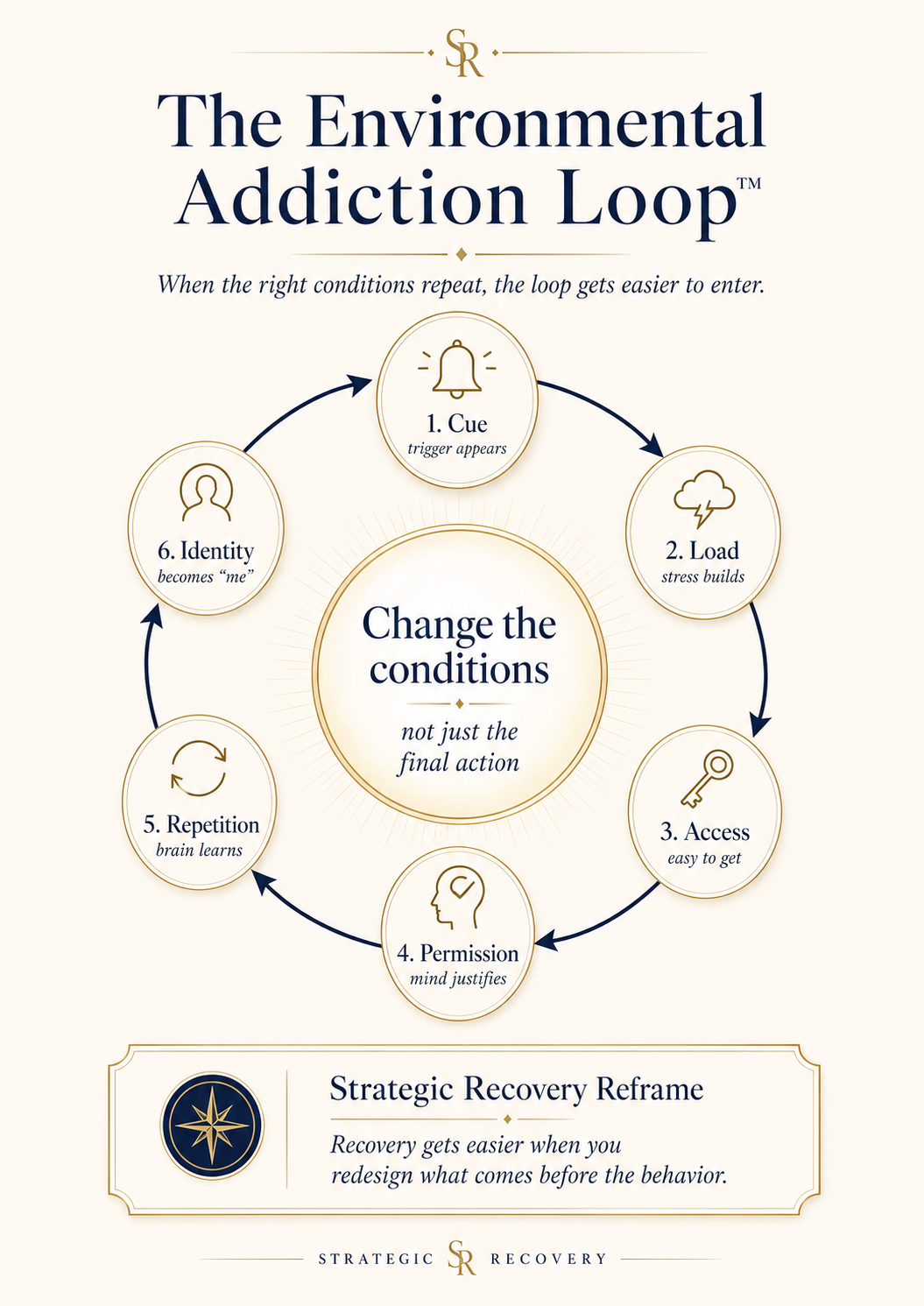
The Environmental Addiction Loop™
When the right conditions line up repeatedly, a familiar loop can take over:
Cue → Load → Access → Permission → Repetition → Identity
1. Cue
A liquor store.
A route home.
A particular bar.
A bottle on the counter.
A Friday night.
A smell.
A song.
A text from an old friend.
A paycheck.
A lonely evening.
A notification.
2. Load
Stress.
Sleep deprivation.
Pain.
Conflict.
Financial fear.
Boredom.
Grief.
Shame.
Overwork.
Parenting exhaustion.
The feeling that life is overwhelming and you have nowhere safe to go.
3. Access
How close is the substance, behavior, person, app, dealer, delivery service, or escape route?
How easy is it to obtain?
How private is it?
How normalized is it?
How little friction exists between the craving and the action?
4. Permission
“Everyone does it.”
“It is not that bad.”
“I deserve this.”
“I will quit tomorrow.”
“Nobody will know.”
“I can handle it.”
5. Repetition
The brain learns what the environment keeps rewarding.
Every repeated loop makes the next loop easier to enter.
6. Identity
Eventually, a person stops saying:
“I am caught in a pattern.”
And starts saying:
“This is just who I am.”
That is where shame becomes especially dangerous.
Because now the person is not only trying to interrupt a behavior.
They are trying to outgrow an identity.
The tactical move is not simply to fight the final action harder.
It is to redesign the conditions that come before.
Recovery is not only about resisting the final action. It is about changing the conditions that keep making that action feel inevitable.
The Geographic Swap Trap™
One of the most important lessons from my own story is this:
You can leave one addiction ecosystem without yet entering a recovery ecosystem.
I left Ocean Beach and reduced frictionless alcohol access, which had shaped my twenties.
But I did not yet have a complete recovery architecture in place.
I was still exhausted.
Still vulnerable.
Still looking for relief.
Still living in an environment where another high-impact resource became more available.
That is the Geographic Swap Trap™.
You can leave bars and become surrounded by pills.
You can reduce alcohol access while increasing opioid access.
You can walk away from one group and slowly become embedded in another.
You can quit one exhausted resource while remaining exhausted enough to reach for the next available one.
Yet… a new zip code does not automatically create a new life.
A move becomes recovery-supportive when paired with a larger redesign of access, relationships, routines, identity, purpose, nervous-system support, and daily structure.
Recovery is not solely about leaving the old place.
It is building a new ecology where the old solution is no longer the easiest answer to pain.

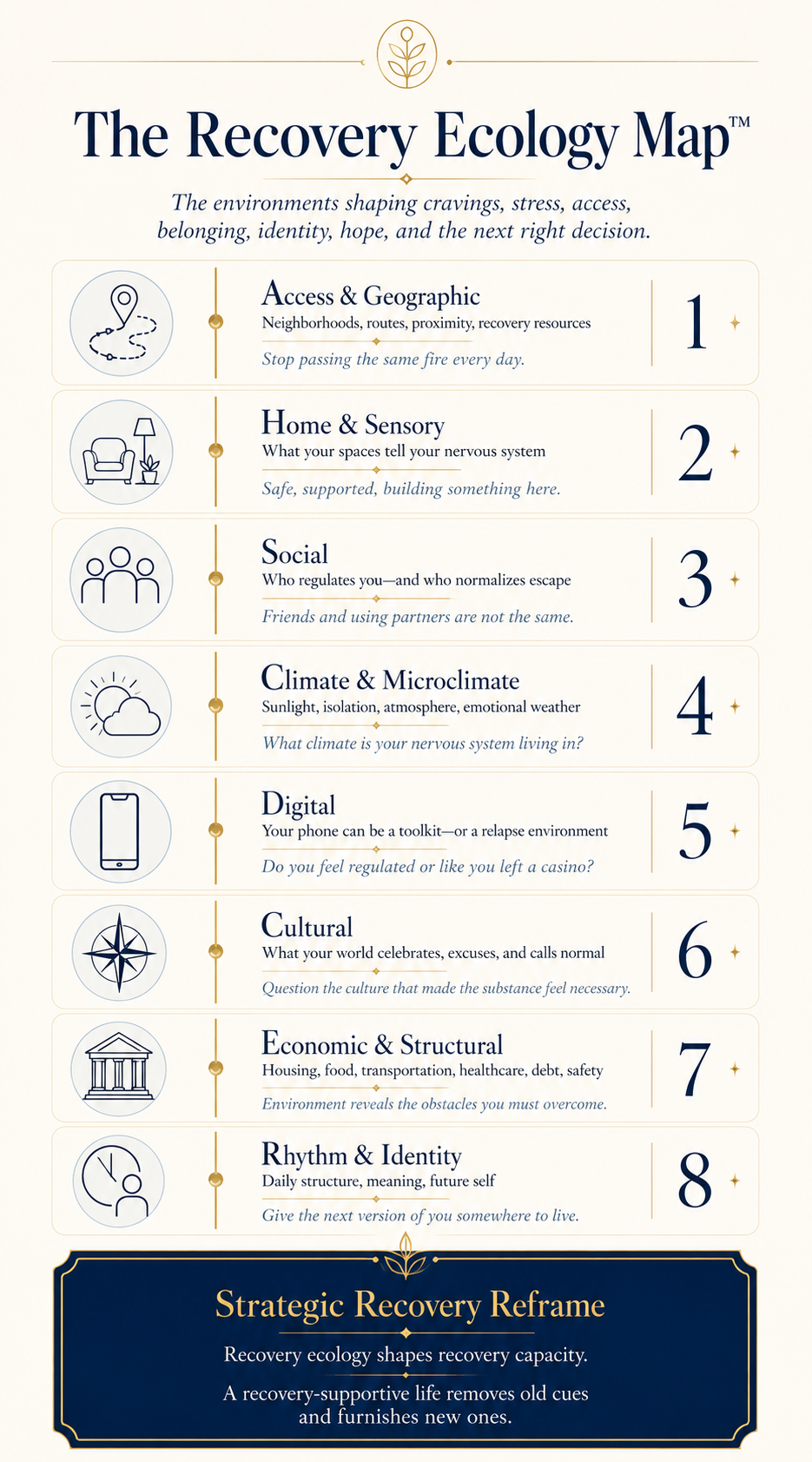
The Recovery Ecology Map™
Your recovery ecology is the total environment shaping your cravings, stress load, access, belonging, identity, hope, and ability to make the next right decision.
1. Access and Geographic Environment
This includes your neighborhood, route home, proximity to bars or stores, delivery options, transportation, local drug culture, nearby recovery resources, parks, gyms, meetings, and safe places to spend time.
Geography is not destiny.
But it can determine how often you are asked to resist each day.
Sometimes a powerful recovery intervention is not “be stronger.”
Sometimes it is:
Stop passing the same fire every day.
2. Home and Sensory Environment
Your bedroom, kitchen, bathroom, car, lighting, clutter, food access, sleep setup, visible reminders of old use, and overall atmosphere all send messages to your nervous system.
A bottle on the counter is not neutral.
No food in the house is not a neutral message.
A dark, chaotic room where you cannot sleep is not neutral.
A car full of old receipts, fast-food bags, and chaos is not neutral.
A recovery-supportive home does not need to be perfect or expensive.
It needs to communicate:
“You are safe here. You are supported here. You are building something here.”
Water where you can see it.
Protein nearby.
Supplements in plain sight.
A clean place to sleep.
Walking shoes by the door.
A book on the nightstand.
One chair that becomes a place to breathe, pray, journal, meditate, or simply sit without feeling the need to escape.
3. Social Environment
Who are you around most often?
Who normalizes what?
Who brings out your future self?
Who helps you feel more regulated, honest, hopeful, and accountable?
Does making you feel a sense of belonging require abandoning yourself?
Social support and broader recovery capital—”the internal and external resources available to someone in recovery”—are repeatedly associated with better recovery stability and quality-of-life outcomes.
This does not mean you need flawless relationships.
It means you need honesty.
Some people are friends.
Some people are using partners.
Those are not the same thing.
Your closest relationships either help your nervous system settle or teach it to keep escaping.
4. Climate and Microclimate Environment
Environment is not only the weather.
It is also climate.
And microclimate.
The climate of a place can influence sunlight, movement, isolation, access to nature, time spent indoors, seasonal rhythm, and the texture of daily life.
But microclimate goes deeper.
Your home has a microclimate.
Your relationship has a microclimate.
Your workplace has a microclimate.
Your phone has a microclimate.
A home can be sunny outside and emotionally freezing inside.
A relationship can look stable on paper and still feel chronically unsafe in the body.
A job can pay well and still keep someone in a constant state of urgency.
A phone can contain photographs of the people you love while also functioning as a 24-hour machine for fear, comparison, alcohol content, rage, stimulation, and escape.
This is not a simplistic claim that cold weather causes addiction or that moving to a sunny place solves all problems.
It serves as an invitation to ask:
What climate is my nervous system living in?
Two people can live in the same city and inhabit completely different recovery climates.
5. Digital Environment
Your phone is not simply a device.
It is a place where your nervous system lives.
It can become a recovery tool kit:
- A library of recovery education and podcasts
- A meditation timer
- A list of emergency contacts
- A group chat with safe people
- A calendar built around supportive routines
- A bridge to treatment, community, or help
Or it can become a pocket-sized environment for relapse:
- Old contacts
- Delivery apps
- Alcohol or drug content
- Gambling
- Pornography
- Rage bait
- Doomscrolling
- Comparison
- Endless notifications
- An easy escape from discomfort
Ask yourself:
When I put my phone down, do I feel more regulated or like I just walked out of a casino?
Your home screen, saved contacts, notifications, apps, feeds, and content diet are all part of your recovery environment.
6. Cultural Environment
Culture tells us what to celebrate, excuse, minimize, hide, and call normal.
Some cultures worship alcohol.
Some worship productivity.
Some reward people for looking successful while silently falling apart.
Some families treat vulnerability as weakness.
Some workplaces treat burnout as a badge of honor.
Some friend groups treat drinking as a requirement for belonging.
Some online spaces turn dysfunction into entertainment.
What a culture repeatedly normalizes, the nervous system can eventually mistake for safety.
Recovery often requires more than leaving a substance behind.
It requires questioning the culture that made the substance feel necessary.
7. Economic and Structural Environment
Recovery advice becomes shallow when it ignores the real conditions people live in.
Housing matters.
Food access matters.
Transportation matters.
Employment matters.
Insurance matters.
Access to medical care matters.
Debt matters.
Legal stress matters.
Local retail density, advertising, neighborhood safety, and the availability of treatment or recovery support matter too.
NIDA has emphasized that social determinants of health—including financial well-being, housing, healthcare availability, and community context—cannot be separated from addiction science. [3]
This does not eliminate agency.
It tells us where agency has the greatest leverage.
Environment does not erase personal responsibility.
It reveals the true obstacles a person must overcome.
8. Rhythm and Identity Environment
Your daily rhythm is an environment too.
What happens in your first 30 minutes?
What happens at 5:00 p.m.?
What happens when you are tired, hungry, lonely, overstimulated, or unable to sleep?
Do your days have structure?
Do they have meaning?
Do they contain people, movement, nourishment, sunlight, service, learning, and rest? Or are there long, unsupported stretches where the old identity takes over?
School and fatherhood helped create a new identity environment for me.
I was no longer only trying to avoid a substance.
I had somewhere to go.
Something new to learn.
Someone to care for.
A future version of myself that was becoming more real and compelling.
A recovery-supportive life not only removes old cues but also furnishes new ones.
It gives the next version of you somewhere to live.
From Relapse Architecture to Recovery Architecture
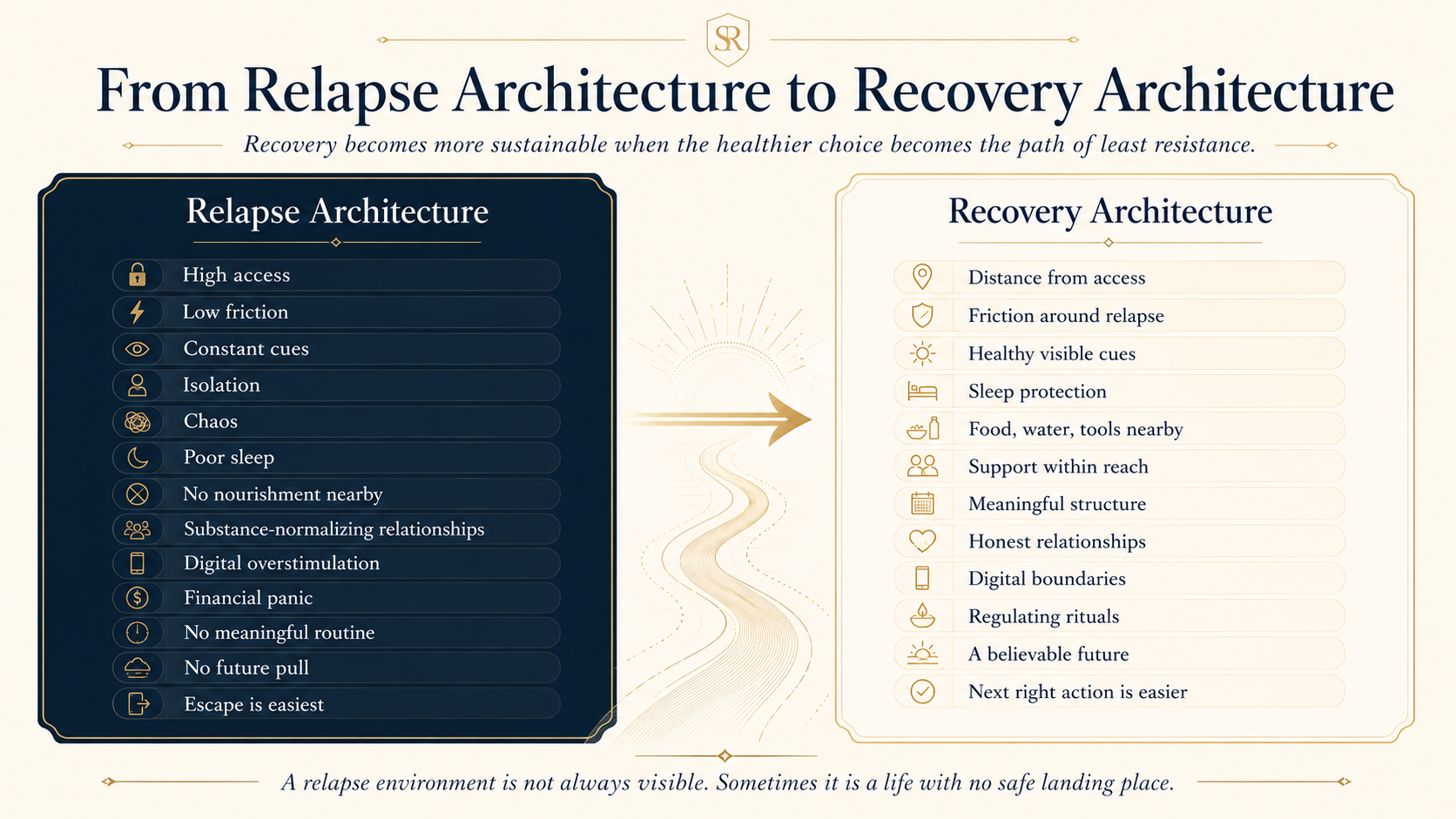
A relapse environment is not always a place where substances are visible.
Sometimes, it is a life in which the nervous system has no safe landing place.
Relapse Architecture
- High access
- Low friction
- Constant cues
- Isolation
- Chaos
- Poor sleep
- No food or nourishment nearby
- Substance-normalizing relationships
- Digital overstimulation
- Financial panic
- No meaningful routine
- No future pull
- Escape is the easiest option
Recovery Architecture
- More distance from access
- Added friction around relapse
- Visible cues for health and stability
- Sleep protection
- Food, water, and recovery tools nearby
- Support within reach
- Meaningful structure
- Honest relationships
- Digital boundaries
- Small rituals that regulate the body
- A believable future
- The next right action is easier to take
Recovery becomes ever more sustainable when the healthier choice is not exclusively possible—it becomes the path of least resistance.
Knowledge Needs a Place to Land
A former group coaching client of mine died in April 2026.
I am withholding his name and identifying details because his story deserves dignity.
He knew a lot about recovery.
He understood supplements.
He understood nutrition.
He understood many of the strategies that can support alcohol recovery.
But he was also isolated, unemployed, financially stressed, living in a cold, dark environment with little sunlight, little movement, little in-person support, and no stable daily structure to support him.
I will not reduce his death to one city, one decision, one missed opportunity, or one cause.
That would not be honest.
But I believe this deeply:
Recovery knowledge matters.
But knowledge needs a strong life structure to support it.
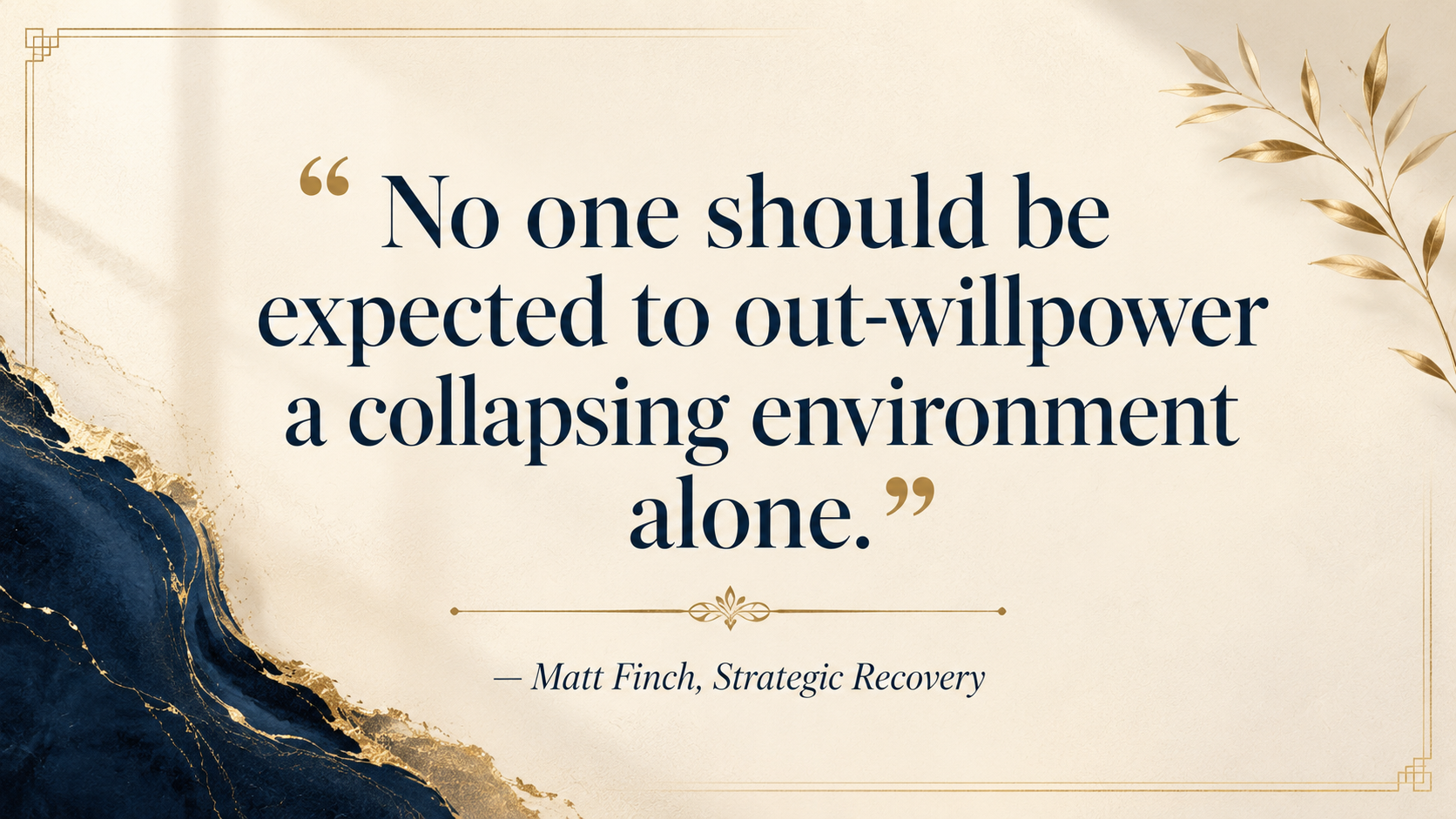
No one should be expected to out-willpower a collapsing environment alone.
The Smallest Controllable Environment Principle™
Not everyone can move.
Not everyone can leave a relationship today.
Not everyone can change jobs, afford private treatment, escape financial pressure, or pick their climate.
It’s real.
And it matters.
But there is almost always a smallest environment you can control.
Your nightstand.
Your car.
Your morning.
Your pantry.
Your bedroom.
Your lock screen.
Your route home.
Your saved contacts.
Your first text of the day.
Your evening routine.
One chair in your home.
One person you stop calling.
One person you start calling.
You may not redesign your entire life this week.
But you can begin redesigning the next ten feet around you.
Begin there.
The Strategic Recovery Environment Audit™
Take 15 minutes to assess the environments you inhabit most often—and identify what may be quietly making freedom easier, harder, or nearly impossible.

For each environment, ask:
There is no need for perfect answers. Look clearly. Name what is true. Choose one next move.
- What cues are here?
- What raises my stress load here?
- How easy is it to access my old escape route here?
- What support is available here?
- Does my nervous system feel safer or more activated here?
- Does this environment reinforce my old identity or my future identity?
- What is one 10% improvement I can make this week?
Audit these areas:
Start with the places, people, rhythms, and systems you encounter most often.
- Bedroom
- Home
- Kitchen
- Car
- Phone
- Social media feed
- Closest relationships
- Neighborhood
- Daily route
- Work environment
- Financial environment
- Sleep atmosphere
- Climate + microclimate
- Daily rhythm
- Red Actively undermining recovery.
- Yellow Mixed, unstable, inconsistent, or in need of stronger boundaries.
- Green Actively supporting recovery and worth protecting.
Does this environment make freedom easier, harder, or nearly impossible?
Build a World That Makes Recovery Easier Than Relapse
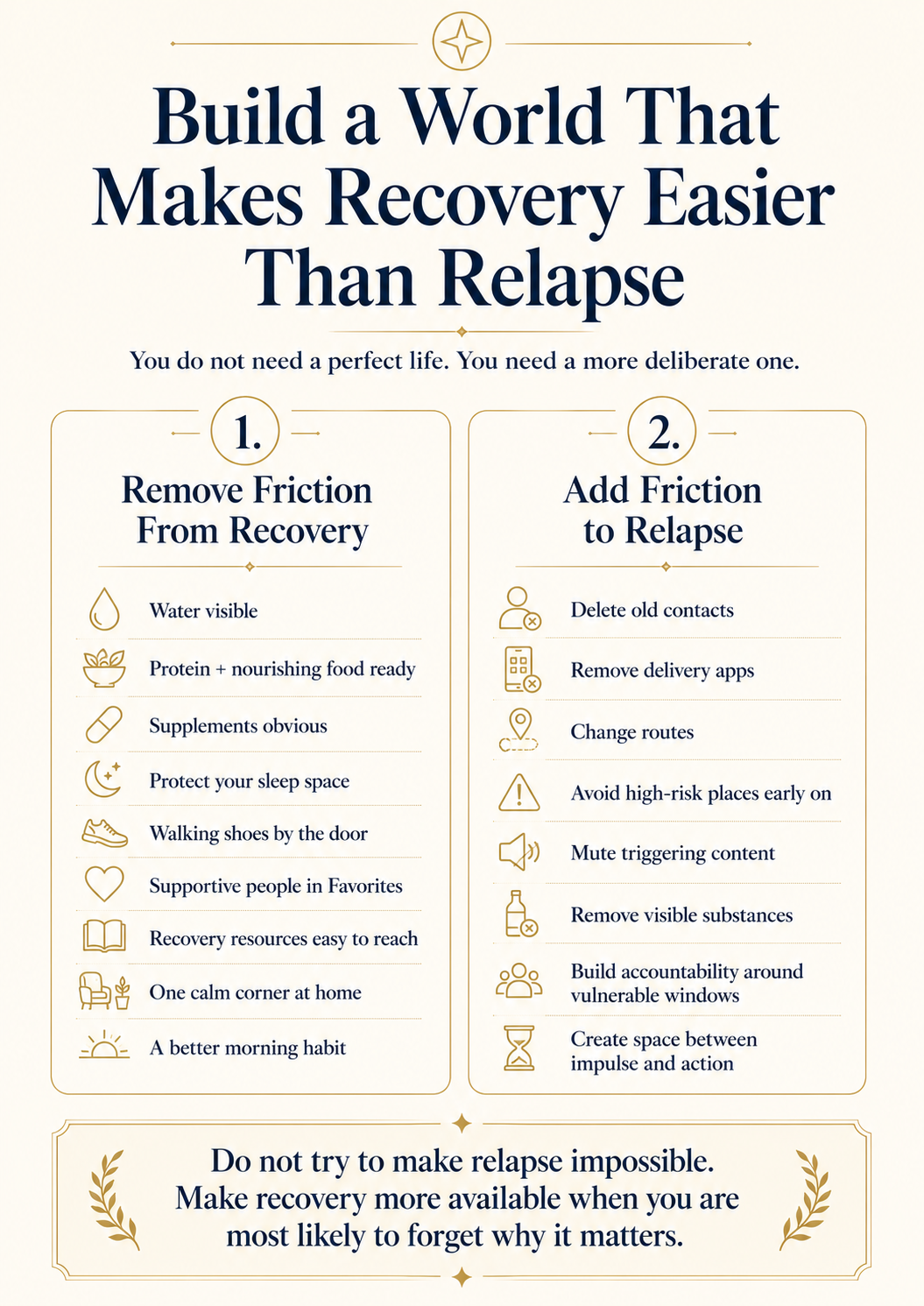
You do not need a perfect life.
You need a more deliberate one.
1. Remove Friction From Recovery
Put water where you can see it.
Keep simple protein and nourishing food available.
Place supplements somewhere obvious.
Protect your sleep space.
Put walking shoes by the door.
Save supportive people in your favorites.
Create a list of meetings, groups, therapists, coaches, medical resources, or recovery supports that is EASY to access… BEFORE a crisis.
Make one calm corner in your home.
Build a morning habit that begins with something other than anxiety, a phone, or an old habit.
2. Add Friction to Relapse
Delete old contacts.
Remove delivery apps.
Change routes.
Avoid high-risk people, places, and things in early recovery.
Block or mute content that makes your brain rehearse the old life.
Remove visible substances when you can.
Build accountability around money, evenings, weekends, paydays, loneliness, and the time windows when you are most vulnerable.
Create space between impulse and action.
You do not need to make relapse impossible to prevent.
You need to make recovery more available when you are most likely to forget its importance.
Stop Blaming the Plant. Start Looking at the Soil.
A plant does not fail because it lacks moral character.
It responds to:
- Soil
- Water
- Sunlight
- Temperature
- Nutrients
- Space
- Pests
- Protection
- Conditions
People do too.
A person cannot be expected to thrive while surrounded by constant cues, easy access, chaos, isolation, poor sleep, financial fear, substance-normalizing relationships, and no believable road forward.
Recovery is not simply about removing a substance from your life.
It is about removing the conditions that keep escape from feeling necessary.
It is about building a home, a circle, a climate, a rhythm, a nervous-system atmosphere, and a future that supports the person you are becoming.
Your environment is not neutral.
It is either rehearsing addiction—
Or rehearsing freedom.

Questions Worth Asking About Your Recovery Environment
A more supportive environment does not create perfection. It makes the next right action easier to remember, reach, and repeat.
01 What is the Environmental Pillar of addiction recovery?
The Environmental Pillar is the total system around you: access, cues, relationships, spaces, routines, digital inputs, climate, finances, and culture. It does not erase personal responsibility. It reveals the conditions a person is being asked to navigate every day.
02 Why can environment matter as much as willpower?
Willpower becomes less available when stress, exhaustion, loneliness, constant cues, and easy access stack up. A recovery-supportive environment adds space between impulse and action while making sleep, nourishment, support, and structure easier to use.
03 Can I create a better recovery environment without moving?
Yes. Start with the smallest controllable environment: the next ten feet around you. Your room, kitchen, phone, route home, evening routine, sleep setup, support contacts, and digital feed can all become safer before a larger change is possible.
04 What is the Geographic Swap Trap™?
The Geographic Swap Trap™ happens when someone leaves one addiction ecosystem but remains exhausted, isolated, under-supported, or vulnerable enough to reach for a new escape route. A new zip code helps most when access, relationships, rhythm, identity, and nervous-system support change too.
05 What makes a home more recovery-supportive?
A supportive home does not need to be expensive or perfect. It can begin with visible water, nourishing food, supplements in plain sight, a protected sleep space, walking shoes by the door, safer cues, and one calm place to breathe, pray, journal, meditate, or simply sit.
06 Which environments should I change first?
Start with the environments you touch every day and the moments where the old pattern is most likely to take over. Red environments need distance or added friction. Yellow environments need stronger boundaries. Green environments deserve protection and repetition.
07 What if I cannot change my home, work, finances, or relationships yet?
Constraint is not failure. Build leverage where you can: pack food and water, change notifications, create a safer evening routine, save one supportive contact, protect one sleep cue, change one route, or create one calm corner. Small environmental changes compound.
08 What does “a life you do not need to escape from” actually mean?
It means building practical and emotional conditions that support the person you are becoming: a more regulated body, honest relationships, meaningful structure, safer access, stronger support, and a future self that feels increasingly believable.
Download the Strategic Recovery Environment Audit™
Identify the spaces, cues, relationships, climates, access points, routines, and digital patterns that may be quietly working against your recovery—and begin building a world you do not need to escape from.
- Map your most important recovery environments in about 15 minutes.
- Use a clear red, yellow, and green system to see where protection or change is needed.
- Choose one strategic 10% upgrade that makes freedom easier this week.
Free PDF worksheet · Print it, save it, or begin with one page today.




Leave a Reply