
For people using 7-OH daily, this is more than a policy headline. It is a moment to understand what is changing, what is not, and how to make the safest next move.
Maybe you saw the headline and felt your stomach drop.
Maybe you use 7-OH every day.
Maybe you have tried to stop before, felt worse than you expected, and returned to it just to feel normal again.
Maybe you have been telling yourself you will get serious about quitting soon.
And now you are seeing Schedule I in the news.
Your first question may not be legal.
It may be:
What happens to me now?
I help people who want to get off 7-OH create a clearer, safer, more strategic recovery path.
This is not a panic article. It is not a “just quit” article. And it is not here to shame anyone for needing something that once seemed to help.
It is here to give you a calm read on what is happening—and help you make a plan before fear, scarcity, or shame starts making one for you.
The Most Important Thing to Know First
As of July 2, 2026, 7-OH is not yet federally Schedule I simply because of this week’s news.
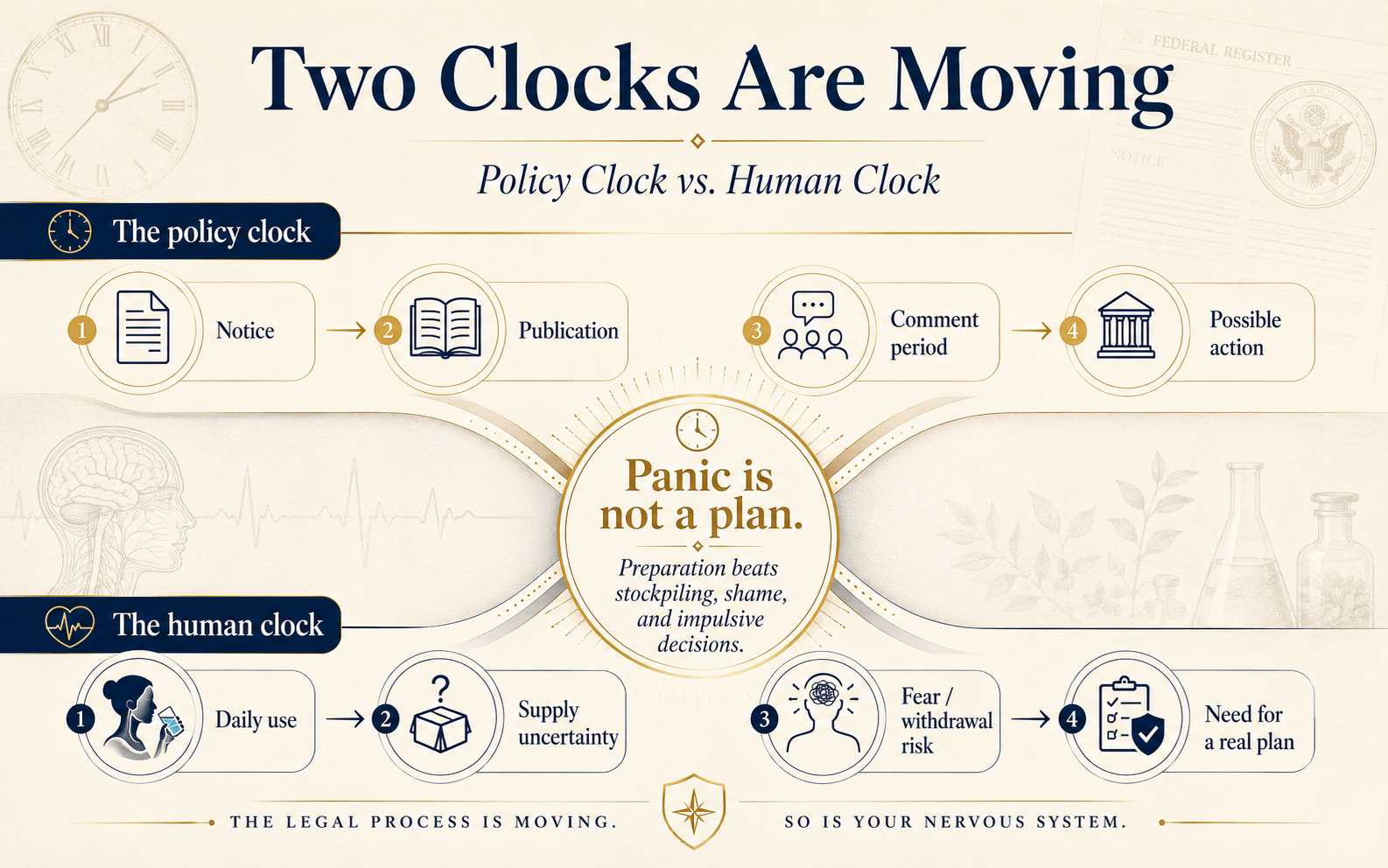
On July 1, the DEA filed two Notices of Intent: one concerning 7-OH above a specified threshold and another concerning three related substances—mitragynine pseudoindoxyl, MGM-15, and MGM-16. The 7-OH notice is scheduled for Federal Register publication on July 6, 2026. [1]
HHS says that after the required 30-day period and consideration of comments related to the threshold, the Attorney General may issue a temporary Schedule I order. [2]
That means this is serious. It is moving. But it is not the same thing as waking up tomorrow to a completed nationwide federal scheduling order.
Do not let a frightening headline force you into an unplanned recovery decision.
What the DEA Is Actually Targeting
This is not a broad announcement that “all kratom is banned.”
The proposed federal action is aimed at 7-OH above a stated threshold, including highly concentrated, enhanced, processed, and synthetic forms.
The DEA notice describes the threshold this way:
- Botanical Mitragyna speciosa material containing more than 0.050% 7-OH by dry weight
- Synthetic products containing more than 0.050% 7-OH by weight/weight, weight/volume, or volume/volume—or more than 1 milligram of 7-OH in the product
- Kratom-derived material further processed into forms such as extracts, concentrates, processed edibles, or pressed pills that exceed those thresholds. [1]
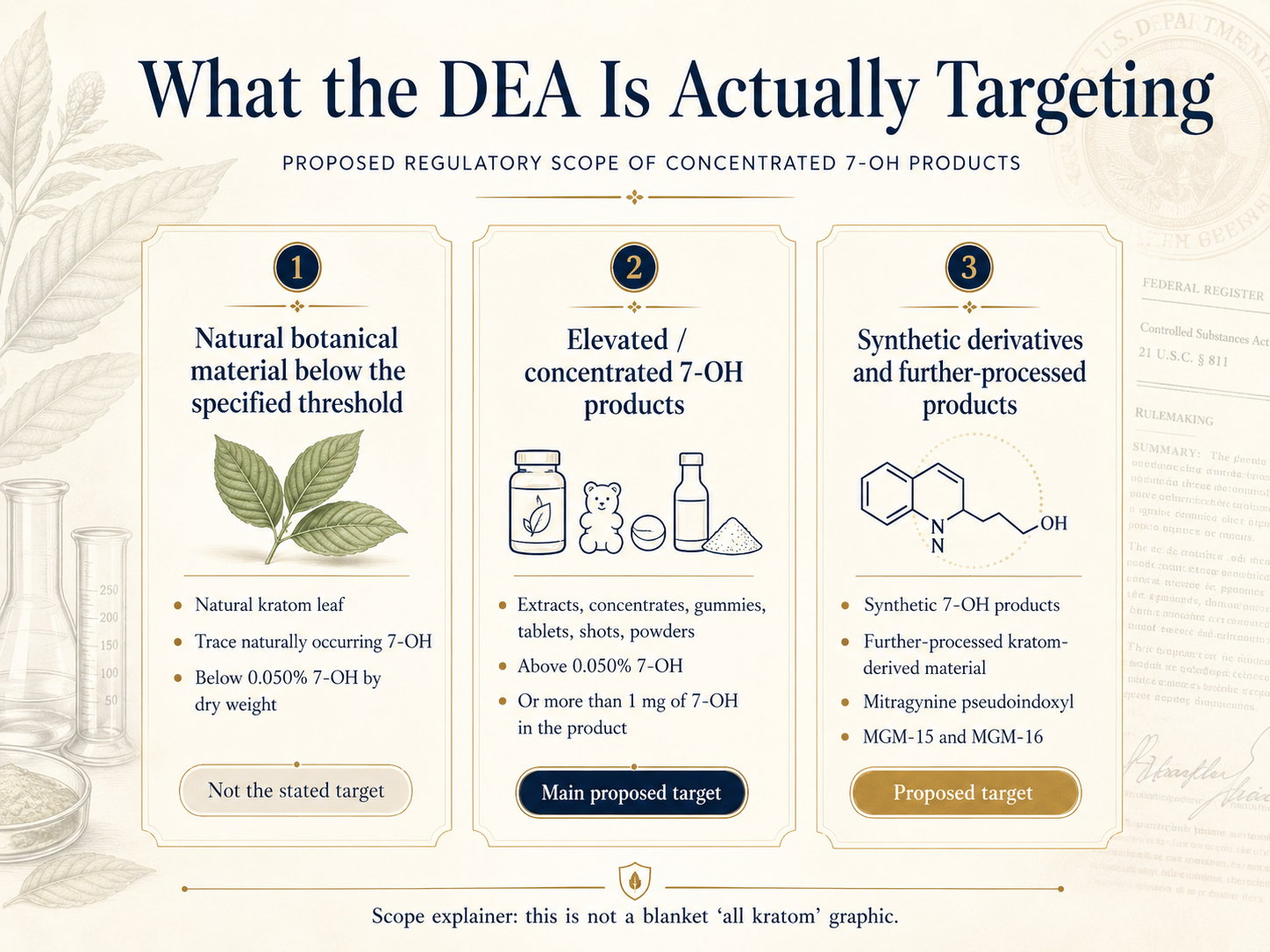
The DEA and HHS have said the action is not intended to capture natural leaf kratom below the specified threshold. Instead, it targets products with elevated concentrations of 7-OH and certain synthetic derivatives. [2]
That distinction matters.
A product can say “kratom” on the label and still be radically different from traditional leaf material.
The real question is not:
“Does this say kratom?”
It is:
“What is actually in this product, how concentrated is it, and what has been done to it?”
Do not assume a retail label, a product category, or a vendor’s marketing language answers that question. For legal questions about a specific product or situation, speak with a qualified attorney.
Why This Is Different From a Typical Kratom Headline
7-OH occurs naturally in trace amounts in kratom leaf.
But the FDA, HHS, and DEA have repeatedly distinguished that trace presence from concentrated products marketed as tablets, gummies, shots, drink mixes, powders, capsules, strips, and similar items. [2][3]
The FDA states that there are no FDA-approved products containing 7-OH, that 7-OH is not lawful in dietary supplements or conventional foods, and that enhanced products have been marketed despite those restrictions. [3]
The FDA has also reported harmful effects associated with 7-OH products, including addiction, anxiety, depression, gastrointestinal distress, insomnia, seizures, and withdrawal symptoms such as restlessness, body aches, fatigue, irritability, and cold sweats. [4]
This does not mean every person who has ever used kratom or 7-OH has the same experience.
It does mean that concentrated 7-OH products have created a public-health and recovery problem large enough that federal agencies are moving quickly.
The Legal Clock May Be Moving. Dependence Does Not Switch Off.
This is the part that policy headlines often miss.
A legal category can change.
A person’s nervous system does not instantly change with it.
If someone uses 7-OH every day, the real-world impact of a changing supply environment may be emotional before it is legal:
- Fear that access will disappear
- Panic buying
- Secrecy
- Financial stress
- Abrupt quitting without support
- Replacing 7-OH with alcohol, benzodiazepines, street opioids, or another risky substance
- Feeling trapped between dependence and uncertainty
That is why this news deserves a recovery conversation—not just a legal conversation.
Scarcity can create panic. Panic can create bad decisions.
The goal is not denial.
The goal is to turn urgency into structure.
If You Use 7-OH Daily, Your First Goal Is Stability
You do not have to solve your entire life this week.
You do not need a perfect taper spreadsheet.
You do not need a flawless recovery identity.
You do not need to make a dramatic promise that you will never struggle again.
You need an accurate picture of where you are—and the right support around you.
Start with these five steps.
1. Make the invisible visible.
Write down the real pattern:
- Product name
- Form: tablets, shots, powders, gummies, strips, extract, etc.
- Stated amount or potency
- How often you use it
- Approximate daily use
- When you first take it each day
- What happens when you delay it
- What symptoms, cravings, fear, or instability show up when you try to cut back
This is not a moral inventory.
It is a reality inventory.
Recovery gets more workable when you stop having to guess.
2. Map the whole nervous-system picture.
List anything else affecting your body and brain:
- Alcohol
- Benzodiazepines
- Prescription opioids
- Gabapentin or pregabalin
- Sleep medications
- Stimulants
- Cannabis
- Prescription medications
- Supplements used for energy, calming, or sleep
- Other substances
This matters because 7-OH is rarely the only variable in the system.
3. Tell one safe person.
Dependence gets stronger in secrecy.
You do not need to tell everyone. But identify one person who can be calm, compassionate, and useful: a family member, partner, recovery peer, clinician, coach, sponsor, or trusted friend.
4. Do not let a news headline force an unplanned detox.
Daily use, high-dose use, co-occurring alcohol or benzodiazepine use, prior withdrawal complications, medical conditions, severe anxiety, depression, or suicidal thoughts can all change what a safer route looks like.
A qualified clinician should help determine the safest course for your situation.
5. Get an assessment before fear turns into a crisis.
An addiction-informed clinician, addiction-medicine provider, treatment program, or primary-care provider can help you understand what support may be appropriate.
Your next right step is not “solve everything.”
It is: get an accurate picture and get the right support around you.
What Not to Do Right Now
Do not assume all kratom is federally banned.
Do not assume nothing will change.
Do not panic-buy and call it a recovery plan.
Do not let shame convince you that you should handle this alone.
Do not make abrupt changes solely because you saw a headline—especially if other substances, serious mental-health symptoms, or medical risks are part of the picture.
Do not substitute alcohol, benzodiazepines, street opioids, or another high-risk substance simply to avoid discomfort.
And do not wait until access problems, health consequences, a relationship rupture, financial crisis, or legal fear forces the next move.
The Question the DEA Cannot Answer for You
The DEA can change a legal category.
It cannot answer the deeper recovery question:
What was 7-OH doing for you?
Maybe it helped you sleep.
Maybe it quieted panic.
Maybe it gave you energy.
Maybe it made pain feel more manageable.
Maybe it helped you socialize, work, parent, cope, or feel normal.
Maybe it was the first thing that seemed to understand your nervous system.
That does not make you weak.
It means the substance made a promise.
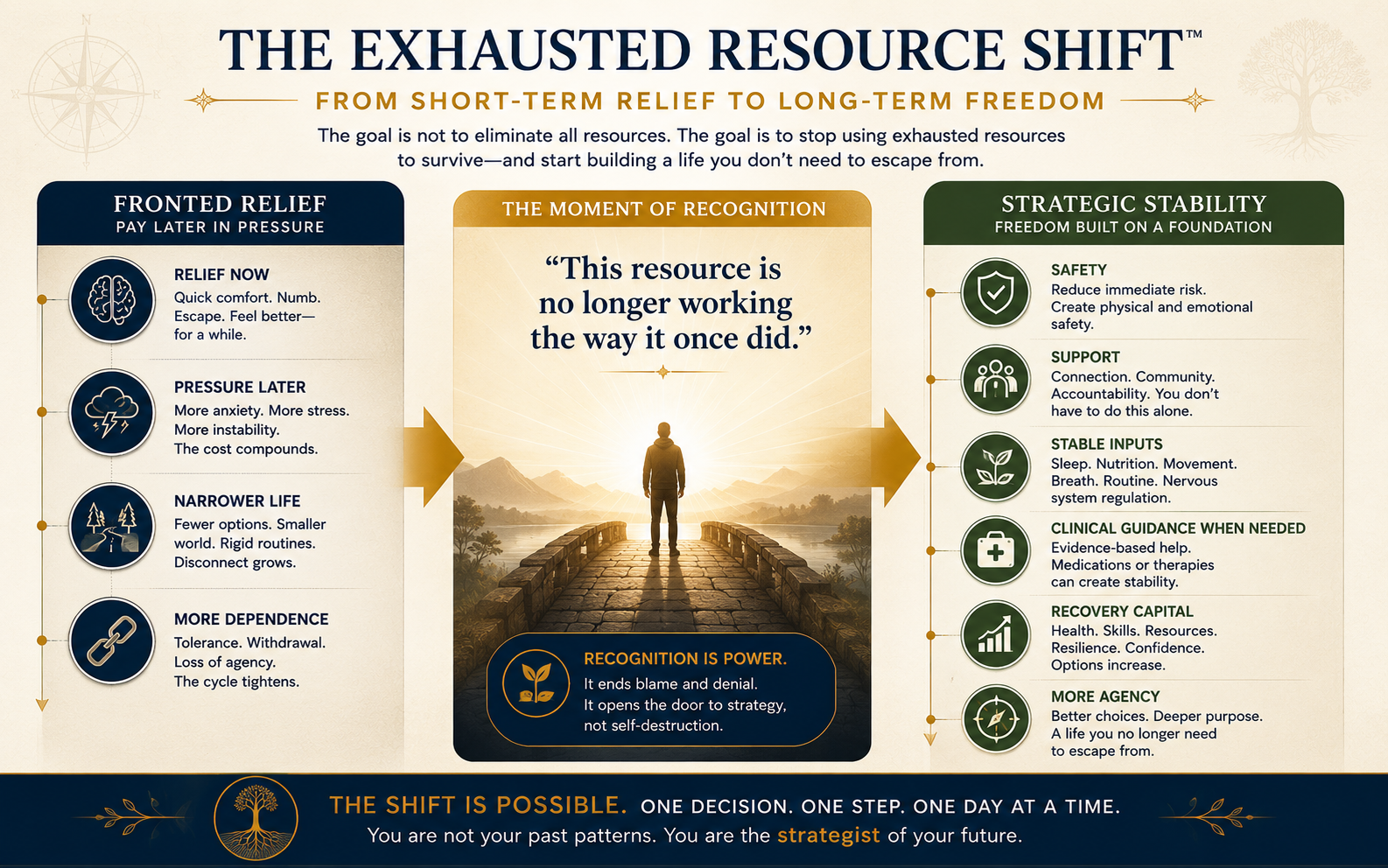
At Strategic Recovery, I call this the Exhausted Resource Principle™:
Every exhausted resource once made a promise.
At first, the resource may offer relief, comfort, quiet, energy, confidence, escape, reward, or survival.
Then the cost begins to rise.
You need more.
You think about it more.
You organize life around it more.
You hide it more.
You fear losing it more.
Eventually, what once helped you cope becomes something you must cope with.
That is not a reason for shame.
It is a reason to build a better plan.
Recovery is not only about removing the substance.
It is about understanding the promise beneath the pattern—and learning safer, stronger ways to meet the need.
Five Questions That Move You From Panic Into Strategy
You do not need perfect answers. You only need honesty.
1. What exactly am I taking—and how much?
Not the amount you wish you were taking.
The real pattern.
2. What does it help me feel, avoid, or survive?
Relief? Sleep? Energy? Emotional quiet? Pain control? Confidence? Escape? Feeling normal?
3. What happens when I cannot take it?
Cravings? Withdrawal? Fear? Insomnia? Depression? Restlessness? Pain? A feeling that life is suddenly too hard to manage?
4. What parts of my life are becoming smaller because of it?
Finances? Relationships? Health? Freedom? Self-respect? Peace of mind? Time? Motivation? Future plans?
5. What support would make change more realistic this week?
Not someday.
This week.
A clinician? A treatment assessment? A trusted person who knows? A recovery meeting? A written plan? A safer environment? A conversation you have been avoiding?
These questions are not here to overwhelm you.
They are here to help you stop guessing.
For Families: Lead With Safety, Not Shame
If someone you love uses 7-OH, this news may scare you too.
Try this:
“I saw the news and thought of you. I am not here to judge you or force you into anything. I want to understand what you are taking and help you make a plan before this gets harder.”
Avoid this:
- “Just stop.”
- “You should have known better.”
- “You are going to get arrested.”
- “Why can’t you control it?”
- “Just switch to something else.”
- “At least it is not fentanyl.”
The goal is not to win an argument.
The goal is to keep the person connected long enough for help to become possible.
Safety first. Shame never.

Where Coaching Fits—and Where Medical Care Must Lead
I am a recovery coach.
I help people get honest about the pattern, organize the situation, prepare for appropriate support, build recovery capital, identify the promise beneath the substance, and create a recovery architecture that works in real life—not just in theory.
Coaching is not medical detox. It does not replace addiction medicine, emergency care, psychiatric care, or a licensed clinician’s judgment.
Medical care should lead when there are questions about withdrawal safety, medication, seizures, serious medical conditions, severe psychiatric symptoms, polysubstance use, or immediate danger.
But many people also need support before, during, and after formal treatment.
They need help to:
- Stop minimizing what is happening
- Prepare clear questions for providers
- Build an environment that supports change
- Identify triggers and high-risk windows
- Create a realistic stabilization routine
- Reduce relapse risk
- Repair relationships and recovery capital
- Build healthier ways to meet the needs 7-OH once met
- Create a life that no longer feels like something they need to escape from
When Help Cannot Wait
You do not have to manage a medical or emotional emergency alone. Use the appropriate support below right away.
Call 911 or go to the nearest emergency department
Act now if someone is unresponsive, has slowed or difficult breathing, has a seizure, is severely confused, experiences chest pain, or cannot stay safe.
Poison Help
For a possible adverse reaction to a 7-OH product, contact Poison Help for immediate guidance.
Call or Text 988
For immediate mental-health or substance-use crisis support in the United States, 988 offers 24/7 judgment-free support.
SAMHSA National Helpline
For confidential treatment referral and information in the United States, call SAMHSA’s National Helpline.
Frequently Asked Questions
The answers below are written for clarity. Select a citation to jump to its matching source in the Sources & Regulatory Updates section.
01 Is 7-OH federally illegal right now?
02 Did the DEA ban all kratom?
No. The government has stated that the action is not intended to regulate natural leaf kratom that does not contain enhanced 7-OH levels or exceed the specified threshold.
03 What products could be covered?
The proposed action describes botanical material above 0.050% 7-OH by dry weight, plus certain synthetic and further-processed products exceeding stated percentage or milligram thresholds.
04 When could a temporary Schedule I order take effect?
05 Does this include gummies, shots, tablets, powders, or strips?
06 Should I suddenly stop using 7-OH because of this news?
The safest route varies by person. Daily use, total intake, other substances, medical conditions, withdrawal history, and mental-health symptoms can all matter. Seek individualized clinical guidance rather than letting panic make the plan.
Do Not Wait for Fear to Become the Turning Point
For some people, this news will be a wake-up call.
Not because they are bad.
Not because they failed.
But because something that once seemed manageable has quietly become something their nervous system, health, relationships, finances, or future now revolves around.
There is no shame in recognizing that.
But there is a decision point.
You can wait for fear, access problems, withdrawal, consequences, or scarcity to force the next move.
Or you can begin building the right support structure now.
You can get honest.
You can get support.
You can make a safer plan.
And you can begin building a life that no longer requires 7-OH to feel survivable.



Leave a Reply