
You Don’t Need More Willpower — You Need Better Inputs
(Natural Biohacking for Relapse Prevention) | Episode 44
This page features the full Strategic Recovery Podcast audio episode — a deep dive into how
natural biohacking can stabilize your brain, regulate your nervous system, and dramatically reduce relapse risk.
Inside, you’ll learn how to use powerful, simple inputs like sunlight, movement, cold exposure, heat therapy, breathwork, and nature
to shift your internal state — not by force, but by design.
Featuring the Strategic Recovery Input Model™, stacking systems, and the
7-Day Input Reset Protocol to help you increase energy, stabilize mood, and outgrow cravings naturally.
You don’t need a new life. You need new inputs.
Strategic Recovery Field Notes
Strategic Recovery with Matt Finch — Episode 44 Show Notes
You removed the substance… but something still feels off.
Energy isn’t stable. Mood isn’t consistent. Cravings still show up — especially at certain times of day.
And the default explanation is: “I need to try harder.”
This episode dismantles that completely.
Because what if the real problem isn’t effort… but the conditions your biology is operating inside of?
These notes will show you how to change those conditions using natural, repeatable inputs — so stability, clarity, and reduced cravings become the default… not something you have to fight for.
Quick Navigation
Inputs · Regulation · Biohacking · Stacking · Identity
- Act I — The Real Shift: Willpower → Inputs
- Act II — Biohacking (Without the Cringe)
- Act III — The Strategic Recovery Upgrade Model
- Act IV — Sunlight: The Input That Fixes Half Your Life
- Act V — Cold: Rehearsing Discomfort Without Relapse
- Act VI — Heat: Turning Off Survival Mode
- Act VII — Movement: Your Built-In Pharmacy
- Act VIII — Nature: The Environment Your Brain Expects
- Act IX — Grounding (Reality Check)
- Act X — The Self: Control Your State on Demand
- Act XI–XII — Connection + Stacking: The Real Upgrade
- Act XIII–XIV — Relapse Systems + The Trap
- Close — Identity, Inputs, and the 7-Day Reset
Act I — The Real Shift: Willpower → Inputs
One of the biggest misunderstandings in recovery is the belief that success is mainly a function of discipline, grit, and trying harder.
This episode introduces a more strategic lens: effort cannot override a misconfigured system.
Willpower fluctuates with sleep, blood sugar, emotional stress, nervous system state, and time of day. Biology is far more predictable than motivation.
Core reframe: if your inputs are wrong, your outputs will be wrong — no matter how hard you try.
Mic drop: you’re not inconsistent — your inputs are.
Act II — Biohacking (Without the Cringe)
In Strategic Recovery, biohacking is not about gadgets, obsession, or 25-step routines. It is about changing your environment so your biology produces better outcomes automatically.
What Real Biohacking Is
- Strategic
- Sustainable
- Biology-first
- Focused on leverage
What It Is Not
- Perfectionism
- Overcomplication
- Trend-chasing
- Replacing fundamentals
Most people try to control outcomes directly: more energy, fewer cravings, better focus, lower anxiety. But the more strategic question is: what conditions are creating those outcomes?
Signature line: you don’t need a substance to change your state — you need a system that does it for you.
Reframe: you don’t fix recovery by trying harder — you fix it by designing better.
Act III — The Strategic Recovery Upgrade Model
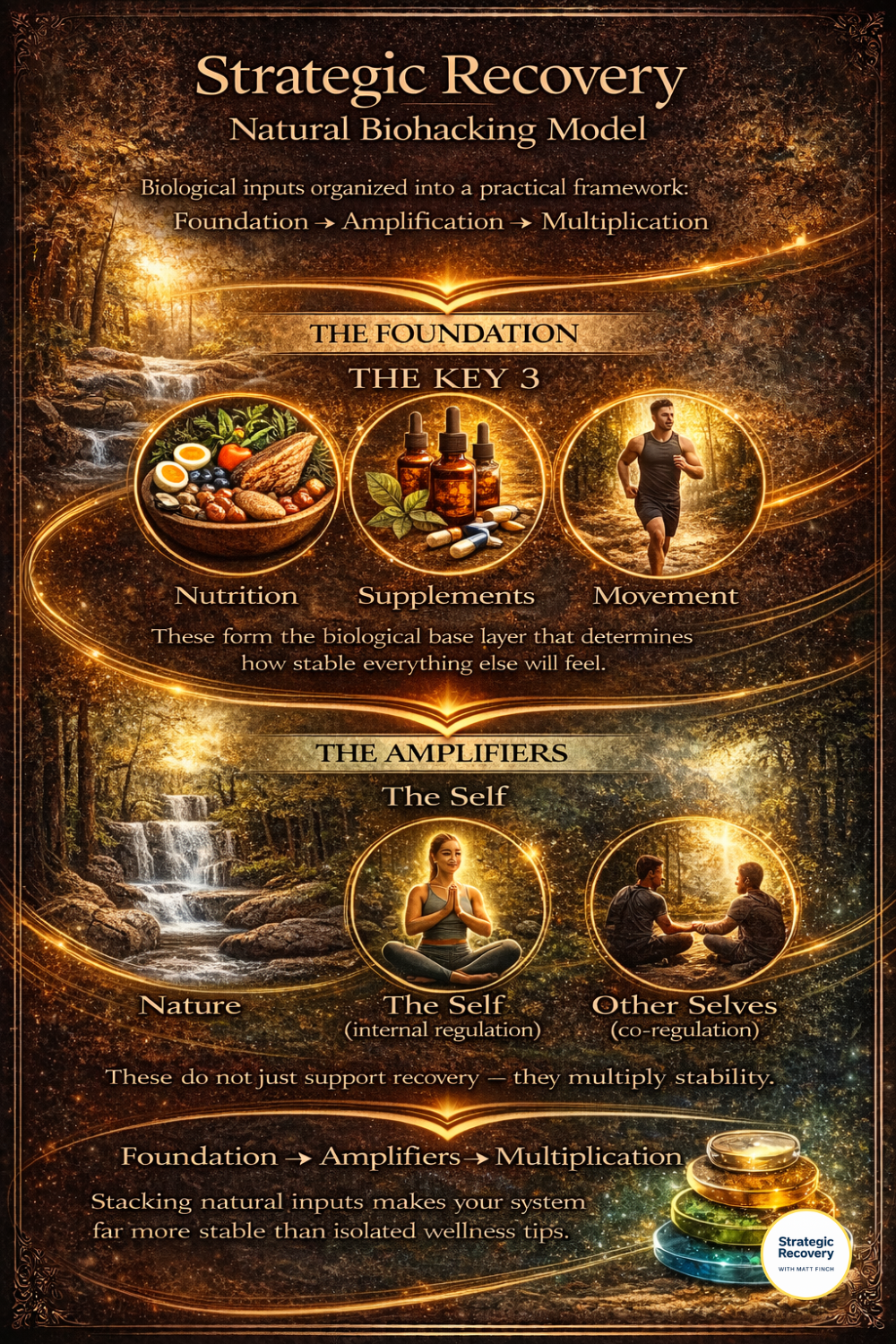
This episode organizes natural biohacking through a practical framework: Foundation → Amplification → Multiplication.
The Foundation: The Key 3
- Nutrition
- Supplements
- Movement
These form the biological base layer that determines how stable everything else will feel.
The Amplifiers
- Nature
- The Self (internal regulation)
- Other Selves (co-regulation)
These do not just support recovery — they multiply stability.
The multiplier is stacking: combining inputs so they amplify each other instead of functioning as isolated tasks.
Core line: stacking doesn’t add results — it multiplies them.
Translation: you’re not building habits — you’re building a system that runs your life.
Act IV — Sunlight: The Input That Fixes Half Your Life
Light is not a wellness bonus. It is a primary control system. Your brain uses light to regulate cortisol, dopamine, melatonin, and the timing of your entire day.
When the signal is wrong, the timing is wrong. When the timing is wrong, the chemistry is wrong. And when the chemistry is wrong, everything feels harder than it should.
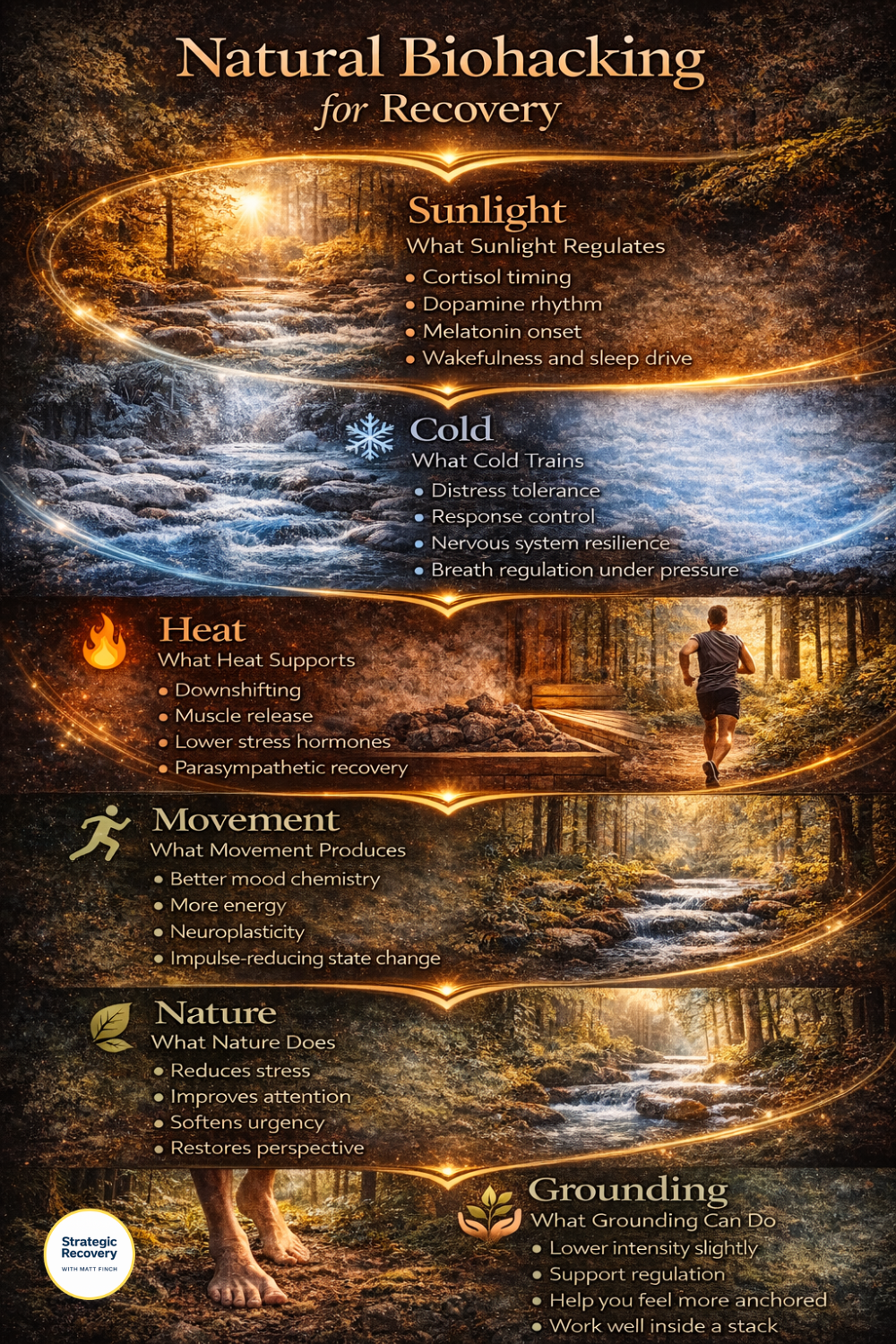
What Sunlight Regulates
- Cortisol timing
- Dopamine rhythm
- Melatonin onset
- Wakefulness and sleep drive
The Circadian Injury Pattern
- No real morning light
- Too much indoor living
- Excess screen exposure at night
- Late-day urge windows intensify
One of the most important reframes in the episode: most people think they have a motivation problem, when they actually have mistimed biology.
Signature line: addiction doesn’t just hijack dopamine — it hijacks daylight.
Bottom line: if your light is off, everything feels harder than it should.
Act V — Cold: Rehearsing Discomfort Without Relapse
Cold exposure is not about proving you are tough. It is about proving you do not have to escape discomfort.
By stepping into controlled intensity and learning to regulate your breath and nervous system inside it, you rehearse the exact moment many people lose: the peak of discomfort.
What Cold Trains
- Distress tolerance
- Response control
- Nervous system resilience
- Breath regulation under pressure
What Cold Boosts
- Dopamine
- Norepinephrine
- Endorphins
- State-control confidence
This becomes “urge window training”: not removing discomfort, but changing your relationship to it.
Core line: you don’t relapse because life is hard — you relapse because your system can’t handle hard.
Identity shift: you’re no longer someone who escapes discomfort — you’re someone who can stay.
Act VI — Heat: Turning Off Survival Mode
Heat therapy teaches the opposite side of regulation. If cold teaches you how to stay in intensity, heat teaches you how to come back from it.
Warmth activates the parasympathetic nervous system, lowers tension, softens the body, and sends a signal many recovering people are unfamiliar with: you’re safe.
What Heat Supports
- Downshifting
- Muscle release
- Lower stress hormones
- Parasympathetic recovery
The Deeper Recovery Use
- Relief without substances
- Unwinding stored tension
- Helping the body access safety
- Supporting sustainable calm
The deeper insight: many people are not addicted only to substances. They are addicted to relief.
Bottom line: you don’t need to try to relax — you need inputs that make relaxation inevitable.
Insight: calm isn’t something you wait for — it’s something you create.
Act VII — Movement: Your Built-In Pharmacy
Movement is not just physical. It is neurological medicine.
Every time you move your body, you stimulate endorphins, dopamine, serotonin, norepinephrine, and BDNF — changing your state without the crash that substances create.
What Movement Produces
- Better mood chemistry
- More energy
- Neuroplasticity
- Impulse-reducing state change
What It Rewires
- Consistency
- Self-trust
- Identity
- Response to stress
The episode emphasizes repetition over intensity: you do not need to become an athlete — you need to become someone who moves.
Signature line: don’t wait to feel better to move — move, and you’ll feel better.
Identity line: every time you move, you become someone who shows up.
Act VIII — Nature: The Environment Your Brain Expects
Nature is not random “self-care.” It is a return to the environment your nervous system was built to regulate within.
Modern environments overstimulate, dysregulate, and compress awareness. Nature expands awareness, reduces rumination, restores clarity, and helps the body feel safe enough to settle.
What Nature Does
- Reduces stress
- Improves attention
- Softens urgency
- Restores perspective
Why It Matters in Recovery
- Cravings feel less intense
- Rumination decreases
- Awareness expands
- Environment stops working against you
One of the key lines in the episode: addiction thrives in artificial environments. Recovery thrives in natural ones.
Practical principle: don’t treat nature like a bonus — treat it like a requirement.
Perspective shift: your problems don’t always need solving — sometimes they need space.
Act IX — Grounding (Reality Check)
This section adds an important honesty filter. Grounding may support sleep, stress reduction, and nervous system regulation — but it is supportive, not foundational.
In other words: grounding can help, but it cannot carry your recovery.
What Grounding Can Do
- Lower intensity slightly
- Support regulation
- Help you feel more anchored
- Work well inside a stack
What It Cannot Replace
- Sunlight
- Movement
- Sleep alignment
- Nervous system skills
Strategic takeaway: build your system on the fundamentals — and let grounding enhance the experience.
Final line: grounding isn’t the foundation of recovery — it’s part of the environment that supports it.
Act X — The Self: Control Your State on Demand
External inputs matter. But recovery also requires internal access: the ability to regulate your state when you cannot immediately change your environment.
Breathwork, awareness, and presence create that access. They allow you to feel something without being controlled by it.
What State Control Changes
- Heart rate
- Tension
- Reactive patterns
- Relationship to urges
Simple Tool
Slow exhale breathing
- Inhale 4
- Exhale 6
- 2–5 minutes
- Practice before you “need” it
The deeper insight: addiction is often not about the substance. It is about not wanting to feel what you’re feeling.
Signature line: if you can control your state, you reduce your need to escape it.
Power line: the moment you can sit with a feeling… is the moment it stops controlling you.
Act XI–XII — Connection + Stacking: The Real Upgrade
Recovery is not only individual regulation. It also requires co-regulation. Humans are not meant to stabilize in isolation.
Connection changes chemistry through oxytocin and safety signaling. This is why isolation quietly increases relapse vulnerability: not because people are weak, but because they are disconnected.
Connection Regulates
- Stress hormones
- Emotional intensity
- Loneliness-driven urges
- Nervous system instability
Stacking Creates Multiplication
- Morning stack: sunlight + walk + breath
- Stress stack: cold + slow breathing
- Recovery stack: heat + music + magnesium
- Nature stack: outside + movement + awareness
Stacking is where the whole episode comes together. Instead of isolated tasks, you begin running systems.
Core line: single inputs help — stacks transform.
Core truth: one input can change your day — stacking changes your baseline.
Act XIII–XIV — Relapse Systems + The Trap
One of the most important reframes in the episode: relapse is not a willpower failure — it is a system failure.
Low sleep, unstable blood sugar, no sunlight, high stress, no movement, isolation, and a dysregulated nervous system create a predictable setup for relapse.
The Unoptimized System
- Wake up tired
- Skip breakfast
- Coffee → crash
- No movement
- Stress accumulates
- Evening urge feels urgent
The Optimized System
- Morning light
- Protein and fuel stability
- Movement
- Breathing + state control
- Connection + nature
- Urge appears — but passes
The trap is trying to optimize everything at once. The more strategic path is: one morning input, one regulation tool, one movement anchor — then stack slowly.
Golden rule: the best system is the one you actually run.
Final reframe: you didn’t fail — your system produced exactly what it was designed to produce.
Close — Identity, Inputs, and the 7-Day Reset
This is where everything changes.
You stop asking: “Why do I keep struggling?”
And you start asking: “What system am I running?”
And once you see it that way… everything becomes adjustable.
Energy. Mood. Cravings. Stability.
Not through force… but through design.
The practical invitation is simple: run the 7-Day Input Reset. Morning sunlight. Ten minutes of movement. Cold finish. Night wind-down. Track your energy, mood, cravings, and sleep.
The goal is not perfection. The goal is to experience what changes when you stop forcing recovery… and start building the conditions that make it easier.
Final line: you don’t need a new life — you need new inputs. Fix the inputs… and your life starts fixing itself.

Key Concepts
The shift from willpower-based recovery to input-driven stability, performance, and long-term relapse resistance.
- You don’t fix recovery by trying harder — you fix it by changing the inputs your biology is responding to.
- Energy, mood, and cravings are outputs — they reflect your sleep, light exposure, stress, nutrition, and environment.
- Sunlight sets your entire system — when your circadian rhythm is aligned, everything else becomes easier.
- Cold trains your ability to stay — instead of escaping discomfort, you build capacity to move through it.
- Heat teaches your body to release — relaxation becomes something your system can reliably access.
- Movement is your internal pharmacy — you generate the chemistry you used to outsource.
- Nature restores baseline regulation — your brain stabilizes faster in the environment it evolved in.
- Breathwork gives you control on demand — if you can regulate your state, you reduce your need to escape it.
- Stacking is where transformation happens — single inputs help, but combined inputs change your baseline.
- Relapse is a system failure, not a personal failure — change the system, and the outcome changes.
Strategic Recovery Natural Biohacking Model
A premium visual map of the Strategic Recovery Upgrade Model — showing how foundation, amplification, and stacking work together to create a more stable, supported, and relapse-resistant recovery system.
Want the print-ready PDF version?
Download the optimized PDF so you can print it, keep it in your planner, add it to your recovery binder, or place it somewhere visible as a daily reminder of how the model works.
Tip: print one copy for your recovery space and one for your journal, planner, or binder so the model stays visible when you need quick clarity.
Episode 44 Resources
Strategic Recovery articles, episode links, and foundational tools featured in this episode — focused on better inputs, nervous system regulation, circadian alignment, movement, and relapse-resistant recovery.
- State Alchemy (Ep. 21) A foundational Strategic Recovery framework for shifting physiology, focus, and language to consciously change your state
- Nutrition for Recovery A deeper guide to blood sugar stability, amino acid building blocks, and feeding the brain so recovery feels more stable
- Supplements for Recovery A practical guide to foundational nutrients, neurotransmitter support, and recovery-focused supplementation principles
- Movement for Recovery (Ep. 30) How movement works as a built-in pharmacy for endorphins, dopamine, stress regulation, and anti-craving momentum
- Sunlight for Recovery Why sunlight is one of the highest-leverage inputs for dopamine timing, circadian rhythm, energy, and late-day craving reduction
- The Urge Window & Impulsivity (Ep. 37) A key episode for understanding how urges rise, peak, and fall — and how to stay through discomfort without reacting
- Nervous System Dysregulation & Addiction A deep dive into stress physiology, survival mode, resilience building, and why regulation is central to relapse prevention
Natural Biohacking for Recovery
A premium visual guide to six natural inputs that help regulate the system underneath cravings — sunlight, cold, heat, movement, nature, and grounding — so recovery feels less forced and more biologically supported.
Want the print-ready PDF version?
Download the optimized PDF so you can print it, place it in your planner, pin it to a refrigerator with a magnet, or keep it visible as a daily reminder of the inputs that help your system self-correct.
Tip: print one copy for your recovery space and one for your journal, planner, or binder so the framework stays visible when you actually need it most.
Frequently Asked Questions — Natural Biohacking and Better Inputs for Recovery
Clear, grounded answers to help you apply the episode fast: how to use sunlight, cold, heat, movement, nature, grounding, and nervous system regulation to reduce cravings and build a more stable recovery baseline.
-
What does “natural biohacking” mean in Strategic Recovery terms?
Natural biohacking means changing your inputs and environment so your biology produces better outcomes automatically.
Instead of trying to force energy, calm, focus, or consistency, you improve the conditions that create them.
Translation: you stop fighting the system and start working with it.
-
Why is this episode focused so heavily on the body and nervous system?
Because recovery gets dramatically easier when the body is more stable.
If your circadian rhythm is off, your blood sugar is unstable, your stress system is overloaded, and your nervous system is dysregulated, then everything feels harder than it should.
This is not reducing recovery to biology — it is stabilizing the platform that deeper healing will stand on.
-
How does sunlight actually help addiction recovery?
Sunlight helps regulate cortisol timing, dopamine rhythm, melatonin onset, wakefulness, and sleep drive.
When your system gets the right light signals, your internal timing improves — and that can reduce fatigue, mood instability, and late-day craving intensity.
Core idea: sunlight is not just a wellness bonus — it is a primary timing signal.
-
Why does cold exposure matter for relapse prevention?
Cold exposure trains distress tolerance, response control, nervous system resilience, and breath regulation under pressure.
It gives you a safe way to rehearse discomfort without escaping it — which is directly relevant to urge windows, cravings, stress, and impulsive behavior.
Cold is not just about toughness. It is about learning how to stay.
-
What does heat therapy support in recovery?
Heat supports downshifting, muscle release, lower stress hormones, and parasympathetic recovery.
In simple terms, it helps the body access safety and release tension instead of staying stuck in low-level survival mode.
Translation: heat helps your body remember how to let go.
-
Why is movement such a big deal in this episode?
Because movement improves mood chemistry, energy, neuroplasticity, and impulse-reducing state change.
It is one of the most reliable ways to generate better internal chemistry without the spike-crash cycle that substances create.
Movement is not just physical — it is neurological medicine.
-
How does nature help when cravings or overwhelm hit?
Nature helps reduce stress, improve attention, soften urgency, and restore perspective.
It often widens your awareness, which lowers intensity. Problems feel smaller, thoughts get quieter, and urges lose some of their grip.
Core idea: recovery thrives in environments that help your system feel less trapped.
-
What is grounding’s actual role in this framework?
Grounding may help lower intensity slightly, support regulation, help you feel more anchored, and work well inside a stack.
But it is not the foundation. It is a supportive layer, not the main driver of change.
Use it — just do not ask it to carry more than it can.
-
What does it mean that “relapse is a system failure”?
It means relapse is often the output of an unstable system — not proof that you are weak or broken.
If sleep is poor, stress is high, blood sugar is unstable, movement is low, connection is absent, and your nervous system is overloaded, then urges are more likely to feel urgent and harder to manage.
Bottom line: change the inputs, and you often change the outcome.
-
How do I start without trying to optimize everything at once?
Start with one morning input, one regulation tool, and one movement anchor.
For example: morning sunlight, slow exhale breathing, and a 10-minute walk.
The best system is not the most advanced one. It is the one you can actually run consistently.
-
What is an example of a simple starter stack from this episode?
A simple stack could be morning sunlight + a 10-minute walk + slow breathing.
That combination supports circadian rhythm, blood flow, state regulation, and a calmer baseline before the day gets chaotic.
Translation: you are not trying to do more — you are trying to create signal and leverage.
-
Can these natural inputs replace therapy, community, or deeper emotional work?
No. These inputs do not replace deeper recovery work — they make it easier to do.
They help stabilize the platform underneath emotional healing, social repair, behavioral consistency, and spiritual integration.
This is the biological groundwork, not the whole house.
-
If I only take one action from this episode, what should it be?
Start the 7-Day Input Reset with one non-negotiable: get outside for morning sunlight as early as you reasonably can.
If you want a second move, add 10 minutes of movement. If you want a third, add slow exhale breathing.
That is enough to begin shifting the system.
These FAQs are educational guidance, not medical advice. If you are tapering substances, taking medication, pregnant, or managing a medical or psychiatric condition, coordinate major recovery and health changes with a licensed clinician where appropriate.
🙏 Thank you for being part of the Strategic Recovery community.
👉 Click Here and Right Click to Save As to Download>>
🎧 Available on your favorite platform:






Leave a Reply