
Find the right recovery tools, in the right order, for the person you actually are—so you can stabilize, repair, rewire, and build a life you no longer need to escape from.
Most people do not need more random recovery advice.
They need a map.
They may already know that sleep, nourishment, movement, therapy, support, boundaries, meditation, environment, purpose, and healthier habits can all matter.
But knowing a long list of tools is not the same as knowing:
- Which tool matters most right now?
- What can I realistically sustain with my current capacity?
- What kind of support fits the season I am in?
- What is underneath the pattern I keep repeating?
That is why generic recovery plans often fall apart.
Not because a person is lazy.
Not because they do not want change badly enough.
Not because they have “failed” at recovery.
Often, the plan simply did not fit the person, the problem, or the moment.
Current addiction-care standards emphasize person-centered, multidimensional assessment and individualized planning. NIAAA similarly notes that different people can need different routes to recovery. [1–2]
That is the purpose of the Strategic Recovery Operating System™.
It is a whole-person decision map that helps you identify:
- Where you are
- What needs support
- What fits your wiring
- What your next right step actually is
Not a perfect plan.
Not a total life overhaul.
Not twenty new habits.
One clear, compassionate, strategic move.

The Strategic Recovery Operating System™ at a Glance
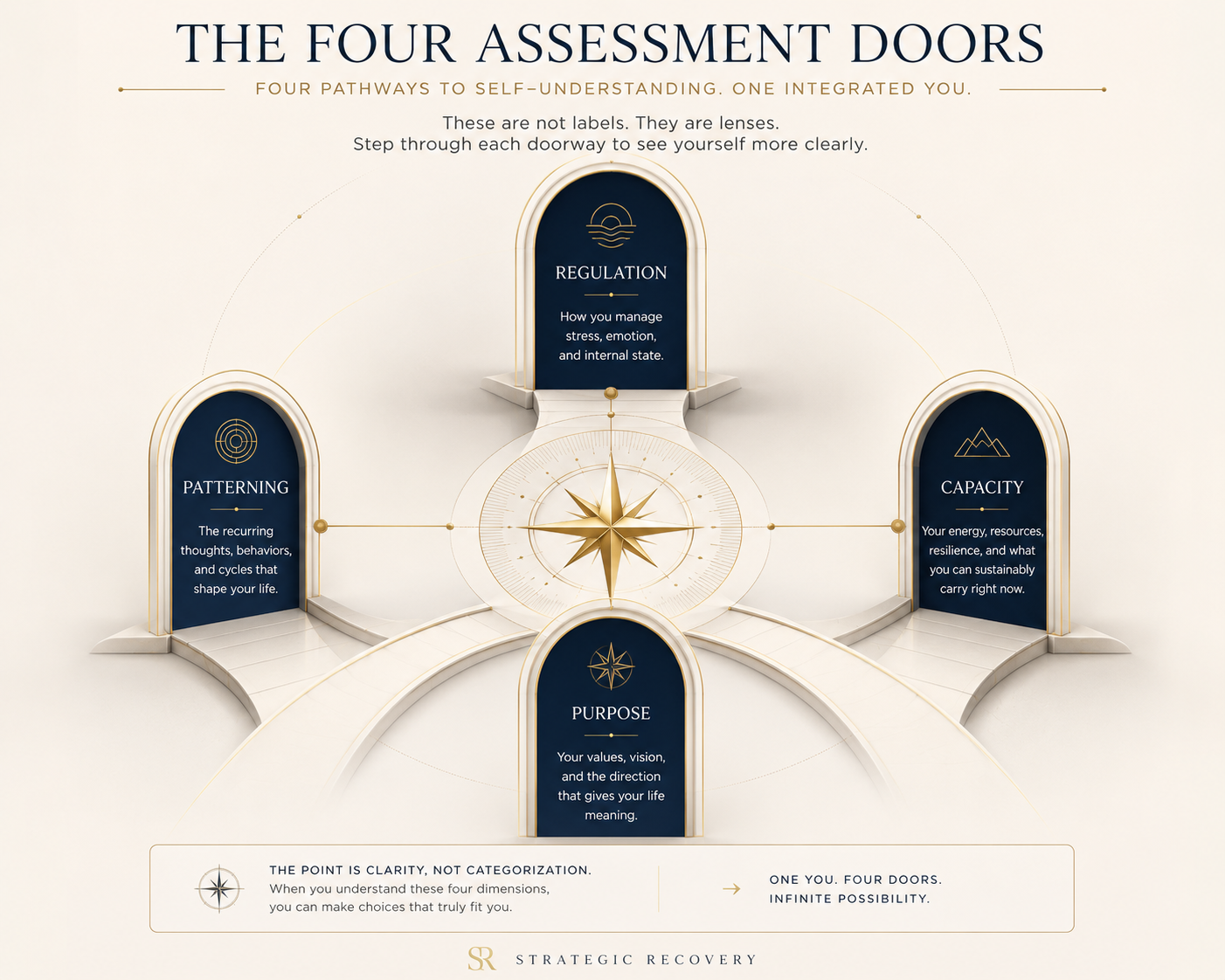
The Operating System uses three coordinates to reveal a fourth.
1. Who Am I?
(Assessments)
Your nervous system, patterns, capacity, motivations, values, and personal wiring.
2. What Needs Support?
(Pillars)
The part of your recovery system where a small improvement could create the biggest positive ripple.
3. When Is This Appropriate?
(Phases)
Your current recovery season—and the kind of work that fits it.
Together, these three coordinates reveal:
My Next Right Step
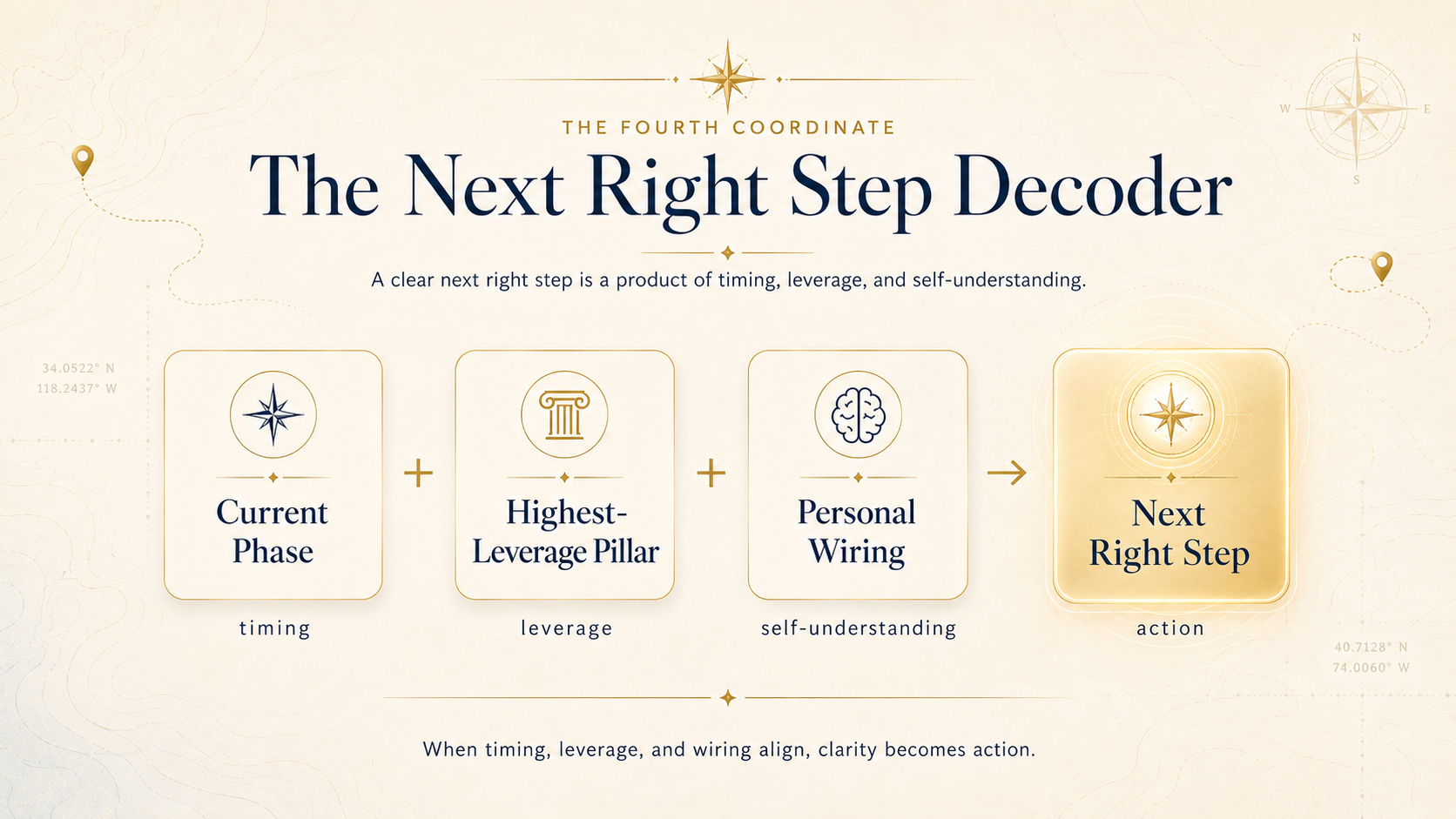
(Current Phase + Highest-Leverage Pillar + Personal Wiring = Next Right Step)
The goal is not to engineer your entire future today.
The goal is to identify the next move that fits the life you are actually living this week.
Why “Good Recovery Advice” Can Still Be the Wrong Plan
A recovery tool can be helpful, premature, irrelevant, or overwhelming depending on the person and the moment.
A strategy that transforms one person may drain another.
A tool that is powerful in one phase may be too demanding in another.
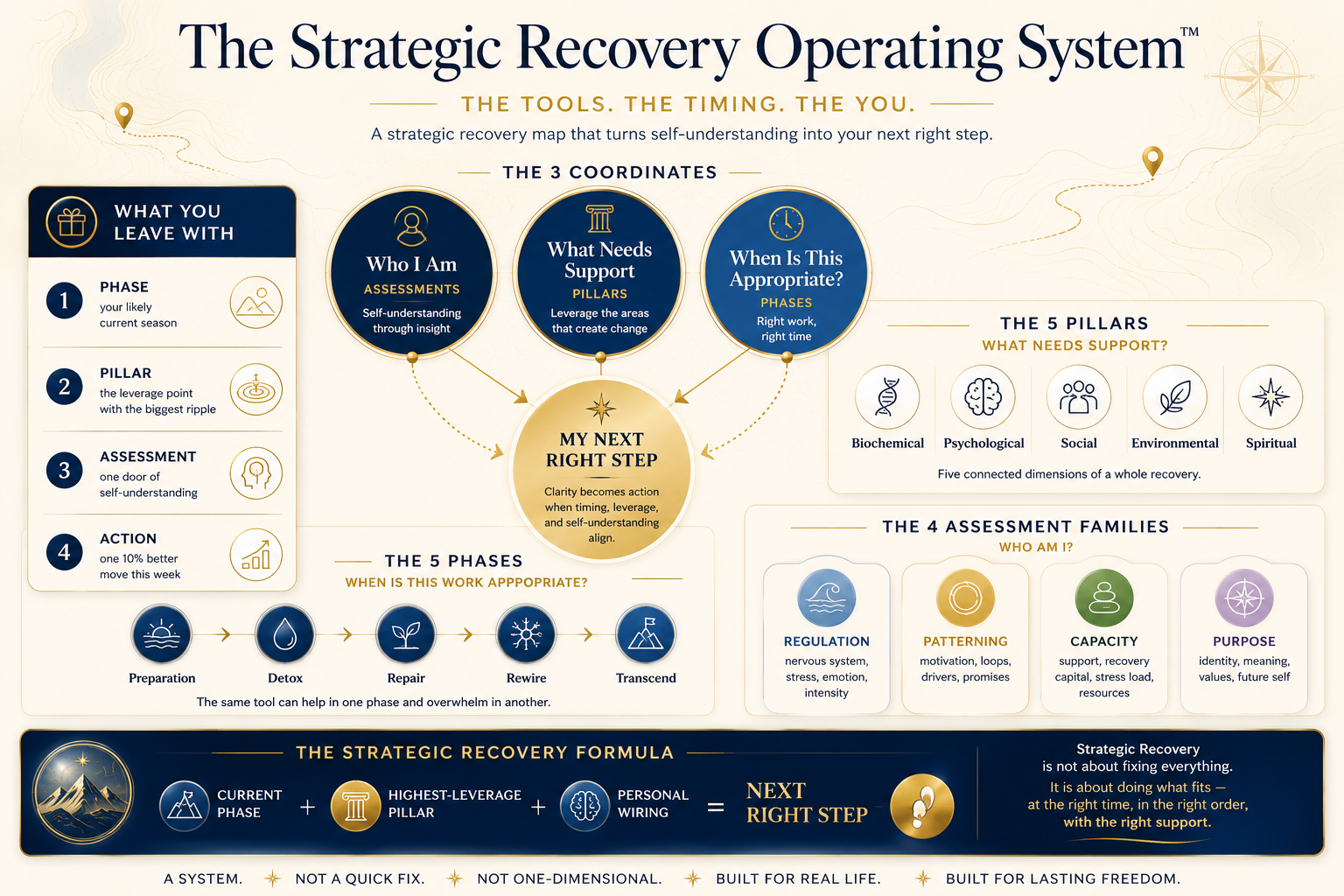
Four common mismatches explain why.
The Timing Mismatch
Someone in early stabilization may need sleep, safety, nourishment, structure, and support—not an intense productivity system, deep trauma processing, or a sweeping identity overhaul.
That does not make advanced tools bad.
It means they may not be the right tools yet.
The right tool at the wrong time can feel like failure.
The Leverage Mismatch
Someone may try to fix motivation when their sleep is collapsing.
They may work on mindset while their environment is full of cues, access, stress, and chaos.
They may research ten strategies when the missing piece is simply eating before the evening danger window, sending one honest text, or setting up one recovery-supportive routine.
Not every action creates the same ripple.
The better question is:
Which area, if strengthened by 10%, would make other things easier?
The Capacity Mismatch
A plan can look excellent on paper and still demand more energy, money, time, executive function, emotional bandwidth, or support than someone currently has.
A depleted system does not need a more punishing plan.
It needs a smaller, safer, more supported one.
The Wiring Mismatch
Some people need nervous-system regulation first.
Others need environmental change, accountability, practical support, emotional safety, meaning, structure, or a clearer understanding of the promise beneath their old coping pattern.
A useful recovery tool becomes powerful when it is matched to the right person, at the right time, for the right problem.
The Three Coordinates
Coordinate #1: Who Am I?
(Assessments Reveal Personal Wiring)
Assessments are not labels.
They are not verdicts.
They are not boxes to trap yourself inside.
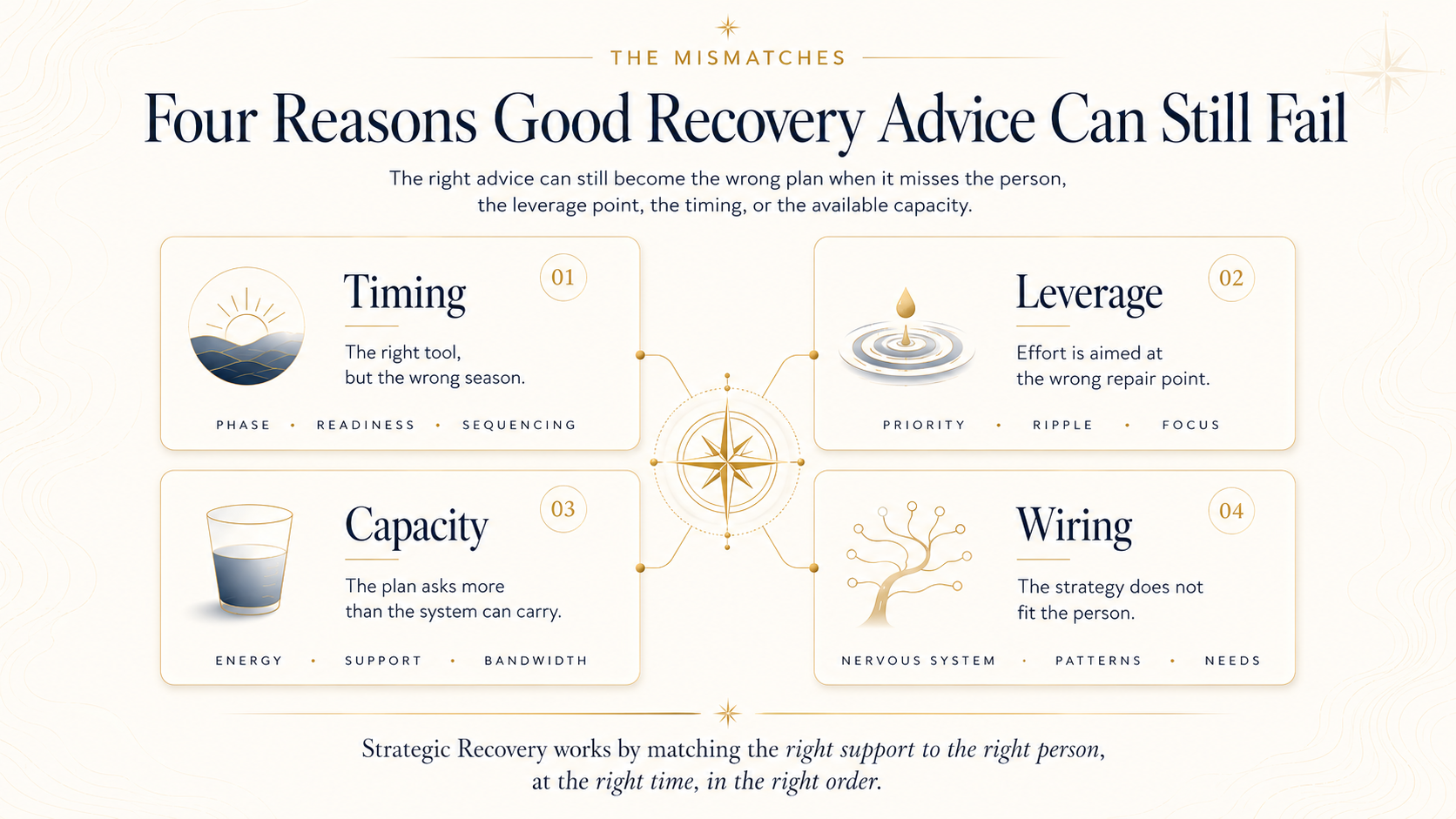
Used well, they are doors of self-understanding.
They can help explain why certain strategies work, why others collapse, what your nervous system needs, which patterns keep repeating, where your capacity is limited, and what support may make follow-through more realistic.
You do not need twelve assessments at once.
You need one useful door that helps you stop guessing.
Regulation
This family explores stress sensitivity, emotional intensity, stimulation, overwhelm, boredom, activation, shutdown, and nervous-system needs.
Ask:
What helps my nervous system feel safe, steady, and capable?
For one person, the answer may be a morning walk, fewer evening inputs, food before caffeine, more rest, breathwork, or a less chaotic schedule.
For another, it may be learning that an intense feeling is not necessarily an emergency.
Patterning
This family explores habits, motivation, repeating loops, immediate-reward cycles, old coping strategies, and the promise beneath an exhausted resource.
Ask:
What pattern keeps repeating—and what is it trying to do for me?
Many old behaviors began as an attempt to solve a real problem:
- Relief
- Quiet
- Comfort
- Energy
- Confidence
- Escape
- Numbness
- Belonging
- A break from the mind
The goal is not simply to take away the old resource.
It is to understand the need underneath it—and build a better source.
Capacity
This family explores sleep, energy, time, health, practical stability, support, recovery capital, stress load, and available resources.
Ask:
Where am I resourced, and where am I running on empty?
Sleep disruption is common in recovery and can increase vulnerability to relapse. That does not make poor sleep destiny. It makes sleep useful information—and an important part of the recovery plan. [3]
Capacity is not an excuse.
It is data.
When capacity is low, the plan must become smaller, simpler, safer, and more supported.
Purpose
This family explores identity, values, contribution, future self, meaning, truth, faith, service, and the life someone wants to build beyond escape.
Ask:
What kind of person and life am I becoming?
Recovery cannot only be about avoiding the old life.
Eventually, it becomes about creating one you no longer want to escape from.
For the complete self-understanding framework, explore The Strategic Recovery Blueprint: 12 Assessments.
Coordinate #2: What Needs Support?
(The Five Pillars Reveal Your Highest-Leverage Repair Point)
Recovery is not only about removing an exhausted resource.
It is about strengthening the human system that no longer needs that resource to survive.
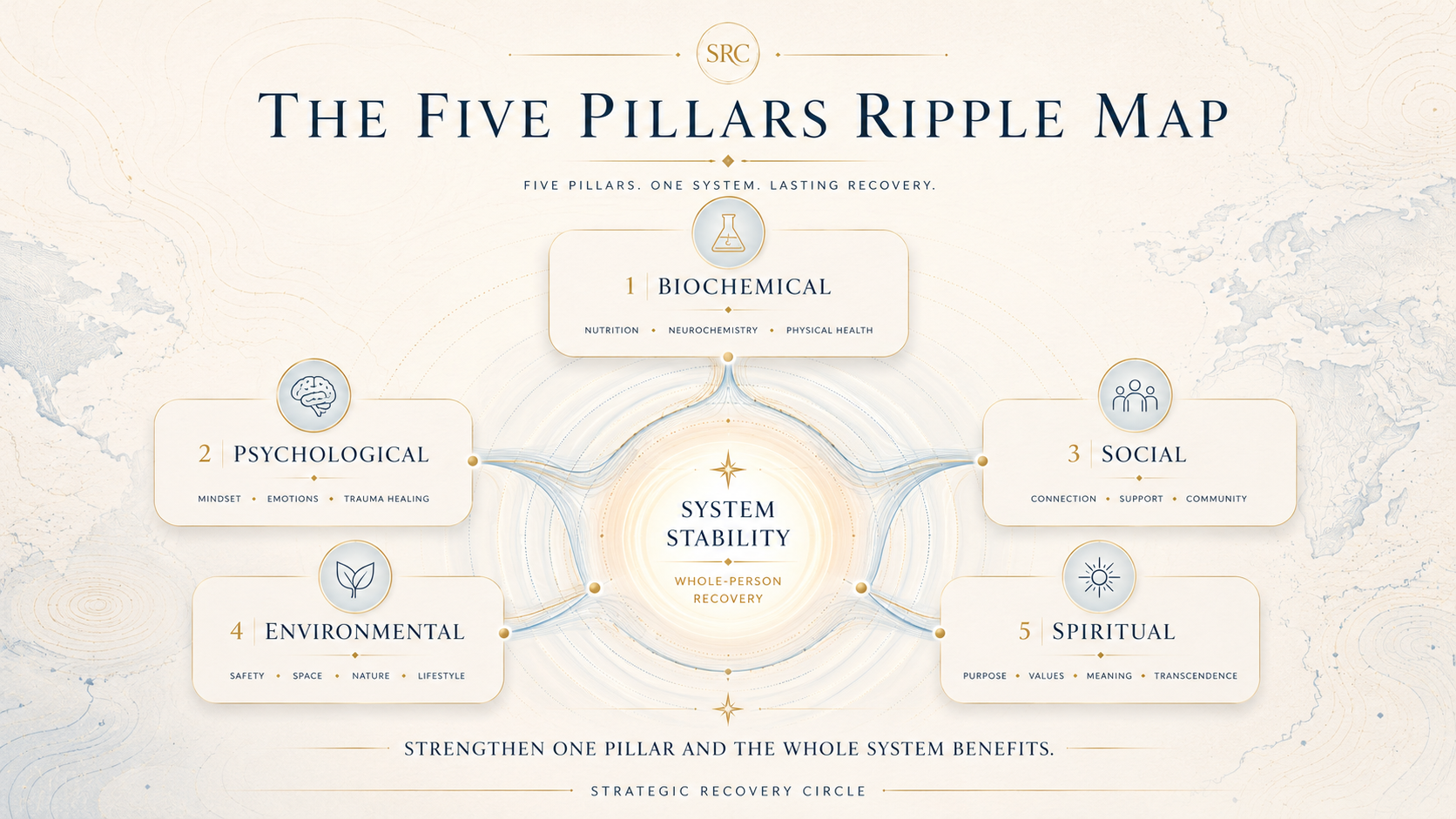
The Five Pillars are connected. When one becomes depleted, the others often feel the strain. When one becomes stronger, it can create a positive ripple across the entire system.
Biochemical
Sleep, nourishment, hydration, movement, energy, physical repair, brain health, and appropriate medical care when needed.
Ask:
What would help my body feel 10% safer, steadier, or more resourced?
This might be a stabilizing breakfast, a bedtime cue, a walk, hydration, a medical appointment, or more structure during the part of the day when you are most vulnerable.
Psychological
Emotions, beliefs, shame, coping patterns, self-talk, mental flexibility, trauma-informed support, and inner safety.
Ask:
What emotional or mental pattern most needs compassion and support?
The next right step may be therapy, journaling, naming an emotion, challenging one shame-based belief, practicing self-forgiveness, or learning to pause before reacting.
Social
Belonging, accountability, honesty, repair, boundaries, communication, connection, and asking for help.
Ask:
Who or what relationship could make recovery more sustainable?
Peer support can help people stay engaged in recovery, build skills and relationships, and reduce isolation. [4]
One honest text before the danger window can be strategic recovery.
Environmental
Home, schedule, routines, cues, access, digital inputs, sensory environment, transportation, work structure, and daily friction.
Ask:
What in my environment makes the old pattern easier—or the new pattern harder?
A simple environmental shift can be powerful:
- Remove one cue.
- Create one friction point between you and the old pattern.
- Put a supportive object where you will see it.
- Move the phone outside the bedroom.
- Prepare the next right choice before you need it.
Environment can become either a trigger field or a recovery scaffold.
Spiritual
Meaning, values, integrity, faith, truth, service, connection, awe, and the life you want to protect.
Ask:
What helps me remember that my life is worth protecting?
This pillar does not require one religious worldview.
It asks what reconnects you with what is true, meaningful, and larger than immediate relief.
For the complete framework, read The Five Pillars of Strategic Recovery™.
Coordinate #3: When Is This Appropriate?
(The Five Phases Help You Respect Timing)
The same recovery tool can help in one phase and overwhelm in another.
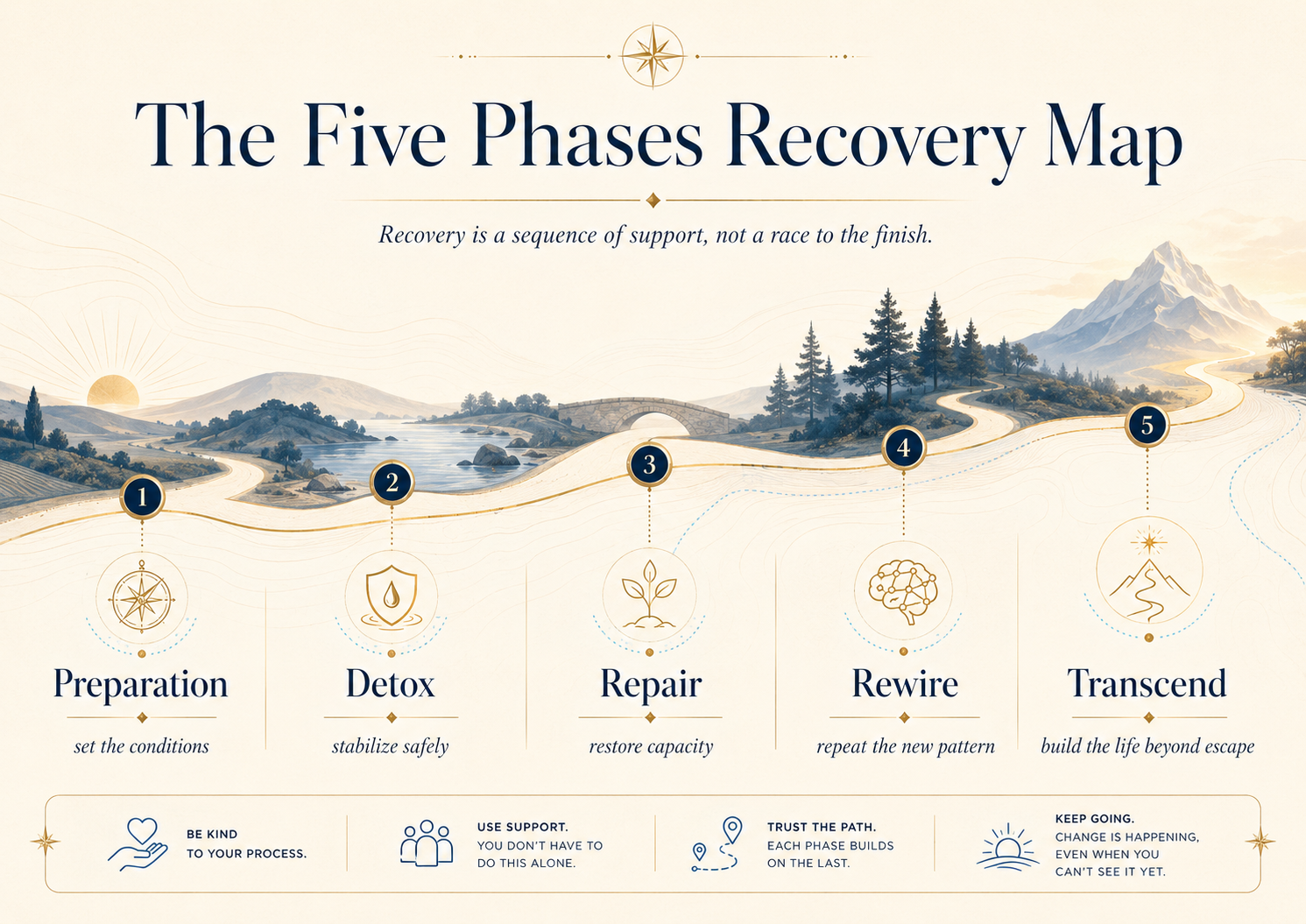
The Five Phases are not rigid boxes, and recovery is rarely perfectly linear. Think of them as orientation points: a way to identify the kind of work that is most appropriate now.
Preparation
Clarify the truth. Reduce chaos. Gather support. Assess risk. Create safety. Set up the conditions for change.
Ask:
What needs to be in place before I ask more of myself?
Detox
Separate from an old regulator or destabilizing pattern while prioritizing safety and stabilization.
Ask:
What helps me become safer and more stable during this transition?
Alcohol withdrawal can involve serious complications, including seizures and delirium. People who have taken benzodiazepines regularly should not abruptly stop them without clinical guidance. [5–6]
This is not the phase for white-knuckling medically risky withdrawal.
Qualified medical or clinical support may be necessary.
Repair
Restore sleep, nourishment, energy, nervous-system stability, mood, and basic functioning.
Ask:
What needs replenishment before I push for more growth?
Repair is not a detour from recovery.
For many people, repair is the recovery work.
Rewire
Build new routines, rewards, relationships, boundaries, coping strategies, and responses to stress, boredom, loneliness, craving, and emotional pain.
Ask:
What new pattern needs repetition until it feels more natural?
Rewire is where recovery becomes embodied.
Not through one perfect decision, but through repeated evidence that a different response is possible.
Transcend
Expand into meaning, contribution, service, creativity, identity, purpose, and a life that no longer needs to be escaped from.
Ask:
What kind of life am I building that I no longer want to escape from?
Timing is not a limitation.
It is a form of intelligence.
For the full phase map, read The Strategic Recovery Map: 5 Phases of Addiction Healing.
The 4th Coordinate: My Next Right Step
Once you understand your likely phase, identify your highest-leverage pillar, and choose one useful assessment door, you can stop spinning in vague self-improvement.
You can choose a next right step.
That step has four parts:
1. Phase
Your likely current recovery season.
2. Pillar
The leverage point where support could create the biggest ripple.
3. Assessment
One useful door of self-understanding.
4. Action
One realistic 10% better move for this week.
Here is an example:
Phase: Repair
Pillar: Biochemical
Assessment Door: Capacity
Action: For the next seven days, I will eat one stabilizing protein-plus-carbohydrate meal before the part of the day when cravings, anxiety, or emotional depletion usually rise.
That is not flashy.
It is strategic.
Another person may be in Preparation, identify the Social Pillar as their leverage point, choose Patterning as their assessment door, and make this their next right step:
I will tell one safe person the time of day I am most likely to struggle and ask for a short check-in before that window.
The best next step is often smaller than the mind wants it to be.
That is part of why it works.
Make It 10% Better, Not Perfect
The most sustainable recovery plans are rarely built on intensity.
They are built on repeatability.
A 10% better action is not a dramatic promise to change every area of life by Monday.
It is one move that is:
- Small enough to complete
- Meaningful enough to matter
- Structured enough to repeat
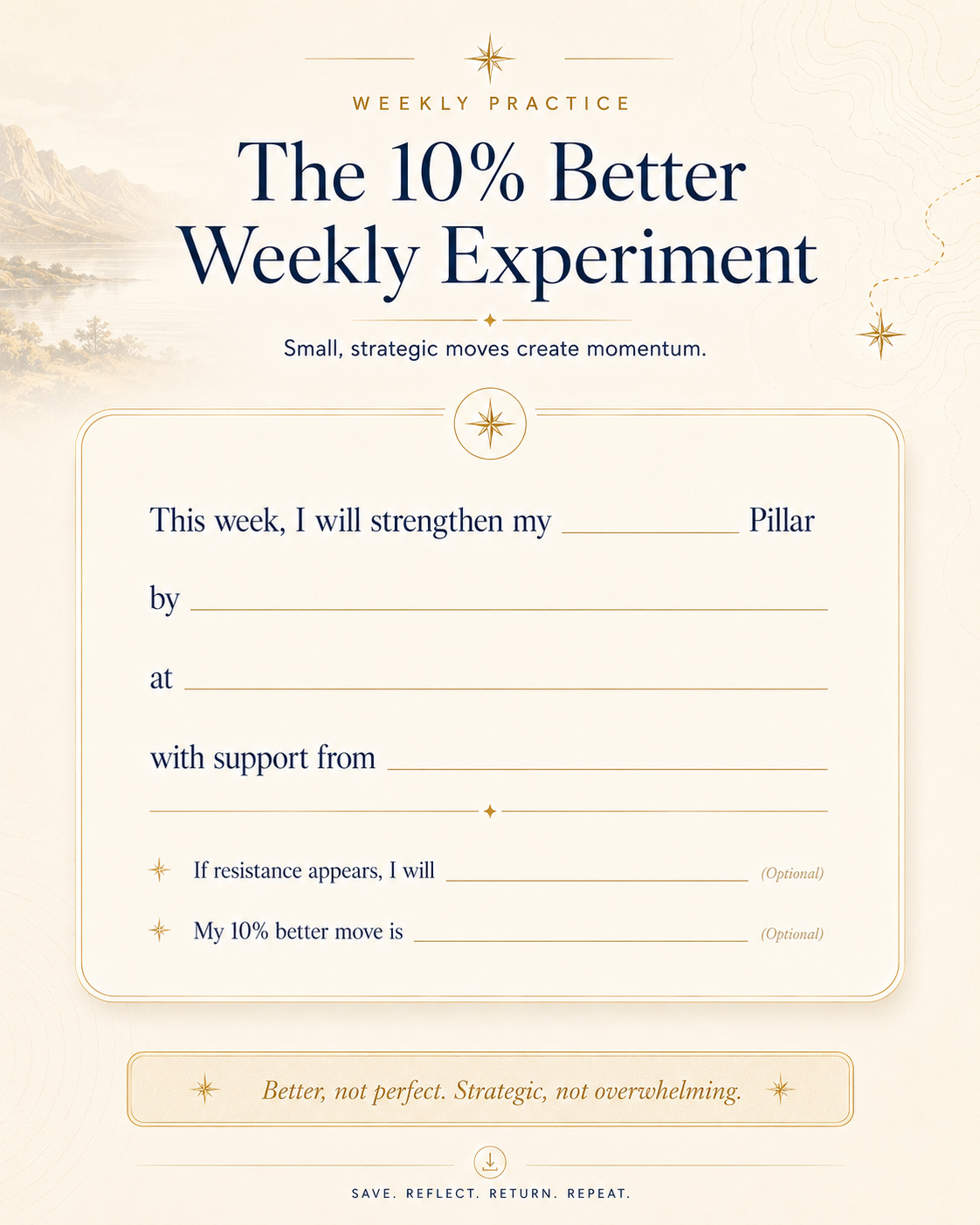
Use this template:
This week, I will strengthen my __________ Pillar by __________ at __________ with support from __________.
For example:
This week, I will strengthen my Environmental Pillar by charging my phone outside the bedroom at 9:30 p.m., using a reminder alarm and a book placed on my nightstand.
Or:
This week, I will strengthen my Social Pillar by texting one safe person before 5:00 p.m. on weekdays, using a saved draft message.
Or:
This week, I will strengthen my Spiritual Pillar by spending five quiet minutes outside each morning before checking my phone.
Small does not mean insignificant.
Small means repeatable.
Repeatable creates evidence.
Evidence builds trust.
Trust builds momentum.
Use the Operating System in Seven Minutes
You do not need to understand every part of your life before you begin.
Start here.
1. What phase am I most likely in right now?
- Preparation?
- Detox?
- Repair?
- Rewire?
- Transcend?
2. Which pillar needs the most support?
- Biochemical?
- Psychological?
- Social?
- Environmental?
- Spiritual?
3. Which assessment family would help me stop guessing?
- Regulation?
- Patterning?
- Capacity?
- Purpose?
4. What is one 10% better action I can complete in the next seven days?
Then add one support structure:
- Reminder
- Calendar block
- Visible cue
- Prepared environment
- Supportive person
- Smaller fallback version for difficult days
At the end of the week, review without shame:
- What worked?
- What created friction?
- What needs to become smaller, safer, simpler, or more supported?
This is not a trial.
It is information.
Recovery becomes more effective when feedback replaces self-attack.
From Pressure to Coordinates
Many people approach recovery with pressure:
- “I should be further along.”
- “I should know what to do.”
- “I should be able to fix everything at once.”
- “I should not still struggle with this.”
Pressure overloads the same system recovery is trying to heal.
The Strategic Recovery Operating System™ offers a different approach.
You are not behind.
You are locating yourself.
You are not broken.
You are identifying what needs support.
You do not need a perfect five-year plan.
You need a next right step that fits your current life—and that you can repeat.
That is how recovery becomes less punishing and more sustainable.
Ten Questions That Make Recovery More Navigable
A practical reference for finding the next supportive move—without needing to solve your entire future at once.
01 What is the Strategic Recovery Operating System™?
It is a practical recovery decision framework. It helps you identify where you are, what most needs support, and what strategies fit your real nervous system and life circumstances—so you can choose a next step that is useful now.
02 Why is “the best recovery tool” often the wrong question?
Because a useful tool can still be mistimed, aimed at the wrong leverage point, or require more capacity than a person has available. Better questions are: What is needed now? What is most likely to help this person? What can their life actually carry?
03 How do I identify my current recovery phase?
Look for the primary job of this season. You may be preparing for change, stabilizing through detox, restoring depleted capacity, rewiring familiar patterns, or building a life beyond escape. Your phase is a practical orientation—not a label, grade, or permanent identity.
04 How do I choose the highest-leverage pillar?
Ask which area, if strengthened, would create the most meaningful positive ripple. Sometimes it is sleep or nutrition. Sometimes it is isolation, unsafe environments, emotional regulation, or a missing sense of purpose. Choose the pillar that would make the rest of the system easier to support.
05 What does “personal wiring” mean in practice?
Personal wiring includes your nervous-system sensitivity, recurring patterns, available energy, values, strengths, history, and the types of support that help you stay engaged. It is not an excuse or a limitation. It is information that helps a recovery plan fit the actual person using it.
06 Do I need to work on all Five Pillars at the same time?
No. The pillars interact, but trying to improve everything at once usually creates pressure and dropout. Begin with the most important leverage point, use a manageable experiment, and allow the benefits to ripple outward. Recovery can be whole-person without being all-at-once.
07 What does “10% better, not perfect” actually look like?
It means selecting one small action that is realistic enough to repeat: a steadier meal, a ten-minute walk, an earlier bedtime cue, a support meeting, a boundary, a short journal entry, or a change that makes the desired behavior easier. Small actions gain power when they are aligned, supported, and repeated.
08 What happens when a recovery experiment does not work?
It becomes useful data. Notice what helped, what created friction, and what the system could not realistically sustain. Then revise the experiment. A strong recovery plan is adaptive: it improves the fit between the strategy, the timing, and the person.
09 Can this framework help someone who is still using substances?
Yes. The framework is not reserved for people who have already reached a particular milestone. It can help organize safer next steps, preparation, support, and conversations about change. When withdrawal, overdose risk, mental-health instability, or medical concerns are present, professional assessment is part of the next right step.
10 When is professional or emergency support the next right step?
Medical, mental-health, or emergency support is especially important when there is uncertain withdrawal risk, severe symptoms, danger of self-harm or harm to others, overdose risk, confusion, seizures, chest pain, or any situation that feels medically unsafe. In the United States, 988 offers immediate mental-health and substance-use crisis support, and 911 is appropriate for immediate danger or medical emergencies.
Build Your Strategic Recovery Operating System™ With Support
The Strategic Recovery Circle™ is a private weekly Zoom space for people who want more than generic advice, passive inspiration, or another plan that asks too much too soon.
Inside the Circle, we apply the Operating System in real life.
Members learn how to identify their current phase, strengthen their highest-leverage pillar, understand the promise beneath old survival patterns, build healthier sources of regulation and reward, and create realistic weekly experiments that fit their actual capacity.
The Circle meets Thursdays from 7:00–8:30 p.m. Eastern.
Strategic Recovery is not about fixing everything.
It is about doing what fits—at the right time, in the right order, with the right support.
Join the Strategic Recovery Circle™
A private weekly space for practical recovery tools, real connection, and support for your next right step.
Join the Strategic Recovery Circle™Opens secure enrollment in a new window.
Educational and Safety Note
This resource is educational and reflective in nature. It is not medical advice, diagnosis, or a substitute for individualized care.
Medically risky withdrawal, medication changes, severe or rapidly worsening symptoms, intoxication, acute mental-health symptoms, or immediate safety concerns should be addressed with qualified medical, clinical, psychiatric, or emergency support.
In the United States, call or text 988 for immediate mental-health or substance-use crisis support. Call 911 when someone is in immediate danger or having a medical emergency. [7]
Evidence & Safety Sources
Clinical standards, public-health guidance, and safety resources referenced throughout this article.
- 01 The ASAM Criteria®, Fourth Edition — American Society of Addiction Medicine
- 02 Different People, Different Options — NIAAA Alcohol Treatment Navigator
- 03 Sleep Disturbance as a Universal Risk Factor for Relapse in Addictions — NIH / PubMed Central
- 04 Peer Support Workers for Those in Recovery — SAMHSA
- 05 The ASAM Clinical Practice Guideline on Alcohol Withdrawal Management
- 06 The Joint Clinical Practice Guideline on Benzodiazepine Tapering — ASAM
- 07 988 Suicide & Crisis Lifeline




Leave a Reply