
Now Playing: Episode #27 — The Holiday Relapse Trap — And How to Escape It Forever
This page hosts the full Strategic Recovery Podcast audio episode (37:59 duration) on the most high-risk season of the year. We break down why relapse spikes during the holidays — and then build a complete Strategic Recovery™ system to stay free, calm, grounded, and sovereign through parties, family dynamics, airports, travel fatigue, sugar chaos, sleep disruption, grief triggers, social pressure, and FOMO. You’ll learn how to shift from reactive survival into proactive planning using the 5 Phases, the 5 Pillars, and a simple risk–reward formula that protects your nervous system before pressure hits.
✨ The holidays don’t “cause” relapse — they expose weak systems. This episode helps you build a stronger system so freedom isn’t fragile… it’s designed.
Strategic Recovery Field Notes 🎄
Strategic Recovery with Matt Finch — Episode 27 Field Notes
In this episode, we break down the Holiday Relapse Trap from every angle — biochemical, psychological, social, environmental, and spiritual — and then rebuild a complete, proactive plan that helps you stay free, calm, grounded, and sovereign through the most triggering season of the year.
Use these notes as a companion while you listen, a checklist for your calendar planning, and a mini field guide you can return to every year before the holidays begin. ✍️
🧭 Quick Navigation
Field Guide · Episode 27 · Holiday Freedom Blueprint
- ⚠️ Intro — The Most Dangerous Season of the Year
- 🌍 Why Relapse Spikes During the Holidays — The Macro View
- 🔁 The Holiday Relapse Loop — Micro View
- 🥂 Rewriting the Holiday–Alcohol Myth
- 🧭 Strategic Recovery™ — Holidays Edition: The 5 Phases
- 🏛️ The 5 Pillars — Holiday Stability System
- ⚖️ The Holiday Risk–Reward Formula
- 🛡️ Why Avoiding Holiday Parties Might Be the Wisest Move
- 🕊️ FOMO — Once and For All
- ✈️ Airports, Travel & Holiday Stress
- 🧬 Proactive vs Reactive — Two Timelines
- 💛 Final Message — Holiday Sovereignty
⚠️ Intro — The Most Dangerous Season of the Year
The stretch between Thanksgiving and New Year’s compresses almost every major relapse trigger into a short time window: stress, loneliness, social pressure, travel fatigue, sleep disruption, sugar overload, family dynamics, and “tradition” narratives that normalize drinking and numbing.
The goal of this episode is simple: replace reactivity with strategy. Instead of hoping you’ll “be strong” in the moment, you’ll build a plan that supports your biology, protects your nervous system, and makes freedom the most likely outcome.
🌍 Why Relapse Spikes During the Holidays — The Macro View
🧪 Biochemical Overload
- Blood sugar chaos from sugar, alcohol, skipped meals, and irregular eating
- Sleep disruption from travel, late nights, and stimulation overload
- Inflammatory foods increasing anxiety, irritability, and cravings
- Alcohol framed as “relaxation” while destabilizing neurotransmitters and sleep
Key idea: your brain doesn’t know it’s “the holidays” — it only knows when it’s under attack.
🧠 Psychological Pressure
- Nostalgia mixed with grief and unmet expectations
- Family-of-origin wounds and old roles resurfacing
- Shame loops (“I should be happier than this”)
- Social comparison amplified by seasonal media and “perfect holiday” myths
Key idea: memory + emotion + expectation = a perfect storm if unplanned.
🧑🤝🧑 Social Pressure
- Peer pressure disguised as tradition and bonding
- “Just have one” culture and subtle exclusion dynamics
- Fear of being judged, labeled, or misunderstood
- FOMO amplified by social feeds and highlight reels
Key idea: you don’t need permission to protect your recovery.
🏟️ Environmental + Spiritual Triggers
- Airports and travel stress (decision fatigue + alcohol access)
- Parties centered around drinking or overstimulation
- Ads everywhere linking alcohol to love, warmth, and belonging
- Meaning replaced by consumption; presence replaced by performance
Key idea: when meaning collapses, substances rush in to fill the void.
🔁 The Holiday Relapse Loop — Micro View
Relapse usually doesn’t begin with a drink. It begins with exposure without preparation. Unplanned environment → emotional spike → nervous system overload → old conditioning → rationalization → temporary relief → shame → self-attack → momentum collapse → full return to the addictive loop.
This is not a moral failure. It’s a systems failure. And Strategic Recovery exists to break loops before they start — by supporting biology, building strategy, and protecting nervous-system regulation.
🥂 Rewriting the Holiday–Alcohol Myth
Alcohol is marketed as connection, celebration, relaxation, and belonging — especially during the holidays. But biologically, it’s a neurotoxin and central nervous system depressant that disrupts sleep, destabilizes mood, hijacks dopamine, and amplifies unresolved stress and trauma.
Alcohol doesn’t create joy. It borrows joy from tomorrow — with interest. When you see the myth clearly, you stop feeling deprived… and start feeling protected.
🧭 Strategic Recovery™ — Holidays Edition: The 5 Phases
1) 🧾 Preparation (The Master Phase)
- Review your calendar and identify high-risk days
- Decide in advance which events you’ll attend — and which you won’t
- Create a “leave early” plan and a “don’t go” plan
- Line up an accountability partner before the season begins
Rule: Reactive people decide in the moment. Strategic people decide ahead of time.
2) 🧊 Detox (Holiday Style)
- Reduce stimulation, sugar exposure, and decision fatigue
- Choose fewer events — with higher quality and lower risk
- Protect your nervous system like it’s sacred
Truth: sometimes staying home is the most sober, intelligent move you can make.
3) 🛠️ Repair
- Extra sleep and hydration
- Extra nutrients and stress-buffering support
- Extra self-compassion during grief and emotional waves
Seasonal strategy: this is not the time to push — it’s the time to stabilize.
4) 🔁 Rewire + 5) ✨ Transcend
- Rewrite beliefs about “needing” alcohol to belong
- Create new rituals that anchor pleasure to safety
- Use the holidays as training for identity-level freedom
Outcome: you don’t just survive the season — you outgrow it.
🏛️ The 5 Pillars — Holiday Stability System
🧪 Biochemical
- Protein before events (stabilizes blood sugar and reduces cravings)
- Hydration + electrolytes throughout the day
- Sleep protection as a non-negotiable boundary
- Anti-craving supplement support (travel kit + evening kit)
- Limit sugar spikes that masquerade as anxiety or urges
🧠 Psychological
- Pre-written scripts for offers (“No thanks, I’m good.”)
- Exit plans (leave time + ride + accountability check-in)
- Expectation management (“I’m here to stay regulated, not impress.”)
- Journaling prompts:
- What am I afraid I’ll miss?
- What do I actually gain by staying free?
🧑🤝🧑 Social
- Accountability partner set before the season starts
- Confidant check-ins (“Call me at 9pm” agreement)
- Clear communication of boundaries — without over-explaining
- At least one low-risk, alcohol-free connection ritual each week
🏠 Environmental
- Strategic seating at events (away from bars and high-traffic areas)
- Always holding a non-alcoholic drink to reduce offers
- Arrive late, leave early — without apology
- Control lighting, noise, and stimulation whenever possible
- Design your home as a recovery sanctuary during the holidays
✨ Spiritual
- Meaning > stimulation
- Ritual > consumption
- Presence > performance
- Return to the body: breath, prayer, nature, silence, gratitude
- Remember: peace is not boring — it’s regulated safety
⚖️ The Holiday Risk–Reward Formula
Before any event, ask one question: Does the potential reward outweigh the biological, psychological, and spiritual cost? If the answer is not a clear yes — you don’t go. This is not avoidance. This is strategic self-respect.
🧪 Biological Cost
- Will this disrupt sleep, blood sugar, or cravings?
- Will I leave more regulated — or less?
🧠 Psychological Cost
- Will I feel pressured to perform or conform?
- Will old roles or shame loops activate?
✨ Spiritual Cost
- Will this nourish meaning — or replace it with distraction?
- Will I leave aligned — or fragmented?
🛡️ Why Avoiding Holiday Parties Might Be the Wisest Move
Missing one party can save an entire year of your life. FOMO fades. Relapse scars last. Avoiding alcohol-centered environments isn’t failure — it’s maturity. You’re not isolating… you’re choosing a different frequency.
🕊️ FOMO — Once and For All
FOMO disappears when you realize: most people are numbing, the joy is artificial, the hangover is real, the conversations are forgettable, and the cost is enormous. Meanwhile, peace compounds — and self-trust strengthens every time you choose freedom.
✈️ Airports, Travel & Holiday Stress
Airports are relapse traps. Treat travel as a nervous-system challenge — not a social event. Use a travel protocol so your baseline stays stable in a chaotic environment.
🧃 Eat Before You Fly
Low blood sugar mimics anxiety and amplifies cravings. Protein first = protection.
🧳 Bring Supplements
Build a travel kit that supports stress, sleep, and cravings — especially on long days.
🎧 Use Noise-Canceling Headphones
Reduce sensory load. Tell your nervous system: “You don’t have to scan.”
🚫 Avoid Airport Bars Entirely
No exposure experiments. No “proof.” Precision boundaries win.
🚶 Walk · 💧 Hydrate · 🌬️ Breathe
Discharge stress hormones. Restore baseline. Arrive intact.
🧭 The Core Principle
Your goal is not entertainment — it’s arriving regulated.
🧬 Proactive vs Reactive — Two Timelines
⚠️ The Reactive Timeline
No plan. Sleep slips. Blood sugar crashes. Exposure hits. Overwhelm rises. Old conditioning wakes up. Then: “I’ll figure it out when I get there.” Overwhelm → drinking → shame → momentum collapse → relapse.
✅ The Strategic Timeline
Decisions made in advance. Support lined up. Body nourished. Nervous system protected. Exit plans ready. Pressure hits — and you already know the move. Planned → supported → nourished → empowered → free.
The difference was never willpower. It was strategy — and strategy turns chaos into structure, pressure into clarity, and triggers into training.
💛 Final Message — Holiday Sovereignty
You don’t owe anyone your nervous system. You don’t owe anyone your sobriety. You don’t owe anyone access to your healing. The holidays aren’t a test — they’re training. And when you walk into January clear, grounded, proud, intact, and free… you’ll realize something powerful: You didn’t miss anything. You reclaimed everything.
The Holiday Relapse Trap — At a Glance
The holidays compress stress, social pressure, grief, and disrupted routines into one season. This visual map shows the forces colliding beneath the surface — so you can plan ahead and stay sovereign instead of reactive.
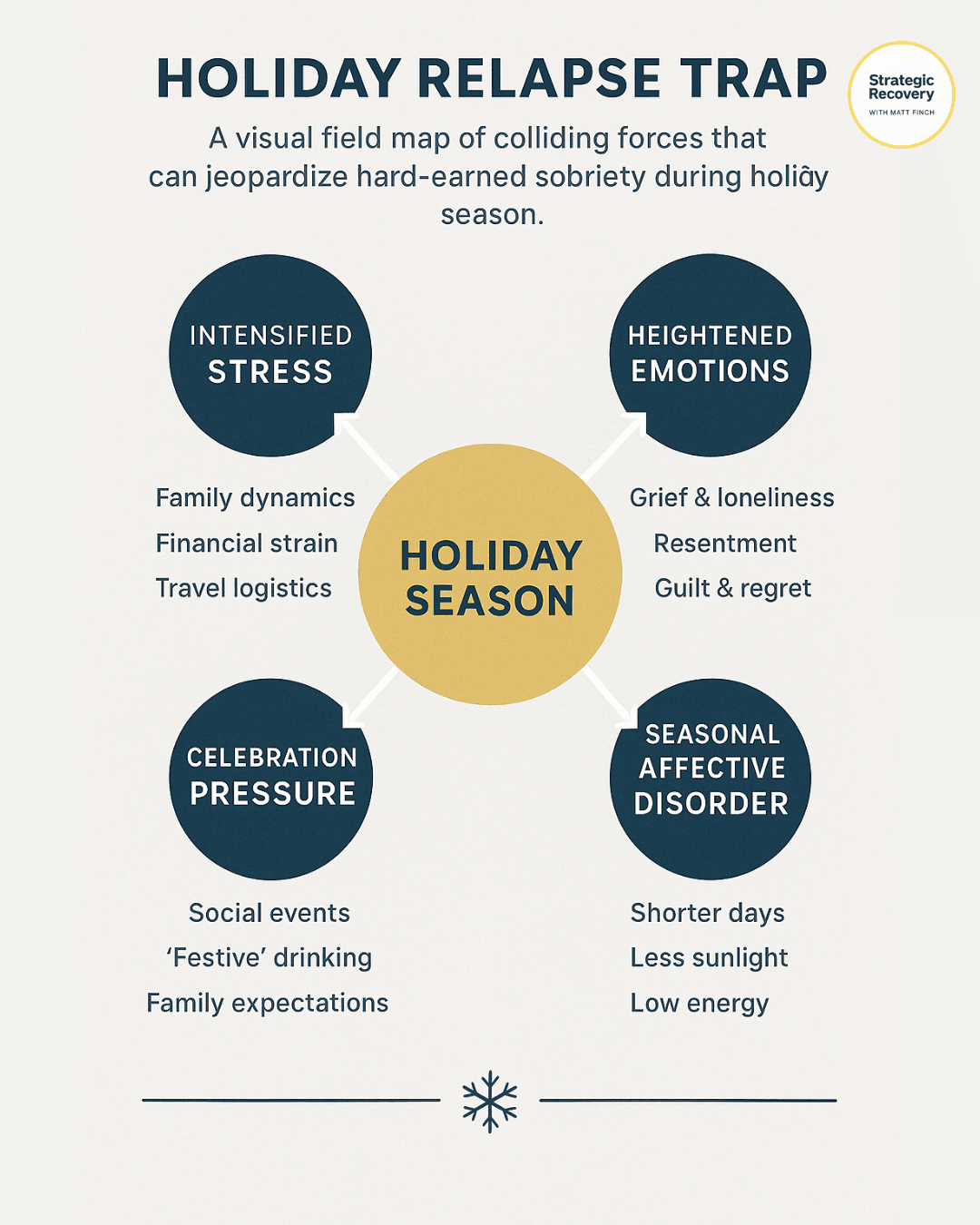
Use this as a prevention compass: when you can name the forces, you can design protection — and walk into January clear, grounded, and intact.
Alcohol-Free Mixology (The Replacement Ritual That Actually Works) ✨
If parties, cravings, or “just one” pressure rises during the holidays, this is one of the simplest ways to stay in control: upgrade the ritual without returning to the toxin. Choose a drink that feels premium, calming, and satisfying — so your nervous system gets the signal: “We’re safe. We’re included. We’re still celebrating.”
The Holiday Relapse Trap — Your Questions Answered
This FAQ is a fast, practical companion to Episode 27. Use it to plan ahead, reduce risk, and stay free through parties, family dynamics, travel stress, emotional triggers, and holiday FOMO — without white-knuckling or “just trying harder.”
-
1.Why do the holidays feel so dangerous for relapse?
Because the holidays compress almost every classic trigger into one season: disrupted sleep, sugar chaos, travel fatigue, family-of-origin stress, grief activation, social pressure, and cultural conditioning that frames alcohol as “connection.”
The key reframe from Strategic Recovery™ is this: the holidays don’t cause relapse — they reveal weak systems. If your biology is depleted, your boundaries are fuzzy, and your plan is “figure it out later,” the season will expose it.
-
2.What if I’m early in recovery — should I skip parties completely?
For many people, yes — skipping alcohol-centered events in early recovery is not “avoidance.” It’s strategic self-respect.
Early recovery often means your brain’s reward system is still recalibrating and your nervous system is more reactive. High-stimulation environments can feel like a wave you’re expected to surf while learning how to swim. If you’re not sure, that uncertainty is already data.
You can replace risky events with planned alternatives: dinner with safe people, a movie night, a sunrise hike, a tea ritual, a gym session, a service project, or a “sober sanctuary” gathering.
-
3.How do I decide if an event is “worth it” for me?
Use the Holiday Risk–Reward Formula from Episode 27. Ask: Does the reward outweigh the biological, psychological, and spiritual cost?
If the answer isn’t a clear yes — don’t go. No drama. No debate. You’re not “missing out.” You’re protecting momentum.
A simple standard: if you can’t picture yourself leaving that event more regulated than you arrived, it’s probably not a wise investment right now.
-
4.What do I say when people push alcohol on me?
Keep it short. Calm. Repeatable. You don’t owe explanations.
Try: “No thanks — I’m good.” · “Not tonight.” · “I’m driving.” · “I’ve got an early morning.”
Then pivot the conversation: “How have you been?” or “Tell me what’s new.” If pressure continues, that’s not connection — that’s a boundary test. You’re allowed to leave.
-
5.How do I handle family triggers without spiraling?
Family gatherings often reactivate old roles: the peacemaker, the scapegoat, the “successful one,” the “mess,” the invisible one. Strategic Recovery™ starts with one goal: stay regulated first.
Use micro-boundaries: step outside, breathe slowly, text your confidant, drink water, eat protein, and reset. You can also pre-plan a time limit: arrive late, leave early.
Remember: you’re not there to win the family system. You’re there to protect your healing.
-
6.What’s the fastest way to reduce cravings at holiday events?
Start with the biology. Cravings spike when your body is under-fueled, overstimulated, and sleep-deprived.
Fast wins: protein + hydration before you arrive, keep a non-alcoholic drink in hand, and reduce exposure by moving away from the bar and high-traffic areas.
Your nervous system is always asking one question: “Am I safe?” The more safety signals you provide, the less your brain reaches for old solutions.
-
7.Why does FOMO feel so intense — and how do I end it?
FOMO isn’t really about missing “fun.” It’s about fearing disconnection. The mind imagines a magical party where everyone is present, bonded, and joyful — but the reality is often numbing, overstimulation, and next-day regret.
The cure is comparison with truth: peace compounds. So does self-trust. Every time you choose stability, you build a life that doesn’t require escape — and FOMO fades because you’re no longer hungry for chaos.
-
8.Airports are brutal. What’s the travel protocol from Episode 27?
Treat travel as a nervous-system challenge, not a social event. Airports combine stress, disorientation, crowds, fatigue, and alcohol access — a perfect storm.
Core protocol: eat before you fly, bring your supplements, use noise-canceling headphones, avoid airport bars entirely, walk, hydrate, and breathe slowly.
Your goal is simple: arrive intact.
-
9.What if I slip? Did I “ruin everything”?
No. A slip is information — not identity. Shame says: “You’re back at zero.” Strategy says: “What failed in the system, and how do we fortify it?”
The fastest path back is to interrupt the shame spiral: hydrate, sleep, eat protein, contact support, and recommit to structure within 24 hours. Don’t negotiate. Don’t dramatize. Reset.
-
10.What’s the #1 thing I should do before the holidays begin?
Enter the season with a plan — not a hope. The most protective move is Phase 1 of Strategic Recovery™: Preparation.
Review your calendar, identify your risk windows, decide what you will and won’t attend, and set up an accountability partner + exit plans before the first invitation arrives.
Strategic people decide ahead of time — and that single shift prevents most relapses.
Educational only — not medical advice. If you’re in early recovery, tapering, detoxing, or navigating complex mental health, work with a qualified professional and build a plan that matches your unique biology, history, and support system.
🙏 Thank you for being part of the Strategic Recovery community.
👉 Click Here and Right Click to Save As to Download>>
🎧 Available on your favorite platform:





Leave a Reply